

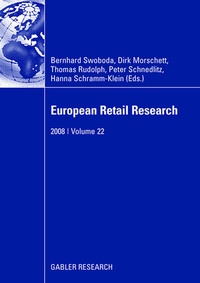
European Retail Research
2008 | Volume 22
1st Edition
Published on 30. January 2009
IX, 227 pages
978-3-8349-8099-1 (ISBN)
Description

Fifteen years after its commercial launching, the Internet has become the second most imp- tant distribution channel (after high street retailing) and a major source of customer infor- tion and empowerment (Urban 2003, 2005; Constantinides/Fountain 2008). A number of - cent developments in this field threaten to further weaken the role of traditional retailing in a number of sectors where retailers and intermediaries have always played an important role. Music, entertainment, press, printing/publishing and traditional travel agents are some of the branches that have already felt the negative effects of Internet-enabled disintermediation. The web has made possible the direct contact between producers and consumers, making the physical retailer of information-based products or intangibles redundant. These developments are widely seen as effects of the Internet evolution and have been ext- sively discussed and debated. However, over the last three years, a new generation of online tools, applications and approaches such as blogs, wikis, online communities and virtual worlds, commonly referred to as Web 2. 0 or Social Media, are increasingly attracting the - tention of practitioners and, recently, of academics. As often happens when revolutionary - novations become booming business, research and theoretical underpinning on the Web 2. 0 issue is still very limited and there is not even a generally accepted definition. What most people would agree though is that a fundamental element of Web 2.
More details
Other editions
Additional editions
Book
10/2008
1st Edition
Springer Gabler
€53.49
Shipment within 7-9 days
Persons
Prof. Dr. Dirk Morschett, University of Fribourg, Switzerland
Prof. Dr. Thomas Rudolph, University of St. Gallen, Switzerland
Prof. Dr. Peter Schnedlitz, Vienna University of Economics and Business Administration, Austria
PD Dr. Hanna Schramm-Klein, Saarland University, Germany
Prof. Prof. h.c. Dr. Bernhard Swoboda, University of Trier, Germany
Prof. Dr. Thomas Rudolph, University of St. Gallen, Switzerland
Prof. Dr. Peter Schnedlitz, Vienna University of Economics and Business Administration, Austria
PD Dr. Hanna Schramm-Klein, Saarland University, Germany
Prof. Prof. h.c. Dr. Bernhard Swoboda, University of Trier, Germany
Content
Social Media: A New Frontier for Retailers?.- International Retail Divestment: Reviews, Case Studies and (E)merging Agenda.- Exploring the Power of Adaptive Selling Techniques on Consumers' Buying Behaviour.- Measurement of Attitude Toward Private Labels: A Replication and Extension.- Determinants of Relationship Continuity between Fashion Retailers and Suppliers in Brazil.- The Impact of Communication on Satisfaction and Loyalty in the Franchise System: Subjective Viewpoints of Franchisees.- Multinationals in Central and Eastern Europe: A Case Study of International Expansion by a Slovenian Retailer.- Potentials of RFID Application in Retailing: A Conjoint-based Preference Analysis.- Retailing in France: Overview and Key Trends / What's up?.- The Austrian Retail Market: A Profile.
Social Media: A New Frontier for Retailers? (p. 1)
Efthymios Constantinides, Carlota Lorenzo Romero and Miguel A. Gómez Boria
Abstract
During the last two decades the retailing industry is finding itself in a state of constant evolution and transformation. Globalization, mergers and acquisitions, and technological developments have drastically changed the retailing landscape. The explosive growth of the Internet has been one of the main catalysts in this process. The effects of the Internet have been mostly felt in retail sectors dealing mainly with intangibles or information products.
But these are not likely to be limited to these sectors, increasingly retailers of physical products realize that the empowered, sophisticated, critical and well-informed consumer of today is essentially different to the consumer they have always known. The web, and particularly what is known as Social Media or Web 2.0, have given consumers much more control, information and power over the market process, posing retailers with a number of important dilemmas and challenges.
This article explains what the new face of the Internet, widely referred to as Web 2.0 or Social Media, is, identifies its importance as a strategic marketing tool and proposes a number of alternative strategies for retailers. Implementing such strategies will allow retailers not only to survive, but also create competitive advantages and thrive in the new environment.
Keywords
Social Media, Web 2.0, Retailing, Internet Retailing, Customer Behaviour, Online Strategy
1. Introduction
Fifteen years after its commercial launching, the Internet has become the second most important distribution channel (after high street retailing) and a major source of customer information and empowerment (Urban 2003, 2005, Constantinides/Fountain 2008). A number of recent developments in this field threaten to further weaken the role of traditional retailing in a number of sectors where retailers and intermediaries have always played an important role.
Music, entertainment, press, printing/publishing and traditional travel agents are some of the branches that have already felt the negative effects of Internet-enabled disintermediation. The web has made possible the direct contact between producers and consumers, making the physical retailer of information-based products or intangibles redundant.
These developments are widely seen as effects of the Internet evolution and have been extensively discussed and debated. However, over the last three years, a new generation of online tools, applications and approaches such as blogs, wikis, online communities and virtual worlds, commonly referred to as Web 2.0 or Social Media, are increasingly attracting the attention of practitioners and, recently, of academics.
As often happens when revolutionary innovations become booming business, research and theoretical underpinning on the Web 2.0 issue is still very limited and there is not even a generally accepted definition. What most people would agree though is that a fundamental element of Web 2.0 is what is widely known as Customer-Generated Content (CGC): besides extracting value, users also add value to Web 2.0 applications and processes by generating, reviewing, editing and disseminating content.
Direct customer involvement and CGC result in powerful network effects and users' communities (O'Reilly 2005).
Efthymios Constantinides, Carlota Lorenzo Romero and Miguel A. Gómez Boria
Abstract
During the last two decades the retailing industry is finding itself in a state of constant evolution and transformation. Globalization, mergers and acquisitions, and technological developments have drastically changed the retailing landscape. The explosive growth of the Internet has been one of the main catalysts in this process. The effects of the Internet have been mostly felt in retail sectors dealing mainly with intangibles or information products.
But these are not likely to be limited to these sectors, increasingly retailers of physical products realize that the empowered, sophisticated, critical and well-informed consumer of today is essentially different to the consumer they have always known. The web, and particularly what is known as Social Media or Web 2.0, have given consumers much more control, information and power over the market process, posing retailers with a number of important dilemmas and challenges.
This article explains what the new face of the Internet, widely referred to as Web 2.0 or Social Media, is, identifies its importance as a strategic marketing tool and proposes a number of alternative strategies for retailers. Implementing such strategies will allow retailers not only to survive, but also create competitive advantages and thrive in the new environment.
Keywords
Social Media, Web 2.0, Retailing, Internet Retailing, Customer Behaviour, Online Strategy
1. Introduction
Fifteen years after its commercial launching, the Internet has become the second most important distribution channel (after high street retailing) and a major source of customer information and empowerment (Urban 2003, 2005, Constantinides/Fountain 2008). A number of recent developments in this field threaten to further weaken the role of traditional retailing in a number of sectors where retailers and intermediaries have always played an important role.
Music, entertainment, press, printing/publishing and traditional travel agents are some of the branches that have already felt the negative effects of Internet-enabled disintermediation. The web has made possible the direct contact between producers and consumers, making the physical retailer of information-based products or intangibles redundant.
These developments are widely seen as effects of the Internet evolution and have been extensively discussed and debated. However, over the last three years, a new generation of online tools, applications and approaches such as blogs, wikis, online communities and virtual worlds, commonly referred to as Web 2.0 or Social Media, are increasingly attracting the attention of practitioners and, recently, of academics.
As often happens when revolutionary innovations become booming business, research and theoretical underpinning on the Web 2.0 issue is still very limited and there is not even a generally accepted definition. What most people would agree though is that a fundamental element of Web 2.0 is what is widely known as Customer-Generated Content (CGC): besides extracting value, users also add value to Web 2.0 applications and processes by generating, reviewing, editing and disseminating content.
Direct customer involvement and CGC result in powerful network effects and users' communities (O'Reilly 2005).
