

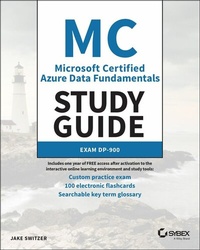
MC Microsoft Certified Azure Data Fundamentals Study Guide
Description

In MC Azure Data Fundamentals Study Guide: Exam DP-900, expert Cloud Solution Architect Jake Switzer delivers a hands-on blueprint to acing the DP-900 Azure data certification. The book prepares you for the test - and for a new career in Azure data analytics, architecture, science, and more - with a laser-focus on the job roles and responsibilities of Azure data professionals.
You'll receive a foundational knowledge of core data concepts, like relational and non-relational data and transactional and analytical data workloads, while diving deep into every competency covered on the DP-900 exam. You'll also get:
* Access to complimentary online study tools, including hundreds of practice exam questions, electronic flashcards, and a searchable glossary
* Additional prep assistance with access to Sybex's superior interactive online learning environment and test bank
* Walkthroughs of skills and knowledge that are absolutely necessary for current and aspiring Azure data pros in introductory roles
Perfect for anyone just beginning to work with data in the cloud, MC Azure Data Fundamentals Study Guide: Exam DP-900 is a can't-miss resource for anyone prepping for the DP-900 exam or considering a new career working with Azure data.
More details
Other editions
Additional editions
Person
JAKE SWITZER is a Cloud Solution Architect at Microsoft specializing in Big Data and Advanced Analytics. He has worked with major athletics customers like the NBA, NFL, MLB, and the USGA on architecting and proving out big data and advanced analytics solutions in Azure.
Content
Assessment Test xvii
Answers to the Assessment Test xxxix
Chapter 1 Core Data Concepts 1
Describe Types of Core Data Workloads 2
Data Value 3
Data Volume 10
Data Variety 11
Data Velocity 14
Describe Data Analytics Core Concepts 21
Data Processing Techniques 21
Describe Analytics Techniques 32
Describe Data Visualization Techniques 34
Summary 40
Exam Essentials 41
Review Questions 44
Chapter 2 Relational Databases in Azure 49
Relational Database Features 51
Relational Database Design Considerations 51
Relational Database Offerings in Azure 61
Azure SQL 63
Azure Synapse Analytics Dedicated SQL Pools 90
Open- Source Databases in Azure 92
Management Tasks for Relational Databases in Azure 96
Deployment Scripting and Automation 96
Migrating to Azure SQL 105
Database Security 106
Common Connectivity Issues 113
Management Tools 115
Query Techniques for SQL 119
DDL vs. DML Commands 120
Query Relational Data in Azure SQL, MySQL, MariaDB, and PostgreSQL 125
Summary 129
Exam Essentials 130
Review Questions 132
Chapter 3 Nonrelational Databases in Azure 139
Nonrelational Database Features 140
Key- Value Store 141
Document Database 142
Columnar Database 143
Graph Database 144
Azure Cosmos DB 145
High Availability 146
Request Units 148
Azure Cosmos DB APIs 150
Management Tasks for Azure Cosmos DB 154
Deployment Options 154
Azure Cosmos DB Security 165
Azure Cosmos DB Common Connectivity Issues 167
Management Tools 169
Summary 170
Exam Essentials 171
Review Questions 174
Chapter 4 File, Object, and Data Lake Storage 177
File and Object Storage Features 178
Azure Storage 179
Performance Tiers 180
Data Redundancy 181
Deploying through the Azure Portal 182
Azure Storage Services 187
Management Tasks for Azure Storage 198
Deployment Scripting and Automation 198
Azure Storage Security 201
Azure Storage Common Connectivity Issues 212
Management Tools 213
Summary 217
Exam Essentials 218
Review Questions 221
Chapter 5 Modern Data Warehouses in Azure 225
Analytical Workload Features 226
Transactional vs. Analytical Workloads 226
Data Processing Techniques 229
Modern Data Warehouse Components 233
Data Modeling Best Practices for Data Warehouses 233
Azure Services for Modern Data Warehouses 234
End- to- End Analytics with Azure Synapse Analytics 268
Deploying an Azure Synapse Analytics Workspace 270
Contents xv
Navigating the Synapse Studio UI 271
Dedicated SQL Pools 275
Serverless SQL Pools 287
Summary 292
Exam Essentials 293
Review Questions 295
Chapter 6 Reporting with Power BI 301
Power BI at a Glance 302
Working with Power BI 303
Summary 324
Exam Essentials 325
Review Questions 326
Appendix Answers to the Review Questions 329
Chapter 1: Core Data Concepts 330
Chapter 2: Relational Databases in Azure 331
Chapter 3: Nonrelational Databases in Azure 333
Chapter 4: File, Object, and Data Lake Storage 334
Chapter 5: Modern Data Warehouses in Azure 335
Chapter 6: Reporting with Power BI 337
Index 339
Introduction
Hello! I am Jake Switzer, and as a data & advanced analytics cloud solution architect at Microsoft, I work with several Microsoft customers on designing and implementing data solutions in Azure. These questions vary day-to-day from very deep technical questions to questions like "What is the right data processing solution for a new data feed that I want to analyze?" or "Why should I move from my on-premises SQL Server solution to a cloud-based data solution?" While these questions vary in difficulty and specificity, they can all be traced back to one common topic: Azure data fundamentals.
If you are picking up this book for the first time, then I assume you are starting your journey as a data practitioner in Azure. The content in this book will not only prepare you for the DP-900 Microsoft Certified Azure Data Fundamentals exam, it will also give you a broad understanding of data solutions in Azure. This book is intended to help you understand the different approaches to storing data in Azure as well as how you can turn raw data into information used to make valuable business decisions. While this exam will not dive deep into specific technical features of the products listed in this book, you will need a broad understanding of these technologies, which will serve as a starting point for becoming more technical with each technology if you so choose.
Who Should Read This Book?
This book is appropriate for anyone who wants to understand Azure data fundamentals in a broad sense and prepare for the DP-900 exam. Technical individuals such as data engineers, data scientists, and DBAs who work with data can greatly benefit from Azure data fundamentals training. This will help them transition their existing skills, whether they are in on-premises data solutions or solutions in other cloud platforms, to a career in Azure. Along with understanding highly technical roles, this book can also help analysts and project managers understand how to use technologies such as Power BI and other Azure data services to help them in their roles. Technical sellers will also find value from this book as they will gain the necessary knowledge for sales discussions where Azure data services are critical to winning business with a potential customer.
What's Included in the Book?
This book consists of six chapters plus supplementary information: a glossary, this introduction, flashcards, and the assessment test after the introduction. The chapters are organized as follows:
- Chapter 1, "Core Data Concepts," covers the foundations of data storage and analysis techniques. It defines the different types of data, data processing patterns, and categories of data analytics.
- Chapter 2, "Relational Databases in Azure," covers the different relational database options in Azure and when to use which one. This includes IaaS and PaaS offerings such as SQL Server in a VM, Azure SQL Database, and Azure SQL Managed Instance. Chapter 2 defines best practices for deploying, migrating to, securing, managing, and querying relational databases in Azure. This chapter also includes the open-source relational database PaaS options that are available in Azure.
- Chapter 3, "Nonrelational Databases in Azure," covers the different types of NoSQL databases and how to implement them with Azure Cosmos DB. This chapter defines the different Azure Cosmos DB APIs and explores how Azure Cosmos DB provides security, high availability, and consistency for NoSQL data.
- Chapter 4, "File, Object, and Data Lake Storage," explores the file and object storage options in Azure Storage, including Azure Files, Azure Blob storage, and Azure Data Lake Storage Gen2 (ADLS). This chapter covers deployment, security, and management options for Azure Storage services.
- Chapter 5, "Modern Data Warehouses in Azure," explores common data processing patterns and features used by analytical workloads. This chapter covers several common Azure services that are used to build modern data warehouses, such as Azure HDInsight, Azure Databricks, Azure Data Factory, and Azure Synapse Analytics.
- Chapter 6, "Reporting with Power BI," explores the different components of Power BI, such as Power BI Desktop, Power BI service, and Power BI Report Builder. This chapter covers the common steps used in a Power BI workflow and the different aspects of interactive reports, paginated reports, and dashboards.
Each chapter begins with a list of the objectives that are covered in that chapter. The book does not cover the objectives in order, so you should not be alarmed at some of the odd ordering of the objectives within the book. At the end of the chapter, you will find the following elements that you can use to prepare for the exam:
- Exam Essentials-This section summarizes the most important information that was covered in the chapter. You should be able to answer questions relevant to this information.
- Review Questions-Each chapter concludes with review questions. You should answer these questions and check your answers against the ones provided after the questions. If you can't answer at least 80 percent of these questions correctly, go back and review the chapter, or at least those sections that seem to be giving you difficulty.
The review questions, assessment test, and other testing elements included in this book are not derived from the exam questions, so do not memorize the answers to these questions and assume that doing so will enable you to pass the exam. You should learn the underlying topic, as described in the text of the book. This will let you answer the questions provided with this book and pass the exam. Learning the underlying topic is also the approach that will serve you best in the workplace.
To get the most out of this book, you should read each chapter from start to finish and then check your memory and understanding with the end-of-chapter elements. Even if you are already familiar with a topic, you should skim the chapter; Azure data services are complex enough that there are often multiple ways to accomplish a task, so you may learn something even if you are already competent in an area.
Recommended Home Lab Setup
There are multiple objectives in the DP-900 exam that will require you to download and install different desktop tools. These tools are described in their respective chapters, with instructions on where to download them and how to use them.
In addition to these tools, it is important to have access to a Microsoft Azure subscription. Because Microsoft Azure is a cloud-based offering, you only need a computer with a connection to the Internet to set up a free Azure subscription for experimentation. You can create a free Azure subscription by going to https://azure.microsoft.com/en-us/free and clicking Start Free. You will need to log in with a Microsoft account, such as a Hotmail, Live, or Outlook account. The Azure website will step you through the process of signing up for your free subscription. While you will need to provide contact information and a credit card number, Microsoft will not charge the credit card unless you upgrade to a paid subscription.
Like all exams, the Azure Data Fundamentals certification exam from Microsoft is updated periodically and may eventually be retired or replaced. In the event Microsoft is no longer offering this exam, the old editions of our books and online tools may be retired. If you have purchased this book after the exam was retired or are attempting to register in the Sybex online learning environment after the exam was retired, please know that we make no guarantees that this exam's online Sybex tools will be available once the exam is no longer available.
Interactive Online Learning Environment and Test Bank
We've put together some really great online tools to help you pass the MC Microsoft Certified Azure Data Fundamentals exam. The interactive online learning environment that accompanies this study guide provides a test bank and study tools to help you prepare for the exam. By using these tools, you can dramatically increase your chances of passing the exam on your first try.
The test bank includes the following:
- Sample Tests Many sample tests are provided throughout this book and online, including the assessment test, which you'll find at the end of this introduction, and the chapter review questions at the end of each chapter. In addition, there is a bonus practice exam. Use all of these practice questions to test your knowledge of the material. The online test bank runs on multiple devices.
- Flashcards The online text bank includes more than 100 flashcards specifically written to hit you hard, so don't get discouraged if you don't ace your way through them at first! They're there to ensure that you're really ready for the exam. And no worries-armed with the assessment test, review questions, practice exam, and flashcards, you'll be more than prepared when exam day comes! Questions are provided in digital flashcard format (a question followed by a single correct answer). You can use the flashcards to reinforce your learning and provide last-minute test prep before the exam.
- Other Study Tools A glossary of key terms from this book and their definitions is available as a fully searchable...
