

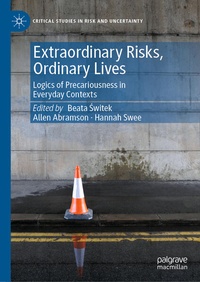
Extraordinary Risks, Ordinary Lives
Description

This book untangles the relationship between expert categorisations of risk and the on-the-ground experiences of untrained 'ordinary' people who may be routinely subjected to significant danger in a variety of extraordinary contexts. It considers political, ethical and moral dimensions of risk and calls for more targeted ethnographic research, designed to reveal how grass-roots risk dispositions and practice intersect with official discourses, individual agency and community resilience.
Reviews / Votes
"This collection of essays provides a wonderful insight into the very ordinary way that us, human beings engage with risk in everyday life. Often overlooked, this important book, captures a key dimension of the lived experience of living with risk." (Frank Furedi, Emeritus Professor of Sociology, University of Kent, UK)
"Through detailed ethnographic investigations, the contributors to this intriguing volume reveal what life is like for people and communities who regularly face extreme threats. This book is highly recommended for anyone who wants to know more about what it is like to regularly face ordeals such as violence, conflict and occupational hazards or deliberately seek out danger as part of leisure pursuits." (Deborah Lupton, SHARP Professor, Centre for Social Research in Health and the Social Policy Research Centre, University of NSW, Australia)"This timely collection seeks to transcend the usual binaries between expert and lay, rationaland irrational that permeate much research on risk. It reveals not only the complexities inherent in the subject but also the situated knowledge that comes from qualitative approaches. A wide range of stimulating case studies and cross-disciplinary commentary deftly demonstrates people's agency in negotiating the management of fear and the retention of hope in high risk, yet ordinary contexts." (Pat Caplan, Emeritus Professor of Anthropology, Goldsmiths College, University of London, UK)
More details
Other editions
Additional editions
Persons
Allen Abramson is a Senior Lecturer in Social Anthropology at University College London, UK.
Hannah Swee is a climate and capacity building specialist for the United Nations.
