

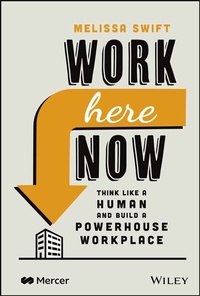
Work Here Now
Think Like a Human and Build a Powerhouse Workplace
1st Edition
Published on 4. January 2023
256 pages
978-1-119-89529-9 (ISBN)
Description

Make work suck less and improve the performance of your people with this practical, hands-on guide
The COVID-19 pandemic and an ever-changing array of new ways of working seem to have all of us asking, "Does work really have to suck this bad?" It looks like a small taste of flexibility and freedom has made many of us rethink the nature of the work we do and how we do it.
In Work Here Now: Think Like a Human and Build a Powerhouse Workplace, Mercer's North American Transformation Leader Melissa Swift delivers an eye-opening roadmap to better work that generates wins for companies and employees alike. In the book, you'll explore different ways to improve the growth-impeding, borderline inhumane people management practices we've created and endured over time. You'll also find:
* 50 strategies to create a powerhouse workplace at organizational level
* 50 strategies to create a powerhouse workplace at team level
* A simple framework to help you make people-centered decisions
An incisive and practical take on managing and working with people that--for once--doesn't rely on hackneyed idealism or management-by-algorithm, Work Here Now is the hands-on performance improvement tool that executives, managers, HR professionals, and other business leaders have been searching for.
The COVID-19 pandemic and an ever-changing array of new ways of working seem to have all of us asking, "Does work really have to suck this bad?" It looks like a small taste of flexibility and freedom has made many of us rethink the nature of the work we do and how we do it.
In Work Here Now: Think Like a Human and Build a Powerhouse Workplace, Mercer's North American Transformation Leader Melissa Swift delivers an eye-opening roadmap to better work that generates wins for companies and employees alike. In the book, you'll explore different ways to improve the growth-impeding, borderline inhumane people management practices we've created and endured over time. You'll also find:
* 50 strategies to create a powerhouse workplace at organizational level
* 50 strategies to create a powerhouse workplace at team level
* A simple framework to help you make people-centered decisions
An incisive and practical take on managing and working with people that--for once--doesn't rely on hackneyed idealism or management-by-algorithm, Work Here Now is the hands-on performance improvement tool that executives, managers, HR professionals, and other business leaders have been searching for.
More details
Other editions
Additional editions
Book
03/2023
1st Edition
Wiley
€26.50
Shipment within 15-20 days
Person
Melissa Swift is the North American Transformation Leader at Mercer. Melissa helps clients bring their workforces to a different and better future. Her work leverages data analytics and a humanist view of the workplace to create extraordinary outcomes. She has been named a "Top Influencer on the Future of Work" by Onalytica.
Content
Chapter 1: The Great Work Unpack: Understanding and Fixing Broken Work
Chapter 2: The Anxiety Monster and the Boss Baby Customer: Slaying Work's Monsters
Chapter 3: Breaking the Copy Machine: Switching off the Past, Switching on the Future
Chapter 4: Decisions About People, for People: How to Make Human-Centric Decisions
Chapter 5: Tech Dreams, Tech Nightmares: Couples Counseling for Humans and Technology
Chapter 6: The Intentional Workforce: Combatting the Great Resignation by Managing Working Populations More Thoughtfully
Chapter 7: Hippos Under the Lagoon: The Powerful Effects of Immigration, Migration, and Incarceration on Your Workforce
Chapter 8: Defeating Greedy Work and Animal Farm Syndrome: Two Critical Levers for an Awesome Working Culture
Chapter 9: A Good Day at Work, Every Day: Towards a Realistic, Human Future of Work
Chapter 2: The Anxiety Monster and the Boss Baby Customer: Slaying Work's Monsters
Chapter 3: Breaking the Copy Machine: Switching off the Past, Switching on the Future
Chapter 4: Decisions About People, for People: How to Make Human-Centric Decisions
Chapter 5: Tech Dreams, Tech Nightmares: Couples Counseling for Humans and Technology
Chapter 6: The Intentional Workforce: Combatting the Great Resignation by Managing Working Populations More Thoughtfully
Chapter 7: Hippos Under the Lagoon: The Powerful Effects of Immigration, Migration, and Incarceration on Your Workforce
Chapter 8: Defeating Greedy Work and Animal Farm Syndrome: Two Critical Levers for an Awesome Working Culture
Chapter 9: A Good Day at Work, Every Day: Towards a Realistic, Human Future of Work
LIST OF STRATEGIES
What to Do: Strategies at the Organization Level
- Strategy 1: Regularly reexamine work for signs of being dangerous (directly or indirectly), dull and annoying, or frustrating and confusing.
- Strategy 2: Don't take intensified work for granted-and don't be afraid to de-intensify.
- Strategy 3: Question long-held assumptions and unintentional choices about work to revolutionize your DEI strategy.
- Strategy 4: Seek to understand work, even if it's painful.
- Strategy 5: Deliberately hold performative work in check.
- Strategy 11: Unpack your foundational talent management assumptions-what decisions have you made on the basis of believing folks are lazy or slow?
- Strategy 12: Regularly examine the jobs that impact your organization the most-have they changed in a way that affects how people's performance of those jobs looks (i.e., do they look lazy or slow because work is changing fast?)?
- Strategy 13: Map how your customer experience and your employee experience interact.
- Strategy 14: Tread carefully in how you talk about seamlessness and frictionlesness-internally and externally.
- Strategy 15: Actively promote replacements for the anxiety monster and the boss baby customer.
- Strategy 21: Create a "single account of the truth" on the workforce of your organization-however you employ them-and systems and processes to maintain it in real-time.
- Strategy 22: Maintain and periodically energize an organization-wide conversation about how work gets done.
- Strategy 23: Optimize how work gets done by different populations-tackling one chunk at a time.
- Strategy 24: Reinvent HR-on your organization's terms.
- Strategy 25: Just do less!
- Strategy 31: Understand when you're making a decision that impacts your human workers, know who owns that decision, and identify who's truly impacted.
- Strategy 32: Look at the key roles in your organization, and remove any unneeded qualifications or aspects of work that are limiting the talent pool of who can do that work.
- Strategy 33: Smash your technology silo.
- Strategy 34: Make humanism an acceptable part of corporate discourse.
- Strategy 35: Examine roles designed for obsolescence-do they have features you'd consider unacceptable in longer-term roles?
- Strategy 41: Obsess over tech governance.
- Strategy 42: Make sure you're choosing tech for the right reasons-and then make sure you're re-choosing it.
- Strategy 43: Marie Kondo your tech stack-using an employee's-eye view.
- Strategy 44: Have an honest conversation about cybersecurity-and what it's going to feel like.
- Strategy 45: Make sure tech is working at the speed of humans, and not vice versa.
- Strategy 51: Rigorously and regularly audit your performance management results for bias-and be prepared to take dramatic action to address.
- Strategy 52: Cultivate thoughtful ways of managing performance by team or unit, avoiding the "hand-to-hand combat" of measuring individual by individual.
- Strategy 53: Bring your contingent workforce up to "measurement parity" with your full-time workforce, including shared governance, capture in organizational systems, and centralized budgeting.
- Strategy 54: Rigorously and regularly audit your pay philosophy and pay equity-are you paying for what you think you're paying for, and are you paying fairly, in real time?
- Strategy 55: Figure out which employee groups are "burnt out," and which are "fed up," and design differentiated strategies to address each set of issues.
- Strategy 61: In your DEI efforts, consider a broader array of populations, including foreign-born workers, previously incarcerated populations, etc.
- Strategy 62: Dramatically up the inclusion factor on your talent acquisition process.
- Strategy 63: Understand the role of foreign-born workers at your organization, including the household workers who support your employees, and actively create support programs for this group (including naturalized/green card workers and workers on visas).
- Strategy 64: Take a searching, quantitative and qualitative look at your remote and hybrid work policies in the context of geographical talent markets, those markets' trends, and with a diversity, equity, and inclusion lens.
- Strategy 65: Scenario plan your flexibility and location strategy versus possible changes in your talent markets as well as in the way we work.
- Strategy 71: Evaluate what you're seeking from your leaders at each stage versus structural cues at prior career stages, and seek to eliminate disconnects.
- Strategy 72: Create more fluidity for junior talent, in both how you manage talent and how you hire for early-in-career roles.
- Strategy 73: More love for middle managers!
- Strategy 74: Figure out your organization's drivers of greedy work, and seek to kill them off.
- Strategy 75: Provide concrete incentives to combat greedy work.
- Strategy 81: Deploy increased levels of asynchronous work to create greater flexibility-borrowing helpful practices from organizations where asynchronous work is more prevalent.
- Strategy 82: Teach better written communication skills to help fuel asynchronous work.
- Strategy 83: Dig into deconstruction possibilities for "talent crisis" roles.
- Strategy 84: In an environment of increasingly deconstructed work, explore novel roles with comprehensive talent accountability, especially with a wellness lens.
- Strategy 85: Find opportunities for transparency to drive greater accountability and thus equity.
What to Do: Strategies at the Team Level
- Strategy 6: At a regular cadence, talk to your team about their everyday experience of work-what are they doing, and how are they feeling, day to day and minute to minute?
- Strategy 7: Quiet your "suck it up" voice.
- Strategy 8: Be humble and curious about the parts of your team's work you don't understand.
- Strategy 9: Create metrics to measure and monitor work intensity.
- Strategy 10: Take a searching look as to where you might be encouraging performative work.
- Strategy 16: Examine your feelings about your team-are you seeing them through an anxiety monster lens?
- Strategy 17: Talk to your team about pace-why are you moving at the speed you're moving?
- Strategy 18: Examine whether you're inflicting anxiety monster thoughts on yourself.
- Strategy 19: Talk to your team about their experience of your customer-whether they are customer facing or not!
- Strategy 20: Create a team mechanism for calling out appearances of the anxiety monster and the boss baby customer.
- Strategy 26: Figure out your worst patterns-and have an honest conversation on how to break them within your team.
- Strategy 27: Build your replicant-then destroy them.
- Strategy 28: Turn your reasons not to hire into reasons to hire.
- Strategy 29: Test and learn on disruptive approaches to getting work done, utilizing team contracts if helpful.
- Strategy 30: Not to sound repetitive, but just do less.
- Strategy 36: Model humanism-including self-care.
- Strategy 37: Identify and obliterate "kludges" and temporary solutions that have accidentally become permanent.
- Strategy 38: Plan like a pessimist.
- Strategy 39: Figure out your hidden talent acquisition hurdles to maximize inclusion.
- Strategy 40: Have a few mental models for what "overwhelmed" looks like-and a playbook of strategies to address issues before individuals are in full burnout.
- Strategy 46: Agree on your comms tech.
- Strategy 47: Take tech gripes seriously-and ask about your team's experience of tech.
- Strategy 48: Set realistic expectations around software and hardware.
- Strategy 49: Volunteer your team aggressively as beta testers.
- Strategy 50: Make friends with your CIO.
- Strategy 56: Confront your contractor addiction.
- Strategy 57: Regularly unpack the work/reward balance for your team, and teach them how to do the same for their teams-in real-time, not just at year-end.
- Strategy 58: Identify your "talent competitors," especially those who are not your business competitors.
- Strategy 59: Rigorously train on bias before each performance management cycle.
- Strategy 60: Embed "everyday workforce analytics" into how you and the team work.
- Strategy 66: Drive an ongoing, two-way onboarding journey-especially for diverse or nontraditional hires.
- Strategy 67: Incorporate trauma-informed ways of operating.
- Strategy 68: Cultivate an "immigration aware" mindset-including the foreign-born populations who work in the households of your team.
- Strategy 69: Continuously audit your leadership messaging about location in response to changing external and particularly labor market conditions.
- Strategy 70: Look at how you can create dimensions of flexibility across whom you hire and how they work.
- Strategy 76: Model...
