

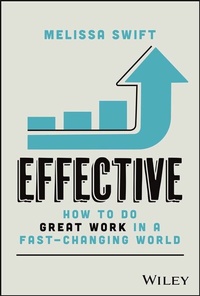
Effective
Description

Navigate the weird, chaotic world of modern work, no matter your position
While there's no shortage of advice on being amazing or avoiding burnout, what if you simply want to get things done in a workplace that feels increasingly impossible? Effective is here to help you get your job done well without losing your mind. Drawing from up-to-date research and provocative interviews with employees across industries and levels, renowned people consultant Melissa Swift offers a positive, well-illuminated path through the dark forest of destabilizing workplace changes.
Effective provides readers with:
- Strategies to triumph amid four trends making work tough today: work intensification, emotional inflection, hyper-transparency, and sheer chaos
- Practical, research-backed approaches to improve their daily work life, from entry-level employees to CEOs
- Tips for maintaining competence in a working world seemingly designed to make you feel incompetent
- Insights on how to make sure your personal sources of effectiveness don't get disrupted by technological change
- Lessons to be learned from jobs where you simply cannot screw up, such as firefighters and air traffic controllers, and how to apply them to a corporate environment
Effective delivers useful content for every level of seniority, teaching readers a new paradigm-shifting approach to thrive in the modern world of work.
More details
Other editions
Additional editions
Person
MELISSA SWIFT is a leading voice on how organizations, teams, and individuals can succeed in an ever more challenging world of work.
As founder and CEO of Anthrome Insight, she is a practicing consultant and keynote speaker helping organizations with data-driven views and concrete actions to shape a productive future in chaotic times. She has held consulting leadership roles at Capgemini, Mercer, Korn Ferry, and Deloitte, and is also the author of Work Here Now: Think Like a Human and Build a Powerhouse Workplace.
Her quarterly columns in MIT Sloan Management Review often rank among their most-read articles. Swift speaks regularly at events including the MIT CIO Symposium, and has been featured in The New York Times, The Washington Post, NPR, and Newsweek.
Visit AnthromeInsight.com
Content
Preface ix
PART I BEING EFFECTIVE 1
1 The Simple Power of Being Effective 3
2 Building Your Effectiveness Architecture to Withstand a Changing World 25
3 The Ground Floor of Your Effectiveness Architecture: Knowledge and Methods 37
4 The Second Floor of Your Effectiveness Architecture: People and Technology 55
5 The Shockingly Consistent Playbook for Effectiveness in High-Stakes Jobs 77
PART II COMBATTING FORCES THAT CHALLENGE EFFECTIVENESS 99
6 Effectiveness Through Battling Work Intensification 101
7 Effectiveness Through Managing Workplace Emotion Appropriately 121
8 Effectiveness Through Harnessing Transparency Properly 139
9 Effectiveness Through Wrestling Down Chaos 163
PART III AN EFFECTIVE FUTURE 185
10 What to Do (Next) When Effectiveness Is Not Possible 187
11 The Future of Effectiveness 205
Appendix: The Effectiveness Self-Assessment 213
Notes 217
Acknowledgments 229
About the Author 233
Index 235
Chapter 1
The Simple Power of Being Effective
Being effective is powerful.
You probably know that in January 2025, fires ravaged the Los Angeles area, killing dozens of people and destroying more than 15,000 structures. Two of the fires-Palisades and Eaton-are in the top three most destructive fires the state has ever experienced.1
But did you know that meteorologist Edgar McGregor predicted the fires-and in doing so, enabled scores of folks to get out alive?
As McGregor told People Magazine, in late December conditions in Los Angeles were eerily similar to those experienced in Lahaina, Maui, and Paradise, California, ahead of devastating fires in those communities. On daily hikes, he could see canyons full of brush ready to burn; the Santa Ana winds would arrive December 30.
He knew fires were coming, and on a local Facebook group, he gave people simple, lifesaving advice. One piece of guidance sticks with me: he told folks to park their cars in their driveways facing out, because the time it takes to back your car out could make the difference between life and death.2
His neighbors in Altadena, California, listened. As McGregor told NPR (National Public Radio), at least one family left town entirely in anticipation of the fires. Many others took his advice on preparation and were able to evacuate quickly when the time came.
This master meteorologist, by the way? He was all of 24 years old.
Gratitude flowed in for McGregor's amazing work. His reaction?
"So people are sending me all these comments and I'm thinking to myself, I just did my job."3
I just did my job. That's what this book is about: being effective at work.
Nothing fancy and nothing complicated, but done right, it can be amazing-for you and the people around you. In McGregor's case, he was firing on all cylinders as a weather scientist: studying the local conditions, understanding what was coming, and communicating about it in a compelling way to people for whom it really mattered. We see him as a hero because of the lifesaving impact he had, but in a way his humble statement is right on. He just did his job. But really, really well.
We can all do this. We can all be effective-and truly do great work-even in a world where that simple thing has gotten incredibly tough.
This book is about how.
Why Effectiveness, Anyway?
Now, let's get to the question you may be asking right now: who is this lady to tell me how to be effective? She doesn't know my work! And that's a fair comment: humans do an incredibly diverse array of jobs. There are people out there studying cacti and people out there teaching AI to not sound like a weirdo. Work ranges from incredibly manual to incredibly cerebral. Some work is awful, and some work is delightful. (The second part of that statement is a specific reference to a video I recently saw of zookeepers walking a wombat on a leash. That is a delightful job.)4
But what's interesting is that the nature of being effective, across so many jobs, is fairly consistent. In this book we'll focus on the common threads that can help us all do better, whether you're wrangling wombats or sadly in some other line of work. As a longtime consultant helping organizations get work right-for their own profitability and their employees' sake-I've seen firsthand, over and over, how the same themes play out across geographies and industries. I've also had the privilege of learning about how various academics and professionals take apart this question of being good at your job, and you'll hear from some of those brilliant people in this book too.
I believe that if people knew more about how work was analyzed and studied, they'd actually do their jobs better. So please consider this book a bridge between the working world and the people who study it. Instead of looking from the individual out like most self-development books do, we're going to look from work and jobs inward. Knowing all the ways work is challenging today-and addressing them programmatically-is more than half the battle.
Back to the who-is-this-lady question though: you might also ask, Melissa, are you, personally, effective?
Folks, it varies.
I've had what they call a jungle-gym career. I've sold crude oil and I've organized children's parties. I've consulted to the C-suite of giant companies and I've worked a switchboard. I've served as a middle manager for large teams and I've started my own company as the sole employee. I turned down an internship doing the work that has become my passion-people consulting-because I wanted to work in London instead; I returned to the field more than a decade later. I've been woefully underemployed, and I've been sadly overtaxed. I've been terrific and I've been . less than terrific.
This is starting to sound like a Traveling Wilburys song. I'll stop.
But I will say this: doing a lot of different work at different kinds of places under very different states of the world, but being the same Melissa, has given me a lot of perspective on what it means to be good at what you're doing. Combine that with my professional practice, leading sizeable organizational consulting projects and teams, and I believe I have a unique vantage point into the simple question of what it means to do great work every day.
In case I'm scaring you with all the talk of "great work," this is not a book on always being "Jordan flu game" great. (It might have been a bad pizza, anyway, though that remains controversial.5) Extraordinary performance is a wonderful, laudable goal, but the road to greatness is always going to lead right through being baseline effective. And for many of us whose achievement drives cause us to constantly skirt burnout, shooting for doing the job as it should be done is a healthier, more productive approach than always trying to knock the cover off the ball.
Let me give you a historical example of how day-to-day effectiveness creates moments of outsize performance. As a frequent speaker, I'm slightly obsessed with how to give better talks. When I learned about the history of one of the greatest speeches of all time, Martin Luther King's "I Have a Dream," it shifted my perspective on how to be good at public speaking. I'd always thought you need some beautiful master script, original and flawless, flowing purely out of your brain alone.
It turns out, the part of the speech we all love was
- improvised on the spot
- somewhat recycled
- prompted by someone in the audience
Listening to King speak to the assembled crowd of a quarter million people, singer Mahalia Jackson exclaimed "Tell 'em about the dream!" She was referring to a speech King had given in Detroit weeks before, in which he painted a compelling picture of a society free of prejudice. At that point, King put his notes away and re-narrated his earlier speech-in a brilliantly fluid and compelling way that completely outdistanced the power of the prior version.6
It was a moment of extraordinary greatness built on a foundation of fundamental effectiveness. King wrote and spoke constantly; he was always testing new material. He listened to people like Jackson about what was resonating (side note, we all need a Mahalia Jackson in our lives, identifying our best stuff!). He ended up being amazing on that day when it truly mattered, because he was day to day doing the job well.
This is what we're going for!
For me personally, the case for getting the basics of being truly effective hit home a few years ago. With one of the best teams I've ever worked with, I was leading a program on digital transformation leadership for a prominent biotech company. We had lively exercises, terrific speakers, and, most importantly, a wonderful group of leaders in the room. Smart, emotionally clued in, thoughtful.
Those leaders kept telling us something interesting though: they were tired. Very tired. Their jobs were taxing-often featuring a mixture of scientific and operational complexity, not to mention the usual challenges of managing people. They worked for a caring, supportive organization, and it was still tough day to day. Their work was just hard.
And they kept getting called out of the room to deal with some brewing situation in Asia.
Did I mention the date of the program?
February 2020.
So now you know where this story is going.
Within weeks, digital transformation was the least of anyone's concerns. Survival was top of mind as we battled COVID. And these heroic biotech leaders were on the front lines of that war.
I wished then, and I still wish now, that I could have those precious days with them back. In my alternate reality, we get down to brass tacks about what would help them do their jobs more easily and effectively. We don't worry, yet, about the higher-order challenges of incorporating digital innovation; we talk about how to get through each day with aplomb. We equip them not for an intriguing future that absolutely did show up, but for the unbelievable test right around the corner.
That experience taught me that the most extreme moments-raging fires, pandemics, a...
