


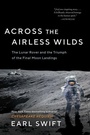
Across the Airless Wilds
Description

"THRILLING. ... Up-end[s] the Apollo narrative entirely." ?The Times (London)
A "brilliantly observed" (Newsweek) and "endlessly fascinating" (WSJ) rediscovery of the final Apollo moon landings, revealing why these extraordinary yet overshadowed missions?distinguished by the use of the revolutionary lunar roving vehicle?deserve to be celebrated as the pinnacle of human adventure and exploration.
One of The Wall Street Journal's 10 Best Books of the Month
8:36 P.M. EST, December 12, 1972: Apollo 17 astronauts Gene Cernan and Jack Schmitt braked to a stop alongside Nansen Crater, keenly aware that they were far, far from home. They had flown nearly a quarter-million miles to the man in the moon's left eye, landed at its edge, and then driven five miles in to this desolate, boulder-strewn landscape. As they gathered samples, they strode at the outermost edge of mankind's travels. This place, this moment, marked the extreme of exploration for a species born to wander.
A few feet away sat the machine that made the achievement possible: an electric go-cart that folded like a business letter, weighed less than eighty pounds in the moon's reduced gravity, and muscled its way up mountains, around craters, and over undulating plains on America's last three ventures to the lunar surface.
In the decades since, the exploits of the astronauts on those final expeditions have dimmed in the shadow cast by the first moon landing. But Apollo 11 was but a prelude to what came later: while Neil Armstrong and Buzz Aldrin trod a sliver of flat lunar desert smaller than a football field, Apollos 15, 16, and 17 each commanded a mountainous area the size of Manhattan. All told, their crews traveled fifty-six miles, and brought deep science and a far more swashbuckling style of exploration to the moon. And they triumphed for one very American reason: they drove.
In this fast-moving history of the rover and the adventures it ignited, Earl Swift puts the reader alongside the men who dreamed of driving on the moon and designed and built the vehicle, troubleshot its flaws, and drove it on the moon's surface. Finally shining a deserved spotlight on these overlooked characters and the missions they created, Across the Airless Wilds is a celebration of human genius, perseverance, and daring.
Discover the untold story of the men and the machine that defined the golden age of space exploration:
- An Engineering Triumph: How a team of engineers designed and built the revolutionary lunar roving vehicle?a foldable, electric go-cart?to survive the moon's extreme environment.
- The Pinnacle of Exploration: Ride alongside astronauts like Gene Cernan and Jack Schmitt as they drive miles from their lander, exploring lunar terrain the size of Manhattan on the overlooked final Apollo missions.
- NASA's Overlooked History: A gripping narrative that shines a light on the overshadowed missions of Apollo 15, 16, and 17, arguing they represent the true peak of human exploration.
- A New Perspective on the Space Race: Discover why the story of the moon buggy isn't just a footnote to Apollo 11, but a crucial and thrilling chapter in America's journey to the stars.
All prices
More details
Other editions
Additional editions
Person
Earl Swift is the author of the New York Times bestseller Chesapeake Requiem, which was named to ten best-of-the-year lists. His other books include Hell Put to Shame, Across the Airless Wilds, Auto Biography, The Big Roads, and Where They Lay. A former reporter for the Virginian-Pilot and a contributor to Outside and other publications, he is a fellow of Virginia Humanities at the University of Virginia. He lives in the Blue Ridge mountains west of Charlottesville.
Content
- Intro
- Endpapers
- Title Page
- Dedication
- Contents
- Part One: The Difference It Made
- Chapter 1
- Chapter 2
- Chapter 3
- Part Two: Nation of Immigrants
- Chapter 4
- Chapter 5
- Chapter 6
- Chapter 7
- Chapter 8
- Chapter 9
- Chapter 10
- Chapter 11
- Part Three: Principal Considerations
- Chapter 12
- Chapter 13
- Chapter 14
- Chapter 15
- Chapter 16
- Chapter 17
- Chapter 18
- Chapter 19
- Chapter 20
- Chapter 21
- Chapter 22
- Chapter 23
- Chapter 24
- Chapter 25
- Part Four: "We Must Do This!"
- Chapter 26
- Chapter 27
- Chapter 28
- Chapter 29
- Chapter 30
- Chapter 31
- Chapter 32
- Chapter 33
- Chapter 34
- Chapter 35
- Chapter 36
- Part Five: A Painfully Trying Task
- Chapter 37
- Chapter 38
- Chapter 39
- Chapter 40
- Chapter 41
- Chapter 42
- Chapter 43
- Chapter 44
- Chapter 45
- Chapter 46
- Chapter 47
- Chapter 48
- Chapter 49
- Chapter 50
- Chapter 51
- Chapter 52
- Part Six: Across the Airless Wilds
- Chapter 53
- Chapter 54
- Chapter 55
- Chapter 56
- Chapter 57
- Chapter 58
- Chapter 59
- Chapter 60
- Chapter 61
- Chapter 62
- Part Seven: Tire Tracks
- Chapter 63
- Chapter 64
- Chapter 65
- Chapter 66
- Acknowledgments
- Notes
- Index
- Photo Section
- About the Author
- Also by Earl Swift
- Copyright
- About the Publisher
