

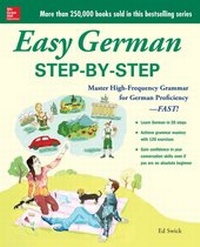
Easy German Step-by-Step
1st Edition
Published on 26. December 2014
402 pages
978-0-07-184045-3 (ISBN)
Description

Take the most direct path to mastering the German language! The best route to learning German starts with a solid grounding in the basics--and that's exactly what Easy German Step-by-Step provides. You won't find a lot of pointless discussion, instead, you get a unique step-by-step approach to learning German, with important concepts linked together by clear explanations, appropriate exercises, and helpful answers. The first steps introduce you to the most common German expressions, enabling you to communicate in everyday situations almost immediately. From there, you're led through a series of interconnected steps taking you from simple to more-challenging concepts at your own pace, along the way are increasingly difficult exercises for practicing what you've learned. This step-by-step approach provides the confidence and tools you need to understand German in no time. Easy German Step-by-Step features: A unique building-block approach to mastering grammar, verbs, and vocabulary Easy-to-grasp descriptions of essential rules and concepts Key verbs and hundreds of key terms introduced on the basis of frequency Numerous exercises that give you valuable practice Access to a FREE flashcard app for studying and practicing on the go
More details
Other editions
Additional editions
Ed Swick
Easy German Step-by-Step
Book
01/2015
McGraw-Hill Professional
€16.08
Shipment within 15-20 days
Content
- Cover
- Title Page
- Copyright Page
- Contents
- Preface
- 1 Pronunciation and Cognates
- The Alphabet
- Step 1: Consonants
- Step 2: Vowels
- Letter Combinations
- Consonants
- Vowels
- Step 3: Cognates
- 2 Gender and heißen
- German Gender
- Step 1: Masculine
- Step 2: Feminine
- Step 3: Neuter
- Heißen
- 3 Nominative Pronouns, der-Words, and the Verb sein
- German Personal Pronouns
- Step 1: Third Person Pronouns and Gender
- Step 2: Der-Words
- The Verb sein
- 4 Ein-Words, haben, and the Present Tense
- Ein-Words
- Kein
- Step 1: Possessive Adjectives
- Step 2: The Verb haben
- Present Tense
- 5 Irregular Present Tense and werden
- Irregular Present Tense
- Step 1: Irregularities Formed with an Umlaut
- Step 2: Irregularities Formed with a Shift from -e- to -i-
- Step 3: Irregularities Formed with a Shift from -e- to -ie-
- Conjugation of werden
- The Impersonal es
- 6 Accusative Case: Direct Objects and Prepositions
- Accusative Case
- Step 1: Direct Object Nouns
- Step 2: Direct Object Pronouns
- Step 3: Prepositions
- Masculine Plurals
- Mastery Check 1
- 7 Regular Past Tense and Interrogative Words
- The Past Tense
- Step 1: The Past Tense Suffix -te
- Step 2: Adverbs for the Past Tense
- Forming Questions
- Step 3: Feminine Plurals
- 8 Irregular Past Tense and Neuter Plurals
- Irregular Past Tense
- Step 1: German Irregular Past Tense
- Step 2: Numbers, the Year, and Age
- Using fragen
- Neuter Plurals
- 9 Dative Case and More Irregular Past Tense
- Dative Case
- Step 1: Dative Case in German
- Haben, sein, werden in the Past Tense
- Step 2: Wissen and kennen
- 10 Dative Expressions and Conjunctions aber, oder, und, and sondern
- The Dative Case
- Step 1: More Dative Verbs and Dative Expressions
- Conjunctions
- Step 2: Können und müssen
- 11 Regular Present Perfect Tense
- The Present Perfect Tense
- Step 1: Haben and Regular Past Participles
- Step 2: Sein and the Present Perfect Tense
- Ordinal Numbers and Prefixes
- Step 3: Ordinal Numbers
- Step 4: Inseparable Prefixes
- 12 Adjective Endings and Separable Prefixes
- Adjectives
- Step 1: Adjective Endings
- Nominative Case Adjectives
- Accusative Case Adjectives
- Step 2: Separable Prefixes
- 13 Irregular Present Perfect Tense and Prefixes
- The Irregular Present Perfect Tense
- Step 1: German Irregular Past Participles
- Step 2: Haben, sein, werden, sterben
- Step 3: Prefixes
- Mastery Check 2
- 14 Genitive Case and Antonyms
- Genitive Case
- Step 1: German Possessives
- Step 2: Containers
- Step 3: Genitive Prepositions
- Antonyms
- Step 4: Opposites in German
- Gehen
- Step 5: Gehen and Infinitives
- 15 Future Tense and Modal Auxiliaries
- The Future Tense
- Step 1: German Future Tense
- Modal Auxiliaries
- Step 2: German Modal Auxiliaries
- 16 Dependent Clauses and Conjunctions
- Dependent Clauses
- Step 1: German Clauses
- Subordinating Conjunctions
- Step 2: Dass and ob
- 17 Dative-Accusative Prepositions
- Prepositions with More Than One Function
- Step 1: Dative Case
- Step 2: Inanimate Pronouns
- Step 3: Accusative Case
- Geography
- Step 4: Die Welt (The World)
- 18 Comparative and Superlative
- Comparative
- Step 1: German Comparative Adverbs and Adjectives
- Step 2: Irregular Comparatives
- Superlative
- Step 3: German Superlative Adverbs and Adjectives
- Step 4: Irregular Superlatives
- 19 Imperatives and Double Infinitives
- Commands
- Step 1: The German Imperative
- Double Infinitives
- Step 2: Present Perfect and Future Tenses
- Step 3: Helfen, hören, lassen, and sehen
- 20 Using All the Cases and All the Tenses
- Cases and Declensions
- Step 1: German Declensions of Nouns and Pronouns
- Tenses
- Step 2: Varieties in the German Tenses
- Mastery Check 3
- Appendix A: Fraktur Alphabet (1600-1940)
- Appendix B: The Principal Parts of Irregular Verbs
- Answer Key
