

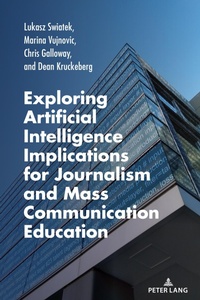
Exploring Artificial Intelligence Implications for Journalism and Mass Communication Education
Description

AI is growing rapidly around the world and has already changed many aspects of our societies. Journalism and mass communication educators are faced with the task of learning about the technology, while immediately applying it to their teaching.
What are the ramifications of AI's expansion for mass communication and journalism education? This book centers the voices of diverse educators, who share their concerns and hopes, as well as the insights that they have gained from their use of this technology, and advises educators how to enhance the implementation of AI in their own teaching and approach the technology more critically.
A timely contribution to a dynamically evolving area, this book is essential reading for teachers, academic developers, institutional leaders, industry members, and other stakeholders who are concerned about the formation of the journalists, editors, advertising specialists, public relations professionals and other communication practitioners of the future.
More details
Other editions
Additional editions
Persons
Lukasz Swiatek, Ph.D., FHERDSA, lectures in the School of the Arts and Media at the University of New South Wales (UNSW) in Kensington, Sydney (Australia). He mainly undertakes research in communication and media studies, higher education and cultural studies.
Marina Vujnovic, Ph.D., APR, is a Professor in the Department of Communication at Monmouth University in West Long Branch, New Jersey (USA). Her work explores intersections between journalism and public relations, looking at issues of participation, activism, transparency and ethics.
Chris Galloway, Ph.D., APR, is an honorary research associate of Massey University. He has taught a range of areas (crisis communication, professional writing, reputation management) in Australia, Aotearoa New Zealand, Indonesia and Pakistan. His research covers crisis communication, reputation management, AI, and its communication-related impacts.
Dean Kruckeberg, Ph.D., APR, FPRSA, is a Professor in the Department of Communication Studies at the University of North Carolina at Charlotte (USA). He is the author and co-author of many books, book chapters and journal articles about public relations, focusing on ethics and global public relations.
Content
Acknowledgments - Note About the Cover - Note About the Higher Education- Related Terminology Used in the Book - Preface - Introduction: The Case for Charting Artificial Intelligence Developments in Journalism and Mass Communication Education - Background: The Factors that Continue to Shape the Growth of Artificial Intelligence - Understanding the Nature of Artificial Intelligence - The Importance of Exploring Artificial Intelligence and Its Implications for Journalism and Mass Communication - The Current Elements in Functionally Oriented Teaching About, and With, Artificial Intelligence in Journalism and Mass Communication Education - The Current Elements in Critically Oriented Teaching About, and With, Artificial Intelligence in Journalism and Mass Communication Education - The Current Elements in Ethics- Focused Teaching About, and With, Artificial Intelligence in Journalism and Mass Communication Education - The Requirements for the Current and Future Professional Development of Journalism and Mass Communication Educators to Teach About, and With, Artificial Intelligence - Future Artificial Intelligence Developments in Higher Education and Their Implications for Journalism and Mass Communication Education - The Next Steps That Journalism and Mass Communication Educators Should be Taking Now and in the Future in Relation to Artificial Intelligence - Conclusion: Key Final Considerations Relating to Artificial Intelligence - Postface: Educators and the Challenge of Controlling AI-Based Change - Further Reading Suggestions - Appendix - Index.
