

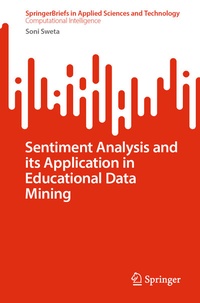
Sentiment Analysis and its Application in Educational Data Mining
Description

The book delves into the fundamental concepts of sentiment analysis, its techniques, and its practical applications in the context of educational data. The book begins by introducing the concept of sentiment analysis and its relevance in educational settings. It provides a thorough overview of the various techniques used for sentiment analysis, including natural language processing, machine learning, and deep learning algorithms. The subsequent chapters explore applications of sentiment analysis in educational data mining across multiple domains. The book illustrates how sentiment analysis can be employed to analyze student feedback and sentiment patterns, enabling educators to gain valuable insights into student engagement, motivation, and satisfaction. It also examines how sentiment analysis can be used to identify and address students' emotional states, such as stress, boredom, or confusion, leading to more personalized and effective interventions. Furthermore, the book explores the integration of sentiment analysis with other educational data mining techniques, such as clustering, classification, and predictive modeling. It showcases real-world case studies and examples that demonstrate how sentiment analysis can be combined with these approaches to improve educational decision-making, curriculum design, and adaptive learning systems.
More details
Other editions
Additional editions
Person
Dr. Soni Sweta, Ph.D. in Computer Science and Engineering from BIT, Mesra, Ranchi, is presently working as an assistant professor in the Department of Computer Science and Engineering at Mukesh Patel School of Technology, Management, and Engineering, NMIMS, Mumbai Campus, Mumbai, Maharashtra. She received her Master of Technology degree from Rajiv Gandhi Proudyogiki Vishwavidyalaya, Bhopal. She is presently guiding many Ph.D., M.Tech, M.C.A, and B.Tech. Scholars. Previously, she had guided many M.Tech., M.C.A, B.C.A, and B.Tech. students in their dissertation and final project work. Her present areas of research are artificial intelligence, natural language processing, soft computing, data mining, machine learning, data science, etc. Being a member of IEEE and life member of CSI(India), she is associated with few reputed journals as a reviewer and member of editorial board. She has acted as a technical committee member in many reputed conferences so far.
Content
Chapter 1: Sentiment Analysis in Natural Language Processing.- Chapter 2: An Overview of Educational Data Mining.- Chapter 3: Impact of Sentiment Analysis in Education Sector.- Chapter 4: Techniques and Approaches in Sentiment Analysis.- Chapter 5: Machine Learning with Sentiment Analysis.- Chapter 6: Incorporation of Sentiment Analysis with Educational Data Mining.- Chapter 7: Preformation Evaluation using Sentiment Analysis.
