

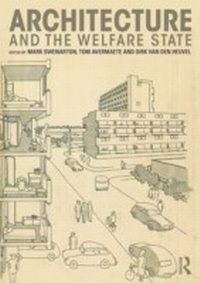
Architecture and the Welfare State
1st Edition
Published on 15. September 2014
360 pages
978-1-317-66190-0 (ISBN)
Description

In the decades following World War Two, and in part in response to the Cold War, governments across Western Europe set out ambitious programmes for social welfare and the redistribution of wealth that aimed to improve the everyday lives of their citizens. Many of these welfare state programmes - housing, schools, new towns, cultural and leisure centres - involved not just construction but a new approach to architectural design, in which the welfare objectives of these state-funded programmes were delineated and debated. The impact on architects and architectural design was profound and far-reaching, with welfare state projects moving centre-stage in architectural discourse not just in Europe but worldwide.
This is the first book to explore the architecture of the welfare state in Western Europe from an international perspective. With chapters covering Austria, Belgium, France, Germany, Italy, The Netherlands, Sweden and the UK, the book explores the complex role played by architecture in the formation and development of the welfare state in both theory and practice.
Themes include:
the role of the built environment in the welfare state as a political project
the colonial dimension of European welfare state architecture and its 'export' to Africa and Asia
the role of welfare state projects in promoting consumer culture and economic growth
the picture of the collective produced by welfare state architecture
the role of architectural innovation in the welfare state
the role of the architect, as opposed to construction companies and others, in determining what was built
the relationship between architectural and social theory
the role of internal institutional critique and the counterculture.
Contributors include: Tom Avermaete, Eve Blau, Nicholas Bullock, Miles Glendinning, Janina Gosseye, Hilde Heynen, Caroline Maniaque-Benton, Helena Mattsson, Luca Molinari, Simon Pepper, Michelle Provoost, Lukasz Stanek, Mark Swenarton, Florian Urban and Dirk van den Heuvel.
This is the first book to explore the architecture of the welfare state in Western Europe from an international perspective. With chapters covering Austria, Belgium, France, Germany, Italy, The Netherlands, Sweden and the UK, the book explores the complex role played by architecture in the formation and development of the welfare state in both theory and practice.
Themes include:
the role of the built environment in the welfare state as a political project
the colonial dimension of European welfare state architecture and its 'export' to Africa and Asia
the role of welfare state projects in promoting consumer culture and economic growth
the picture of the collective produced by welfare state architecture
the role of architectural innovation in the welfare state
the role of the architect, as opposed to construction companies and others, in determining what was built
the relationship between architectural and social theory
the role of internal institutional critique and the counterculture.
Contributors include: Tom Avermaete, Eve Blau, Nicholas Bullock, Miles Glendinning, Janina Gosseye, Hilde Heynen, Caroline Maniaque-Benton, Helena Mattsson, Luca Molinari, Simon Pepper, Michelle Provoost, Lukasz Stanek, Mark Swenarton, Florian Urban and Dirk van den Heuvel.
Reviews / Votes
"Poverty and deprivation are discussed less today than in the 70s, although the wealth gap is greater and housing for the poor is worse. This book is an essential aid to understanding the international discourse between architects during the 30 golden years and the way it was shaped, enabled and constrained by socio-political and economic frameworks." - Kate Macintosh, RIBA Journal"This book scores highly due to the high quality of its contributions. The choice and quantity of illustrations in this book must also be given praise." - Stefan Muthesius, Building Research & Information Journal, University of East Anglia, UK
"Architecture and the Welfare State represents the opening up of new and critical pathways through its territory. Its consistently high scholarship is augmented not only by an extended and thematic bibliography, but also by the appended notes (edited by Adrian Forty) of the workshop from which the book emerged." - Gary A. Boyd, The Queen's University, The Journal of Architecture
"The book is organised around broad themes - 'cultures and continuities', 'critiques and contradictions' and 'national and international' - while detailing much about the experiences of several different countries in Europe and beyond. The result is a rich and stimulating mix that is scholarly, informative and thought-provoking. The editors have successfully combined a central and coherent focus with enough eclecticism to make the book useful both in its entirety and its individual parts." - Town Planning Review, Stephen V. Ward, Oxford Brookes University, UK
"Archtecture and the Welfare State is a valuable contribution - it offers nuanced scrutiny of a period when wealth redistribution by the state was a broadly accepted process in which the built environment figured prominently. It largely delivers on its underlying claim to place the architect (and architecture) more clearly as an actor within the complex social, political, cultural and technological networks." - Lee Stickells, Fabrications, the Journal of the SAHANZ (Australia and New Zealand)
More details
Language
English
Place of publication
London
United Kingdom
Publishing group
Taylor & Francis Ltd
Target group
College/higher education
Professional and scholarly
Illustrations
138 s/w Abbildungen
138 Illustrations, black and white
File size
16,30 MB
ISBN-13
978-1-317-66190-0 (9781317661900)
Copyright in bibliographic data and cover images is held by Nielsen Book Services Limited or by the publishers or by their respective licensors: all rights reserved.
Schweitzer Classification
Other editions
Additional editions
Mark Swenarton | Tom Avermaete | Dirk van den Heuvel
Architecture and the Welfare State
Book
08/2014
1st Edition
Routledge
€75.50
Shipment within 15-20 days
Mark Swenarton | Tom Avermaete | Dirk van den Heuvel
Architecture and the Welfare State
Book
08/2014
1st Edition
Routledge
€282.73
Shipment within 15-20 days
Persons
Mark Swenarton is James Stirling professor of architecture at Liverpool University. His writings on twentieth century social housing include Homes fit for Heroes (1981) and Building the New Jerusalem (2008). He is currently researching the housing built by Camden council under Sydney Cook between 1965 and 1973.
Tom Avermaete is professor of architecture at TU Delft. He is the author of Another Modern: the Post-War Architecture and Urbanism of Candilis-Josic-Woods (2005) and co-editor of Colonial Modern: Aesthetics of the Past, Rebellions for the Future (2010) and of the themed issue of OASE, 'L'Afrique, c'est chic' (2010).
Dirk van den Heuvel is head of the Jaap Bakema Study Centre at the New Institute in Rotterdam and associate professor at TU Delft. He co-edits DASH (Delft Architectural Studies on Housing) and the on-line journal Footprint. With Max Risselada he co-authored Team 10: In Search of a Utopia of the Present (2005).
Tom Avermaete is professor of architecture at TU Delft. He is the author of Another Modern: the Post-War Architecture and Urbanism of Candilis-Josic-Woods (2005) and co-editor of Colonial Modern: Aesthetics of the Past, Rebellions for the Future (2010) and of the themed issue of OASE, 'L'Afrique, c'est chic' (2010).
Dirk van den Heuvel is head of the Jaap Bakema Study Centre at the New Institute in Rotterdam and associate professor at TU Delft. He co-edits DASH (Delft Architectural Studies on Housing) and the on-line journal Footprint. With Max Risselada he co-authored Team 10: In Search of a Utopia of the Present (2005).
Content
1. Introduction Mark Swenarton, Tom Avermaete and Dirk van den Heuvel Part One - Cultures and continuities 2. From Red Superblock to Green Megastructure: Municipal Socialism as Model and Challenge Eve Blau 3. The Welfare State in Flanders: De-pillarization and the Nebulous City Hilde Heynen and Janina Gosseye 4. The beginnings of high-rise social housing in the long 1940s: the case of the LCC and the Woodberry Down estate Simon Pepper 5. West Ham and the Welfare State 1945-70, a Suitable Case for Treatment? Nicholas Bullock Part Two - Critiques and contradictions 6. Who needs 'needs'? French Post-War Architecture and Its Critics Lukasz Stanek 7. The Open Society and its experiments: The case of the Netherlands and Piet Blom Dirk van den Heuvel 8. Where the motorways meet: Architecture and Corporatism in Sweden 1968 Helena Mattsson 9. The Maerkisches Viertel in West Berlin Florian Urban 10. Alternatives to Welfare State: self-build and do-it-yourself Caroline Maniaque-Benton Part Three - National and international 11. From Knoxville to Bidonville: ATBAT and the Architecture of the French Welfare State Tom Avermaete 12. High density without high rise: housing experiments of the 1950s by Patrick Hodgkinson Mark Swenarton 13. Matteotti Village and Gallaratese 2: design criticism of the Italian welfare state Luca Molinari 14. Exporting New Towns: The Welfare City in Africa Michelle Provoost 15. From European Welfare State to Asian capitalism: the transformation of 'British Public Housing' in Hong Kong and Singapore Miles Glendinning Appendix One: Outcomes from the Liverpool Workshop 2012 Further Reading Contributors Biographies Acknowledgements Index.
