

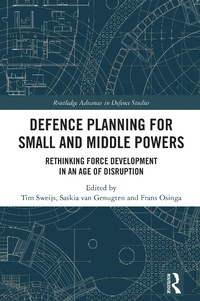
Defence Planning for Small and Middle Powers
Rethinking Force Development in an Age of Disruption
1st Edition
Published on 1. August 2024
302 pages
978-1-040-09856-1 (ISBN)
Description

This book examines the processes, practices and principles of defence planning in small and middle powers.
Small and middle powers are recalibrating their force postures in this age of disruption. They are adapting their defence planning and military innovation processes to protect the security of their nations. The purpose of this book is to explore defence planning and military innovation in 11 contemporary case studies of small and middle powers in North America, Europe, the Middle East, Asia and Oceania. Employing a structured focused comparison framework, it traces patterns in the choices of small and middle powers across the following themes: (1) alliances, dependencies and national ambitions; (2) approaches, processes, methods and techniques; and (3) military innovation strategies and outcomes. Breaking new theoretical ground, it offers a three-pronged typology distinguishing between the strategic defence planner, the transactional defence planners and the complacent defence planner. The book offers a rich array of insights into cases that fall across different geographies, strategic cultures and governance systems. These insights can help guide discussions on how to structure decision-making structures, arrive at ambition levels, formulate priorities, select partners and design defence planning and military innovation processes.
This book will be of much interest to students of defence studies, security studies, public policy and international relations, as well as to professionals in defence planning.
Small and middle powers are recalibrating their force postures in this age of disruption. They are adapting their defence planning and military innovation processes to protect the security of their nations. The purpose of this book is to explore defence planning and military innovation in 11 contemporary case studies of small and middle powers in North America, Europe, the Middle East, Asia and Oceania. Employing a structured focused comparison framework, it traces patterns in the choices of small and middle powers across the following themes: (1) alliances, dependencies and national ambitions; (2) approaches, processes, methods and techniques; and (3) military innovation strategies and outcomes. Breaking new theoretical ground, it offers a three-pronged typology distinguishing between the strategic defence planner, the transactional defence planners and the complacent defence planner. The book offers a rich array of insights into cases that fall across different geographies, strategic cultures and governance systems. These insights can help guide discussions on how to structure decision-making structures, arrive at ambition levels, formulate priorities, select partners and design defence planning and military innovation processes.
This book will be of much interest to students of defence studies, security studies, public policy and international relations, as well as to professionals in defence planning.
Reviews / Votes
'This is a fascinating book-one built around a conceptual structure and implemented with well chosen, contrasting case studies. It begins with recognition that small and medium size countries do defense planning, but go about it very differently than great powers because "their outlook, ambitions , global recognition, dependencies, and available resources tend to differ substantially from great powers." That said, how do they go about it? They encounter dilemmas and contradictions, including some relating to self-image. What happens varies across the cases (Australia, Canada, Finland, Indonesia, Israel, Netherlands, Oman, Singapore, Slovakia, and the United Arab Emirates). As both scholars and practitioners will appreciate, the differences reflect objective matters such as geography, size, and resources, but also the nations' history, culture, personalities, and politics,. Commonalities can be found, as can rules of thumb about what factors matter, but changes also occur in response to events and to trends in military technology, authoritarianism, shooting wars, and domestic politics. The authors deserve credit for a very interesting book with much to teach those familiar only with major-power planning.'Paul K. Davis, Senior Principal Researcher (retired) (RAND) and Professor, Pardee RAND Graduate School, Santa Monica, California
'Students of international security, strategic and military studies have long neglected what most military and civilian defence practitioners do most of the time: prepare and build the future force through various forms of defence planning. This book fills that important gap in the literature with a series of rich and well-structured national case studies that will be relevant for anyone trying to understand defence planning issues beyond the great powers. With powerful analytical categories for the comparative study of defence planning, the book's general framework and specific findings will be highly useful for both expert practitioners and future research.'
Henrik Breitenbauch, Dean, Royal Danish Defence College, Denmark
'In a world that is increasingly dangerous, small and medium powers face unique challenges when it comes to defence planning and military innovation. This volume offers incisive and long overdue comparative analysis of how smaller states prepare to defend themselves. Essential reading for our times.'
Theo Farrell, President, La Trobe University, Australia
More details
Series
Edition
1. Auflage
Language
English
Place of publication
London
United Kingdom
Publishing group
Taylor & Francis Ltd
Target group
College/higher education
Professional and scholarly
Illustrations
3 Tables, black and white; 35 Line drawings, black and white; 35 Illustrations, black and white
ISBN-13
978-1-040-09856-1 (9781040098561)
Copyright in bibliographic data and cover images is held by Nielsen Book Services Limited or by the publishers or by their respective licensors: all rights reserved.
Schweitzer Classification
Other editions
Additional editions
Tim Sweijs | Saskia van Genugten | Frans Osinga
Defence Planning for Small and Middle Powers
Rethinking Force Development in an Age of Disruption
Book
01/2026
1st Edition
Routledge
€64.00
Shipment within 10-20 days
Tim Sweijs | Saskia van Genugten | Frans Osinga
Defence Planning for Small and Middle Powers
Rethinking Force Development in an Age of Disruption
Book
08/2024
1st Edition
Routledge
€208.10
Shipment within 10-20 days
Persons
Tim Sweijs is Director of Research at The Hague Centre for Strategic Studies and Senior Research Fellow at the War Studies Research Centre of the Netherlands Defence Academy.
Saskia van Genugten is Senior Director at MacroScope Strategies (M2S).
Frans Osinga is Professor of War Studies, Leiden University.
Saskia van Genugten is Senior Director at MacroScope Strategies (M2S).
Frans Osinga is Professor of War Studies, Leiden University.
Content
1. Introduction 2. Australia: The Limits of Pragmatism 3. The Contours of Singapore's Defence Planning: Rethinking Deterrence, Defence Diplomacy, and Resilience 4. Israel's Innovation as a Main Pillar of Defence Planning 5. Finland's Defence Planning in Times of Geopolitical Disruption: 'Never Again Alone' 6. Retail Path-Dependence: Indonesia's Post-Authoritarian Defence Planning 7. Emirati defence planning: The overriding importance of the political-cultural system 8. Leveraging Dependencies: Defence Planning in the Sultanate of Oman 9. Turkey: Rising or a Falling Star? 10. Defence Planning in the Netherlands 11. Becoming a Good Ally: Slovak Defence Planning Since Independence 12. Canada and Force Planning: From Making a Virtue of Necessity to the Necessity of Virtue 13. Conclusion
