

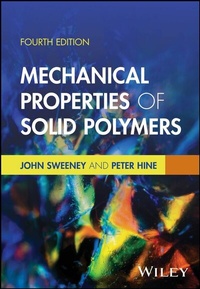
Mechanical Properties of Solid Polymers
Description

The latest edition of the definitive guide on the mechanical behaviors of polymers
In the newly revised fourth edition of Mechanical Properties of Solid Polymers, a team of distinguished researchers delivers an up-to-date discussion of all aspects of the mechanical behavior of solid polymers. The book explores finite elastic behavior, linear viscoelasticity, mechanical relaxations, mechanical anisotropy, non-linear viscoelasticity, yield behavior, and fracture.
The authors emphasize biopolymers - as opposed to petrochemical-based polymers - and incorporate a great deal of computational, numerical, and simulation content. They offer extensive discussions of the effects of recycling, as well as nanocomposites - including carbon nanotubes, graphene, and other materials.
Readers will also find:
- An updated comprehensive account of the properties of solid polymers
- Discussions of the behaviors of polymers through the mathematical techniques of solid mechanics
- Accounts of the influence of morphology on mechanics
- Examples of the application of numerical methods
Perfect for academics, researchers and industrial scientists, Mechanical Properties of Solid Polymers will also benefit students of materials science, physics, and chemistry students.
More details
Other editions
Additional editions
Persons
John Sweeney, PhD, holds a Personal Chair in Polymer Mechanics at the University of Bradford. He is an expert in solid polymer behavior, including viscoelasticity, fracture mechanics, shear banding, large deformations, and nanocomposites.
Peter Hine, PhD, is Associate Professor in the School of Physics and Astronomy at the University of Leeds, UK. His research is focused on understanding how the structure of polymers and polymer composites affect their mechanical properties.
Content
Preface xiii
1 Structure of Polymers 1
1.1 Chemical Composition 1
1.2 Physical Structure 9
References 17
Further Reading 18
2 The Mechanical Properties of Polymers: General Considerations 19
2.1 Objectives 19
2.2 The Different Types of Mechanical Behaviour 19
2.3 The Elastic Solid and the Behaviour of Polymers 21
2.4 Stress and Strain 22
2.5 The Generalized Hooke's Law 26
References 29
3 Finite Strain Elasticity 31
3.1 The Generalized Definition of Strain 31
3.2 The Stress Tensor 43
3.3 The Stress-Strain Relationships 44
3.4 The Use of a Strain-Energy Function 48
References 62
Further Reading 63
4 Rubber-Like Elasticity 65
4.1 General Features of Rubber-Like Behaviour 65
4.2 The Thermodynamics of Deformation 66
4.3 The Statistical Theory 69
4.4 Modifications of Simple Molecular Theory 76
4.5 The Internal Energy Contribution to Rubber Elasticity 85
4.6 Applications Using Finite Element Modelling 87
4.7 Conclusions 88
References 88
Further Reading 91
5 Linear Viscoelastic Behaviour 93
5.1 Viscoelasticity as a Phenomenon 93
5.2 Mathematical Representation of Linear Viscoelasticity 98
5.3 Dynamical Mechanical Measurements: The Complex Modulus and Complex Compliance 109
5.4 The Relationships Between the Complex Moduli and the Stress Relaxation Modulus 114
5.5 The Relaxation Strength 120
References 122
Further Reading 122
6 The Measurement of Viscoelastic Behaviour 125
6.1 Creep and Stress Relaxation 125
6.2 Dynamic Mechanical Thermal Analysis (DMTA) 128
6.3 Wave-Propagation Methods 128
References 132
7 Experimental Studies of Linear Viscoelastic Behaviour as a Function of Frequency and Temperature: Time-Temperature Equivalence 135
7.1 General Introduction 135
7.2 Time-Temperature Equivalence and Superposition 141
7.3 Transition-State Theories 143
7.4 The Time-Temperature Equivalence of the Glass Transition Viscoelastic Behaviour in Amorphous Polymers and the Williams, Landel and Ferry (WLF) Equation 147
7.5 Normal-Mode Theories Based on Motion of Isolated Flexible Chains 156
7.6 The Dynamics of Highly Entangled Polymers 160
References 163
8 Anisotropic Mechanical Behaviour 167
8.1 The Description of Anisotropic Mechanical Behaviour 167
8.2 Mechanical Anisotropy in Polymers 168
8.3 Measurement of Elastic Constants 171
8.4 Development of Mechanical Anisotropy in Oriented Polymers 181
8.5 Interpretation of Mechanical Anisotropy: General Considerations 188
8.6 Experimental Studies of Anisotropic Mechanical Behaviour and Their Interpretation 193
8.7 The Aggregate Model for Chain-Extended Polyethylene and Liquid Crystalline Polymers 208
8.8 Auxetic Materials: Negative Poisson's Ratio 212
References 215
9 Morphology and Structural Effects 223
9.1 Evolution of Structures Under Tension: Cavitation 223
9.2 Effects of Stress Field 225
9.3 One-Dimensional Modelling 229
9.4 Three-Dimensional Models 235
References 241
10 Relaxation Transitions: Experimental Behaviour and Molecular Interpretation 245
10.1 Amorphous Polymers: An Introduction 245
10.2 Factors Affecting the Glass Transition in Amorphous and Low Crystallinity Polymers 247
10.3 Relaxation Transitions in Crystalline Polymers 252
10.4 Conclusions 265
References 265
11 Non-linear Viscoelastic Behaviour 269
11.1 The Engineering Approach 270
11.2 The Rheological Approach 273
References 294
Further Reading 297
12 Yielding and Instability in Polymers 299
12.1 Discussion of the Load-Elongation Curves in Tensile Testing 300
12.2 Ideal Plastic Behaviour 307
12.3 Historical Development of Understanding of the Yield Process 317
12.4 Experimental Evidence for Yield Criteria in Polymers 320
12.5 The Molecular Interpretations of Yield 325
12.6 Yield Considered to Relate to the Movement of Dislocations or Disclinations 338
12.7 The Billon Model 346
12.8 Multi-axial Deformation: Three-Dimensional Plasticity 347
12.9 Cold-Drawing, Strain Hardening and the True Stress-Strain Curve 350
12.10 Shear Bands 358
12.11 Physical Considerations Behind Viscoplastic Modelling 360
References 363
Further Reading 371
13 Fracture 373
13.1 Definition of Tough and Brittle Behaviour in Polymers 373
13.2 Principles of Brittle Fracture of Polymers 374
13.3 Finite Geometries 379
13.4 Elastic Anisotropy 381
13.5 Controlled Fracture in Brittle Polymers 382
13.6 Crazing in Glassy Polymers 384
13.7 Controlled Fracture in Tough Polymers 393
13.8 Factors Influencing Brittle-Ductile Behaviour: Brittle-Ductile Transitions 403
13.9 The Impact Strength of Polymers 410
13.10 The Tensile Strength and Tearing of Polymers in the Rubbery State 417
13.11 Time and Temperature Effects 420
13.12 Fatigue in Polymers 424
References 429
Further Reading 438
Index 439
1
Structure of Polymers
The mechanical properties that form the subject of this book are a consequence of the chemical composition of the polymer and also of its structure at the molecular and supermolecular levels. We shall therefore introduce a few elementary ideas concerning these aspects.
1.1 Chemical Composition
1.1.1 Polymerization
Linear polymers consist of long molecular chains of covalently bonded atoms, each chain being a repetition of much smaller chemical units. One of the simplest polymers is polyethylene, which is an addition polymer made by polymerizing the monomer ethylene, CH2=CH2, to form the polymer.
Note that the double bond is removed during the polymerization (Figure 1.1). The well-known vinyl polymers are made by polymerizing compounds of the form
where X represents a chemical group; examples are as follows:
Polypropylene
Figure 1.1 (a) The polyethylene chain (CH2)n in schematic form (larger spheres, carbon; smaller spheres, hydrogen) and (b) sketch of a molecular model of a polyethylene chain.
Polystyrene
and
poly(vinyl chloride)
Natural rubber, polyisoprene, is a diene, and its repeat unit
contains a double bond.
A condensation reaction is one in which two or more molecules combine into a larger molecule with or without the loss of a small molecule (such as water). One example is the formation of polyethylene terephthalate (the polyester used for terylene and Dacron fibres and transparent films and bottles) from ethylene glycol and terephthalic acid:
Another common condensation polymer is nylon 6,6.
1.1.2 Cross-Linking and Chain-Branching
Linear polymers can be joined by other chains at points along their length to make a cross-linked structure (Figure 1.2). Chemical cross-linking produces a thermosetting polymer, so called because the cross-linking agent is normally activated by heating, after which the material does not soften and melt when heated further, for example Bakelite and epoxy resins. A small amount of cross-linking through sulphur bonds is needed to give natural rubber its characteristic feature of rapid recovery from a large extension.
Very long molecules in linear polymers can entangle to form temporary physical cross-links, and we shall show later that a number of the characteristic properties of solid polymers are explicable in terms of the behaviour of a deformed network.
A less extreme complication is chain-branching, where a secondary chain initiates from a point on the main chain, as is illustrated for polyethylene in Figure 1.3. Low-density polyethylene, as distinct from the high-density linear polyethylene shown in Figure 1.1, possesses on average one long branch per molecule and a larger number of small branches, mainly ethyl (─CH2─CH3) or butyl (─(CH2)3─CH3) side groups. The presence of these branch points leads to considerable differences in mechanical behaviour compared with linear polyethylene.
Figure 1.2 Schematic diagram of a cross-linked polymer.
Figure 1.3 A chain branch in polyethylene.
1.1.3 Average Molecular Mass and Molecular Mass Distribution
Each sample of a polymer contains molecular chains of varying lengths, that is of varying molecular mass (Figure 1.4). The mass (length) distribution is of importance in determining the properties of the polymer, but until the advent of gel permeation chromatography (Vaughan 1960; Moore 1964), it could be determined only by tedious fractionation procedures. Most investigations therefore quoted different types of average molecular mass, the commonest being the number average and the weight average defined as
Figure 1.4 The gel permeation chromatograph traces give a direct indication of the molecular mass distribution. Results are for polylactic acid (PLA) undergoing degradation for periods up to 21 days; note the generally decreasing molecular mass with time.
Stloukl et al., 2016 / with permission of Elsevier.
where Ni is the number of molecules of molecular mass Mi and S denotes summation over all i molecular masses.
The weight average molecular mass is always higher than the number average, as the former is strongly influenced by the relatively small number of very long (massive) molecules. The ratio of the two averages gives a general idea of the width of the molecular mass distribution.
Fundamental measurements of average molecular mass must be performed on solutions so dilute that intermolecular interactions can be ignored or compensated for. The commonest techniques are osmotic pressure for the number average and light scattering for the weight average. Both methods are rather lengthy, so in practice an average molecular mass was often deduced from viscosity measurements of either a dilute solution of the polymer (which relates to Mn) or a polymer melt (which relates to Mw). Each method yielded a different average value, which made it difficult to correlate specimens characterized by different groups of workers.
The molecular mass distribution is important in determining flow properties and so may affect the mechanical properties of a solid polymer indirectly by influencing the final physical state. Direct correlations of molecular mass to viscoelastic behaviour and brittle strength have also been obtained.
1.1.4 Chemical and Steric Isomerism and Stereoregularity
A further complication of the chemical structure of polymers lies in the possibility of different chemical isomeric forms within a repeat unit or between a series of repeat units. Both natural rubber and gutta percha are chemically polyisoprene, but the former is the cis form and the latter is the trans form (see Figure 1.5). The characteristic properties of rubber are a consequence of the loose packing of molecules (i.e. large free volume) that arises from its structure.
Vinyl monomer units
can be added to a growing chain either head-to-tail:
or head-to-head:
Figure 1.5 cis-1,4-Polyisoprene and trans-1,4-polyisoprene.
Figure 1.6 A substituted a-olefin can take three stereosubstituted forms.
Head-to-tail substitution is usual, and only a small proportion of head-to-head linkages can produce a reduction in the tensile strength because of the loss of regularity.
Stereoregularity provides a more complex situation, which we will examine in terms of the simplest type of vinyl polymer (Figure 1.6) and for which we shall suppose that the polymer chain is a planar zigzag. Two very simple regular polymers can be constructed. In the first (Figure 1.6(a)) the substituent groups are all added in an identical manner to give an isotactic polymer. In the second regular polymer (Figure 1.6(b)) there is an inversion of the manner of substitution between consecutive units, giving a syndiotactic polymer for which the substituent groups alternate regularly on opposite sides of the chain. The regular sequence of units is called stereoregularity, and stereoregular polymers are crystalline and can possess high melting temperatures. The working range of a polymer is thereby extended compared with the amorphous atactic form, whose range is limited by the lower softening point. The final alternative structure is formed when the orientation of successive substituents takes place randomly (Figure 1.6(c)) to give an irregular atactic polymer that is incapable of crystallizing. Polypropylene (─CH2CHCH3─)n was for many years obtainable only as an atactic polymer, and its widespread use began only when stereospecific catalysts were developed to produce the isotactic form. Even so, some faulty substitution occurs and atactic chains can be separated from the rest of the polymer by solvent extraction.
1.1.5 Liquid Crystalline Polymers
Liquid crystals (or plastic crystals as they are sometimes called) are materials that show molecular alignment in one direction but not three-dimensional crystalline order. During the last 20 years, liquid crystalline polymers have been developed where the polymer chains are so straight and rigid that small regions of almost uniform orientation (domains) separated by distinct boundaries are produced. In the case where these domains occur in solution, polymers are termed lyotropic. Where the domains occur in the melt, the polymers are termed thermotropic.
An important class of lyotropic liquid crystal polymers are the aramid polymers such as polyparabenzamide
and polyparaphenylene terephthalamide
better known as Kevlar, which is a commercially produced high stiffness and high strength fibre. It is important to emphasize that although Kevlar fibres are prepared by spinning a lyotropic liquid crystalline phase, the final fibre shows clear evidence of three-dimensional order.
Important examples of thermotropic liquid crystalline polymers are copolyesters produced by condensation of hydroxybenzoic acid (HBA)
and 2,6-hydroxynaphthoic acid (HNA)
most usually in the...
