

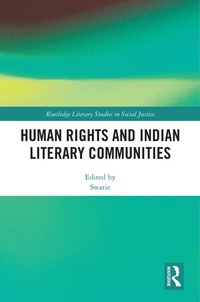
Human Rights and Indian Literary Communities
Published on 31. March 2026
204 pages
978-1-040-66690-6 (ISBN)
Description

Human Rights and Indian Literary Communities explores the relation between literature, the public sphere and the notion of personhood as understood through the concept of human rights in India. While discussing the challenges of social equality, the universal notion that everyone is a rights-bearing person, and rule of law in a postcolonial society like India, it outlines the historical trajectories, geographies and social processes that go into the making of human rights.
This edited collection presents various interpretations of the concept of literary communities, highlighting their indispensable role to the demands of human rights discourse. Each chapter analyses narratives as told in various media and environments - from the public sphere and the Constitution to archival letters, novels, poetry and short stories, as well as documentary and feature films. Contributions from human rights and literary scholars and researchers also adopt an intersectional lens, discussing the micro-histories of the anti-colonial struggle, debates within the queer movement, and the relationship between religion and rights. Wide in scope, this book adopts a sharp focus on the capacity of literary communities to collectively equip those with rights with empathy and care.
By demonstrating how a rights-bearing person is written, not simply constructed, into being, this comprehensive text is an ideal resource for researchers of literary, legal, and postcolonial studies.
This edited collection presents various interpretations of the concept of literary communities, highlighting their indispensable role to the demands of human rights discourse. Each chapter analyses narratives as told in various media and environments - from the public sphere and the Constitution to archival letters, novels, poetry and short stories, as well as documentary and feature films. Contributions from human rights and literary scholars and researchers also adopt an intersectional lens, discussing the micro-histories of the anti-colonial struggle, debates within the queer movement, and the relationship between religion and rights. Wide in scope, this book adopts a sharp focus on the capacity of literary communities to collectively equip those with rights with empathy and care.
By demonstrating how a rights-bearing person is written, not simply constructed, into being, this comprehensive text is an ideal resource for researchers of literary, legal, and postcolonial studies.
More details
Series
Language
English
Place of publication
London
United Kingdom
Publishing group
Taylor & Francis Ltd
Target group
College/higher education
Product notice
Reflowable
File size
1,38 MB
ISBN-13
978-1-040-66690-6 (9781040666906)
Copyright in bibliographic data and cover images is held by Nielsen Book Services Limited or by the publishers or by their respective licensors: all rights reserved.
Schweitzer Classification
Other editions
Additional editions
Book
approx. 03/2026
1st Edition
Routledge
€213.20
Not yet published
Person
Swatie is Assistant Professor at Panjab University's Department of English and Cultural Studies. Her areas of research interest include human rights and literature, literary and critical theory, trauma, war and violence studies, gender and feminism, 21st Century American studies, among others. She is an alumna of Delhi University, India, from where she obtained her PhD, and Dartmouth College's Futures of American Studies Institute, USA.
Content
Introduction: Writing the Human Part I: Histories 1. The Right to Write: Ambedkar's Literary Criticism of any Political Theology 2. Narrating the Slave-Caste: Protestant anxieties and textual productions in nineteenth century Travancore 3. Manto's Language Games: The paradox of partition and the claims of personhood 4. The Poetics of Suffering: Subjecthood and Satire in Raag Darbari Part II: Geographies 5. Beyond the Universal Declaration: Provincialising 'Global' Human Rights through Literature from India's North East 6. Beyond Bare Life: Literary Conceptions of Kashmiri Personhood Part III: Social Processes 7. A Call for Dalit Human Rights in Contemporary India through Yashica Dutt's Coming Out as Dalit 8. Human Rights and the Vulnerability of Caste in Select Indian Films 9. Human Rights, Journalism, and the Politics of Representation: A study of Writing with Fire 10. Born, Dying and Reborn: The Transformations of Literary Community.
