

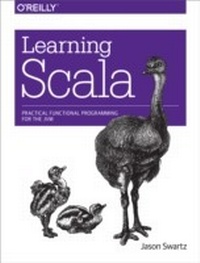
Learning Scala
Practical Functional Programming for the JVM
1st Edition
Published on 11. December 2014
256 pages
978-1-4493-6884-5 (ISBN)
Description

Why learn Scala? You dont need to be a data scientist or distributed computing expert to appreciate this object-oriented functional programming language. This practical book provides a comprehensive yet approachable introduction to the language, complete with syntax diagrams, examples, and exercises. Youll start with Scala's core types and syntax before diving into higher-order functions and immutable data structures.Author Jason Swartz demonstrates why Scalas concise and expressive syntax make it an ideal language for Ruby or Python developers who want to improve their craft, while its type safety and performance ensures that its stable and fast enough for any application.Learn about the core data types, literals, values, and variablesDiscover how to think and write in expressions, the foundation for Scala's syntaxWrite higher-order functions that accept or return other functionsBecome familiar with immutable data structures and easily transform them with type-safe and declarative operationsCreate custom infix operators to simplify existing operations or even to start your own domain-specific languageBuild classes that compose one or more traits for full reusability, or create new functionality by mixing them in at instantiation
More details
Other editions
Additional editions
Book
01/2015
1st Edition
O'Reilly
€37.50
Shipment within 10-20 days
Content
- Intro
- Copyright
- Table of Contents
- Preface
- Who This Book Is For
- Why Write "Learning Scala"?
- Why Learn Scala (or, Why Should You Read "Learning Scala")?
- Reason 1-Your Code Will Be Better
- Reason 2-You'll Be a Better Engineer
- Reason 3-You'll Be a Happier Engineer
- Why Learning Scala May Not Be for You
- About the Syntax Notation in This Book
- Conventions Used in This Book
- Using Code Examples
- Safari® Books Online
- How to Contact Us
- Acknowledgments
- Part I. Core Scala
- Chapter 1. Getting Started with the Scalable Language
- Installing Scala
- Using the Scala REPL
- Summary
- Exercises
- Chapter 2. Working with Data: Literals, Values, Variables, and Types
- Values
- Variables
- Naming
- Types
- Numeric Data Types
- Strings
- An Overview of Scala Types
- Tuples
- Summary
- Exercises
- Chapter 3. Expressions and Conditionals
- Expressions
- Defining Values and Variables with Expressions
- Expression Blocks
- Statements
- If..Else Expression Blocks
- If Expressions
- If-Else Expressions
- Match Expressions
- Matching with Wildcard Patterns
- Matching with Pattern Guards
- Matching Types with Pattern Variables
- Loops
- Iterator Guards
- Nested Iterators
- Value Binding
- While and Do/While Loops
- Summary
- Exercises
- Chapter 4. Functions
- Procedures
- Functions with Empty Parentheses
- Function Invocation with Expression Blocks
- Recursive Functions
- Nested Functions
- Calling Functions with Named Parameters
- Parameters with Default Values
- Vararg Parameters
- Parameter Groups
- Type Parameters
- Methods and Operators
- Writing Readable Functions
- Summary
- Exercises
- Chapter 5. First-Class Functions
- Function Types and Values
- Higher-Order Functions
- Function Literals
- Placeholder Syntax
- Partially Applied Functions and Currying
- By-Name Parameters
- Partial Functions
- Invoking Higher-Order Functions with Function Literal Blocks
- Summary
- Exercises
- Chapter 6. Common Collections
- Lists, Sets, and Maps
- What's in a List?
- The Cons Operator
- List Arithmetic
- Mapping Lists
- Reducing Lists
- Converting Collections
- Java and Scala Collection Compatibility
- Pattern Matching with Collections
- Summary
- Exercises
- Chapter 7. More Collections
- Mutable Collections
- Creating New Mutable Collections
- Creating Mutable Collections from Immutable Ones
- Using Collection Builders
- Arrays
- Seq and Sequences
- Streams
- Monadic Collections
- Option Collections
- Try Collections
- Future Collections
- Summary
- Exercises
- Part II. Object-Oriented Scala
- Chapter 8. Classes
- Defining Classes
- More Class Types
- Abstract Classes
- Anonymous Classes
- More Field and Method Types
- Overloaded Methods
- Apply Methods
- Lazy Values
- Packaging
- Accessing Packaged Classes
- Packaging Syntax
- Privacy Controls
- Privacy Access Modifiers
- Final and Sealed Classes
- Summary
- Exercises
- Chapter 9. Objects, Case Classes, and Traits
- Objects
- Apply Methods and Companion Objects
- Command-Line Applications with Objects
- Case Classes
- Traits
- Self Types
- Instantiation with Traits
- Importing Instance Members
- Summary
- Break-Configuring Your First Scala Project
- Exercises
- Chapter 10. Advanced Typing
- Tuple and Function Value Classes
- Implicit Parameters
- Implicit Classes
- Types
- Type Aliases
- Abstract Types
- Bounded Types
- Type Variance
- Package Objects
- Summary
- Questions
- Appendix A. Reserved Words
- Index
- About the Author
