

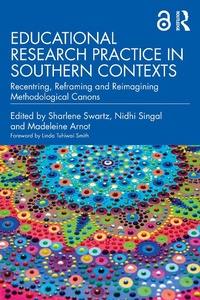
Educational Research Practice in Southern Contexts
Recentring, Reframing and Reimagining Methodological Canons
1st Edition
Published on 13. October 2023
376 pages
978-1-000-99587-9 (ISBN)
Description

Bringing together a unique collection of 18 insightful and innovative internationally focused articles, Educational Research Practice in Southern Contexts offers reflections, case studies, and critically, research methods and processes which decentre, reframe, and reimagine conventional educational research strategies and operationalise the tenets of decolonising theory.
This anthology represents a valuable teaching resource. It provides readers with the chance to read high-quality examples of research that critique current ways of doing research and to reflect on how research methods can contribute to the project of decolonising knowledge production in and about education in, for example, Africa, South Asia, Asia, and Latin America. It grapples with everyday dilemmas and tricky ethical questions about protection, consent, voice, cultural sensitivity, and validation, by engaging with real-world situations and increasing the potential for innovation and new collaborations.
Educational Research Practice in Southern Contexts will be essential reading for anyone teaching educational research methods and will encourage novice and experienced researchers to rethink their research approaches, disentangle the local and global, and challenge those research rituals, codes, and fieldwork practices which are often unproblematically assumed to be universally relevant.
This anthology represents a valuable teaching resource. It provides readers with the chance to read high-quality examples of research that critique current ways of doing research and to reflect on how research methods can contribute to the project of decolonising knowledge production in and about education in, for example, Africa, South Asia, Asia, and Latin America. It grapples with everyday dilemmas and tricky ethical questions about protection, consent, voice, cultural sensitivity, and validation, by engaging with real-world situations and increasing the potential for innovation and new collaborations.
Educational Research Practice in Southern Contexts will be essential reading for anyone teaching educational research methods and will encourage novice and experienced researchers to rethink their research approaches, disentangle the local and global, and challenge those research rituals, codes, and fieldwork practices which are often unproblematically assumed to be universally relevant.
Reviews / Votes
"Many universities are now exploring how to decolonise their curricula. But how can we transform the North-South hierarchies often taken as 'given' within educational research? This book brings together a stimulating collection of methodological and theoretical reflections by educational researchers working in diverse contexts in the Global South. Moving beyond the familiar 'insider-outsider' debates in educational research, these writers engage with the political, cultural and institutional aspects of knowledge construction. This exciting collection will prove invaluable to educational researchers committed to addressing inequalities in cultural values, voice, identities and knowledges."Anna Robinson-Pant, Professor/UNESCO Chair in Adult Literacy and Learning for Social Transformation, School of Education and Lifelong Learning, University of East Anglia, UK
"Researching research itself - how knowledge is produced, what methodologies are deployed, what research practices are at play - in the context of resurgent and insurgent decolonisation of the 21st century is urgent and very necessary. This well-curated volume does just this very well from diverse vantage points, covering various aspects of ethics, gender, responsibility, reflexivity, spirituality, sovereignty, visuality, polyvocality, and inequality as they impinge on research itself. The field of education is the departure point in the agenda to critique hegemonic knowledge paradigms and articulation of submerged Southern epistemologies."
Sabelo J. Ndlovu-Gatsheni, Professor/Chair of Epistemologies of the Global South and Vice-Dean of Research in the Africa Multiple Cluster of Excellence, University of Bayreuth, Germany
"There's much talk now of decolonizing knowledge. What does that mean for education, and specifically for research in education? Sharlene Swartz, Nidhi Singal and Madeleine Arnot have put together a unique and wide-ranging collection, across continents and cultures. This book gives us distinctive perspectives on conceptual debates, hands-on research experience, and a remarkable range of research methods, from statistics to poetry, all considered from global South positions."
Raewyn Connell, Professor Emerita, University of Sydney, Australia
More details
Edition
1. Auflage
Language
English
Place of publication
London
United Kingdom
Publishing group
Taylor & Francis Ltd
Target group
College/higher education
Product notice
Reflowable
Illustrations
10 Tables, black and white; 2 Line drawings, black and white; 1 Halftones, black and white; 3 Illustrations, black and white
ISBN-13
978-1-000-99587-9 (9781000995879)
Copyright in bibliographic data and cover images is held by Nielsen Book Services Limited or by the publishers or by their respective licensors: all rights reserved.
Schweitzer Classification
Other editions
Additional editions
Sharlene Swartz | Nidhi Singal | Madeleine Arnot
Educational Research Practice in Southern Contexts
Recentring, Reframing and Reimagining Methodological Canons
Book
10/2023
1st Edition
Routledge
€207.30
Shipment within 10-20 days
Sharlene Swartz | Nidhi Singal | Madeleine Arnot
Educational Research Practice in Southern Contexts
Recentring, Reframing and Reimagining Methodological Canons
Book
10/2023
1st Edition
Routledge
€66.80
Shipment within 10-20 days
Persons
Sharlene Swartz is Head of the Equitable Education and Economies research division at the Human Sciences Research Council, South Africa.
Nidhi Singal is a Professor of Disability and Inclusive Education at the Faculty of Education, University of Cambridge, UK.
Madeleine Arnot is Emerita Professor in Sociology of Education in the Faculty of Education at the University of Cambridge, UK.
Nidhi Singal is a Professor of Disability and Inclusive Education at the Faculty of Education, University of Cambridge, UK.
Madeleine Arnot is Emerita Professor in Sociology of Education in the Faculty of Education at the University of Cambridge, UK.
Content
1. Recentring, reframing and reimagining the canons of educational research PART 1: RECENTRING SOUTHERN EXPERIENCES OF EDUCATION, KNOWLEDGE AND POWER 2. Towards a postcolonial research ethics in comparative and international education 3. Researching disability and education: Rigour, respect, and responsibility 4. Decentring hegemonic gender theory: The implications for educational research 5. Indigenous anti-colonial knowledge as 'heritage knowledge' for promoting Black/African education in diasporic contexts 6. Postcolonial models, cultural transfers and transnational perspectives in Latin America: A research agenda PART 2: REFRAMING THE CODES, RULES, AND RITUALS OF EDUCATIONAL RESEARCH PRACTICE 7. Reflexivity and the politics of knowledge: Researchers as 'brokers' and 'translators' of educational development 8. Non-Chinese researchers conducting research in Chinese cultures: Critical reflections 9. (Re)Centering the spirit: A spiritual black feminist take on cultivating right relationships in qualitative research 10. Fieldwork for language education research in rural Bangladesh: Ethical issues and dilemmas 11. Informed consent in educational research in the South: Tensions and accommodations PART 3: RE-IMAGINING EDUCATIONAL RESEARCH APPROACHES FOR EMANCIPATION 12. Indigenous data, indigenous methodologies and indigenous data sovereignty 13. Focus groups and methodological rigour outside the minority world: Making the method work to its strengths in Tanzania 14. Social Network Interviewing as an emancipatory Southern methodological innovation 15. Getting the picture and changing the picture: Visual methodologies and educational research in South Africa 16. Entering an ambiguous space: Evoking polyvocality in educational research through collective poetic inquiry 17. Researching family lives, schooling and structural inequality in rural Punjab: The power of a habitus listening guide 18. Pedagogy of absence, conflict, and emergence: Contributions to the decolonisation of education from the Native American, Afro-Portuguese and Romani experiences
