

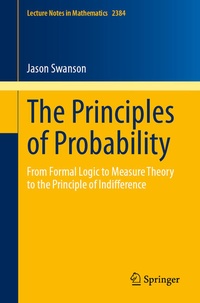
The Principles of Probability
Description

This book presents a logical system that is able to capture all aspects of modern probability as it is practiced today. The system is then used to rigorously formulate the principle of indifference.
Using nine rules of inductive inference, a calculus of probability is developed that operates directly on sentences - without reference to outcomes or sample spaces. Its surprising strength is expressed by three embedding theorems, based on an underlying many-worlds semantics in which random variables play a foundational role.
The calculus allows a formal treatment of the principle of indifference. Roughly speaking, this heuristic idea, which dates back to the time of Laplace, says that we should assign the same probability to two possibilities about which we are "equally ignorant". Despite being almost self-evident, the principle has a problematic history. It is well known to produce paradoxes when used without caution.
This is the first logical system to fully codify modern probability, revealing it to be a form of logic, as Leibniz and Boole envisioned. Modern science is more probabilistic today than ever before. Once shunned by the mainstream, Bayesian ideas now flourish. In such an environment, it is not enough to know how to calculate probabilities. We must understand the nature of probability itself. We must have a conceptual mindset to drive our calculations and our model building. The logical system described in this book lays bare this mindset, showing it to us with explicit clarity.
More details
Other editions
Additional editions
Person
Jason Swanson is a professor of mathematics at the University of Central Florida. After earning his PhD in probability theory in 2004, he was a postdoc at the University of Wisconsin-Madison before moving to Orlando in 2007. His research interests include stochastic financial models, interacting particle systems, stochastic PDEs, network traffic models, fractional Brownian motion, and metastability. He turned his attention to logic in 2019, having long been interested in the foundations of probability. As a postdoc, he transformed probabilistic intuition into concrete winnings as an avid online poker player. While he no longer plays poker, he still brings his expertise to the gaming table, which these days is filled with board games, video games, and role-playing games.
Content
1. Introduction.- 2. Background.- 3. Propositional Calculus.- 4. Propositional Models.- 5.Predicate Logic.- 6. Real Inductive Theories.- 7. Principle of Indifference.- References.- Index of Terms.- Index of Symbols.
