

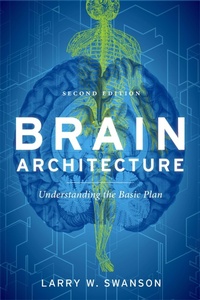
Brain Architecture
Published on 15. August 2011
348 pages
978-0-19-970277-0 (ISBN)
Description

Now in its second edition, Brain Architecture is the continued exploration of how the brain works. It summarizes traditional views about brain structure-function organization clearly and comprehensively and elaborates a new four system network model of nervous system organization. Thoroughly updated and refreshingly clear, this is a must-read for anyone interested in the science of how the brain works.
Oxford Clinical Neuroscience is a comprehensive, cross-searchable collection of resources offering quick and easy access to eleven of Oxford University Press's prestigious neuroscience texts. Joining Oxford Medicine Online these resources offer students, specialists and clinical researchers the best quality content in an easy-to-access format.
More details
Other editions
Additional editions
Book
10/2011
2nd Edition
Oxford University Press Inc
€128.90
Shipment within 15-20 days
Person
Milo Don and Lucille Appleman Professor of Biological Sciences, University of Southern California, Los Angeles,USA
Content
- Cover
- Contents
- Preface to the First Edition
- 1. Thinking about the Brain: Body and Mind
- 2. How the Brain Works: History, Structure, and Function
- Three Biological Perspectives
- 3. The Simplest Nervous Systems: Neurons, Nerve Nets, and Behavior
- Unicellular Organisms: Behaviors Essential for Survival
- Animals without Neurons: Independent Effectors
- The First Nervous System: Hydra's Body and Behavior
- Sensory Neurons: Functional Polarity of Dendrites and Axon
- Motor Neurons: A Second Distinct Neuron Type
- Nerve Nets: Amacrine Extensions and Activity Patterns
- Interneurons: Sign Switchers and Pattern Generators
- Overview: Evolution of Architecture, Not Building Blocks
- 4. Centralization and Symmetry: Ganglia and Nerves
- Flatworms: Bilaterally Symmetrical Predators
- Segmented Worms: Inner Ventral Nerve Cord
- More Evolved Invertebrates
- Overview: Polarity, Regionalization, Bilateral Symmetry, Segments
- 5. The Basic Vertebrate Plan: Transverse Divisions
- Embryological Perspectives
- Earliest Stages of Mammalian Development
- Neural Plate: Central Nervous System Divisions
- Neural Tube: Transverse Brain Divisions
- Neural Crest and Placodes: Peripheral Nervous System
- Overview
- 6. Neurogenesis: Longitudinal Divisions, Parts List, and Adult Flatmap
- Generating Neuron Types: Longitudinal Central Nervous System Divisions
- Generating Gray Matter Regions
- Macroconnections, Mesoconnections, and Microconnections
- A Nervous System Flatmap for Mammals
- Overview: Parts of the Nervous System
- 7. Brain and Behavior: A Four Systems Network Model
- Reflex and Voluntary Control of Behavior
- Behavioral State Control
- Feedback
- Topography versus Systems
- Overview: Defining Each System
- 8. The Motor System: Coordinating External and Internal Behaviors
- Motor Neuron Varieties
- Introduction to the Somatic Motor System: Flexion
- Distribution of Somatic Motor Neuron Pools
- Central Pattern Generators-Sets of Motor Neuron Pools
- Pattern Initiators and Controllers: Drive and Motivation
- The Autonomic Motor System
- The Neuroendocrine Motor System
- The Cerebellum: Motor Coordination and Learning
- Overview: Integration within and between Motor Systems
- 9. The Behavioral State System: Intrinsic Control of Sleep and Wakefulness
- Circadian Rhythms: The Day-Night Cycle
- Reproductive Cycles
- Sleep-Wake Cycles
- Modulating Behavioral State
- 10. The Cognitive System: Thinking and Voluntary Control of Behavior
- Cerebral Cortex Regionalization
- Cortical Cellular Organization
- Cortical Outputs
- The Cerebral Nuclei
- Triple Caudal (Descending) Projection from Cerebrum
- 11. The Sensory System: Inputs from Environment and Body
- Evolution and Development of Sensory Neurons
- Overview of Sensory Neurons
- Overview of Sensory Pathways
- Forebrain Sensory Systems: Olfactory, Visual, Humoral, and Osmotic
- Ganglion Cell Sensory Systems: Submodalities
- Affect: Pain and Pleasure, Emotion, and Mood
- 12. Modifiability: Learning, Stress, Cycles, and Damage Repair
- Learning: Changing Synaptic Strength
- Stress: Biochemical Switching
- Cycles: Circadian and Reproductive
- Damage Repair: Regrowth
- 13. Genome and Connectome
- Appendix A. Describing Position in the Animal Body
- Appendix B. Naming and Classifying Nervous System Parts
- Appendix C. Methods for Analyzing Brain Architecture
- Epigraphs
- Glossary
- A
- B
- C
- D
- E
- F
- G
- H
- I
- L
- M
- N
- P
- R
- S
- T
- V
- W
- Index
- A
- B
- C
- D
- E
- F
- G
- H
- I
- J
- K
- L
- M
- N
- O
- P
- R
- S
- T
- U
- V
- W
- Y
