

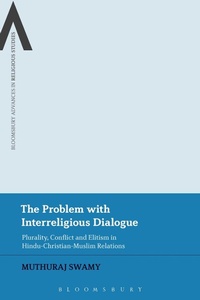
The Problem with Interreligious Dialogue
Plurality, Conflict and Elitism in Hindu-Christian-Muslim Relations
1st Edition
Published on 24. March 2016
248 pages
978-1-4742-5641-4 (ISBN)
Description

Muthuraj Swamy provides a fresh perspective on the world religions paradigm and 'interreligious dialogue'. By challenging the assumption that 'world religions' operate as essential entities separate from the lived experiences of practitioners, he shows that interreligious dialogue is in turn problematic as it is built on this very paradigm, and on the myth of religious conflict.
Offering a critique of the idea of 'dialogue' as it has been advanced by its proponents such as religious leaders and theologians whose aims are to promote inter-religious conversation and understanding, the author argues that this approach is 'elitist' and that in reality, people do not make sharp distinctions between religions, nor do they separate political, economic, social and cultural beliefs and practices from their religious traditions.
Case studies from villages in southern India explore how Hindu, Muslim and Christian communities interact in numerous ways that break the neat categories often used to describe each religion. Swamy argues that those who promote dialogue are ostensibly attempting to overcome the separate identities of religious practitioners through understanding, but in fact, they re-enforce them by encouraging a false sense of separation. The Problem with Interreligious Dialogue: Plurality, Conflict and Elitism in Hindu-Christian-Muslim Relations provides an innovative approach to a central issue confronting Religious Studies, combining both theory and ethnography.
Offering a critique of the idea of 'dialogue' as it has been advanced by its proponents such as religious leaders and theologians whose aims are to promote inter-religious conversation and understanding, the author argues that this approach is 'elitist' and that in reality, people do not make sharp distinctions between religions, nor do they separate political, economic, social and cultural beliefs and practices from their religious traditions.
Case studies from villages in southern India explore how Hindu, Muslim and Christian communities interact in numerous ways that break the neat categories often used to describe each religion. Swamy argues that those who promote dialogue are ostensibly attempting to overcome the separate identities of religious practitioners through understanding, but in fact, they re-enforce them by encouraging a false sense of separation. The Problem with Interreligious Dialogue: Plurality, Conflict and Elitism in Hindu-Christian-Muslim Relations provides an innovative approach to a central issue confronting Religious Studies, combining both theory and ethnography.
More details
Series
Edition
1. Auflage
Language
English
Place of publication
London
United Kingdom
Publishing group
Bloomsbury Publishing PLC
Target group
Professional and scholarly
ISBN-13
978-1-4742-5641-4 (9781474256414)
Copyright in bibliographic data and cover images is held by Nielsen Book Services Limited or by the publishers or by their respective licensors: all rights reserved.
Schweitzer Classification
Other editions
Additional editions

Muthuraj Swamy
The Problem with Interreligious Dialogue
Plurality, Conflict and Elitism in Hindu-Christian-Muslim Relations
Book
09/2017
Bloomsbury Academic
€51.90
Shipment within 15-20 days

Muthuraj Swamy
The Problem with Interreligious Dialogue
Plurality, Conflict and Elitism in Hindu-Christian-Muslim Relations
Book
03/2016
Bloomsbury Academic
€176.40
Shipment within 15-20 days
Person
Muthuraj Swamy is Assistant Professor and Head of the Department of Christian Theology & Ethics in the Union Biblical Seminary (Serampore University), Pune, India. He is the author of Christian Relations to Other Religions: Issues and Interpretations (2015) and Religion-State Relations in Early Christianity and Hindu Nationalism: A Contemporary Appraisal of St. Ambrose of Milan (2015).
Content
Introduction
Part 1: The Problem: The Concept and Practice of Dialogue
1. Dialogue in Post-Colonial India: A Brief Survey
2. The Practice of Dialogue: A Case from Kanyakumari District
Part 2: Limitations of Religious Plurality, Conflict and Elitism
3. 'Religion' and 'World Religions': Some Contemporary Approaches
4. Religious Plurality and Dialogue
5. Are Religions in Conflict?
6. Dialogue and the Myth of Religious Conflicts: A Case Study
7. Dialogue as Elitist
Part 3: Multiple Identities as a Challenger
8. Religion, Multiple Identities and Everyday Relations among Ordinary People
9. After Dialogue
Conclusion
Bibliography
Index
Part 1: The Problem: The Concept and Practice of Dialogue
1. Dialogue in Post-Colonial India: A Brief Survey
2. The Practice of Dialogue: A Case from Kanyakumari District
Part 2: Limitations of Religious Plurality, Conflict and Elitism
3. 'Religion' and 'World Religions': Some Contemporary Approaches
4. Religious Plurality and Dialogue
5. Are Religions in Conflict?
6. Dialogue and the Myth of Religious Conflicts: A Case Study
7. Dialogue as Elitist
Part 3: Multiple Identities as a Challenger
8. Religion, Multiple Identities and Everyday Relations among Ordinary People
9. After Dialogue
Conclusion
Bibliography
Index
