

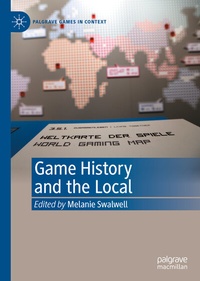
Game History and the Local
Description

This book brings together essays on game history and historiography that reflect on the significance of locality. Game history did not unfold uniformly and the particularities of space and place matter, yet most digital game and software histories are silent with respect to geography. Topics covered include: hyper-local games; temporal anomalies in platform arrival and obsolescence; national videogame workforces; player memories of the places of gameplay; comparative reception studies of a platform; the erasure of cultural markers; the localization of games; and perspectives on the future development of 'local' game history.
Chapters 1 and 12 are available open access under a Creative Commons Attribution 4.0 International License via link.springer.com.More details
Other editions
Additional editions
Person
Melanie Swalwell is Professor of Digital Media Heritage at Swinburne University of Technology, Australia. She is the author of Homebrew Gaming and the Beginnings of Vernacular Digitality (2021), and co-editor of Fans and Videogames: Histories, Fandom, Archives (2017) and The Pleasures of Computer Gaming (2008).
Content
1. Introduction: Game history and the local; Melanie Swalwell.- 2. Adventures in Everyday Spaces: Hyperlocal computer games in 1980-1990s Czechoslovakia; Jaroslav Svelch.- 3. 'The Last Cassette' and the Local Chronology of 8-bit Video Games in Poland; Maria B. Garda and Pawel Grabarczyk.- 4. Swedish Game Development History: The Founders and the social structure; Ulf Sandqvist.- 5. A Place for a Nintendo? Discourse on locale and players' topobiographical identity in the late 1980s and the early 1990s; Jaakko Suominen, Anna Sivula.- 6. On Footwork: Finding the local in American video game history; Laine Nooney.- 7. Bon Voyage: A global tour of local user groups with the Sorcerer of Exidy; Michael Borthwick and Melanie Swalwell.- 8. Cracking Technocultural Memory: Scenes and stories of origin in the PlayStation Portable forensic imaginary; David Murphy.- 9. Indie Games of No Nation: The transnational indie imaginary and the occlusion of national markers; John Vanderhoef.- 10. Video Games Have Never Been Global: Resituating video game localization history; Stephen Mandiberg.- 11. "Welcoming all gods and embracing all places": Computer games as constitutively transcendent of the local; Graeme Kirkpatrick.- 12. Heterodoxy in Game History: Toward more 'connected histories'; Melanie Swalwell.
