

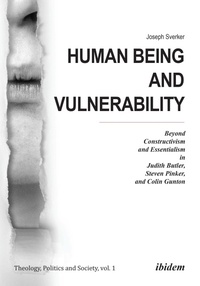
Human Being and Vulnerability
Beyond Constructivism and Essentialism in Judith Butler, Steven Pinker, and Colin Gunton
Published on 24. November 2020
296 pages
978-3-8382-7341-9 (ISBN)
Description

Joseph Sverker explores the division between social constructivism and a biologist essentialism by means of Christian theology. For this, Sverker uses a fascinating approach: He lets critical theorist Judith Butler, psycholinguist Steven Pinker, and systematic theologian Colin Gunton interact. While theology plays a central part to make the interaction possible, the context is also that of the school and the effect of institutions on the pupil as a human being and learner.
In order to understand what underlies the division between nature and nurture, or biology and the social in school, Sverker develops new central concepts such as a kenotic personalism, a weak ontology of relationality, and a relational and performative reading of evolution. He argues that most fundamental for what it is to be human is the person, vulnerability, bodiliness, openness to the other, and dependence.
Sverker concludes that the division between constructivism and essentialism discloses a deeper divide, namely that between fundamentally vulnerable persons on the one hand and constructed independent individuals on the other.
In order to understand what underlies the division between nature and nurture, or biology and the social in school, Sverker develops new central concepts such as a kenotic personalism, a weak ontology of relationality, and a relational and performative reading of evolution. He argues that most fundamental for what it is to be human is the person, vulnerability, bodiliness, openness to the other, and dependence.
Sverker concludes that the division between constructivism and essentialism discloses a deeper divide, namely that between fundamentally vulnerable persons on the one hand and constructed independent individuals on the other.
Reviews / Votes
"The vexed issue of nature versus nurture continues to stir up controversy across the Humanities. In this carefully crafted study, Joseph Sverker stages a cross-disciplinary conversation between Judith Butler, Steven Pinker, and Colin Gunton. Although it never happened in real life, this conversation has practical and profound, real-life consequences. Sverker's proposal for a 'kenotic personalism' is required reading for anyone interested in philosophical and theological anthropology."-Ulrich Schmiedel, Lecturer in Theology, Politics and Ethics, University of Edinburgh "Joseph Sverker's Human Being and Vulnerability is an original and multi-focused analysis of the relations between the social and the biological. In bringing into conversation the disparate works of Judith Butler, Steven Pinker, and Colin Gunton, he explores the cultural, evolutionary, and theological dimensions that need to be addressed not only conceptually, but also pedagogically. We cannot properly address the complexities of the relations between biological, theological, and social life without understanding how these terms work together."-Elisabeth Grosz, Professor of Women's and Gender Studies at Rutgers University "Joseph Sverker engages the cultural constructivism of Judith Butler and the biological essentialism of Steven Pinker in a spirited interactive reading with Colin Gunton's relational ontology, rooted in the personal interrelations of the Trinity and mediated in the particularities of an embodied, temporal creation. The surprising result is that such a conversation, which takes 'openness to the other' as the defining characteristic of the spirit, is able to overcome the initial contradictions in order to explore the possibilities of mutual cross-fertilisation. In his own proposal of a kenotic personalism Sverker shows that self-giving and vulnerability are crucial and complementary aspects of our being as persons in relation, most disturbingly and movingly disclosed in the person of Christ. This book is a compelling example of how sustained self-critical theological conversation can help to overcome the divisions and fissures in our worlds of discourse and meaning which shape the lived reality which we share."-Christoph Schwöbel, School of Divinity, University of St AndrewsMore details
Series
Edition
New edition
Language
English
Place of publication
Hannover
Germany
Target group
Professional and scholarly
Edition type
New edition
File size
3,91 MB
ISBN-13
978-3-8382-7341-9 (9783838273419)
Copyright in bibliographic data and cover images is held by Nielsen Book Services Limited or by the publishers or by their respective licensors: all rights reserved.
Schweitzer Classification
Other editions
Additional editions
Joseph Sverker
Human Being and Vulnerability
Beyond Constructivism and Essentialism in Judith Butler, Steven Pinker, and Colin Gunton
Book
11/2020
ibidem
€39.90
Shipment within 10-15 days
Persons
Joseph Sverker is a lecturer in Systematic Theology and Church History at Stockholm School of Theology on University College Stockholm
Content
- Intro
- Acknowledgments
- Introduction
- Interactive interdisciplinarity and human lived reality
- Social constructivism and biologist essentialism?
- Chapter 1: From interpellated subjecthood to recognized vulnerability
- On the human being, or becoming
- Gendered to be human
- Performativity and human identity
- Relationality and the constitution of humanity
- The problematic body
- Actions
- Judith Butler and the person
- Desire and personhood
- Recognition, personhood and grievability
- Chapter 2: Being human nature
- Language: window to human nature
- Nature/nurture
- Unique environment
- Genes, personality and behavior
- Computationalism and the individual
- Webbed causality
- The individual and human nature
- Death of the self again?
- Openness and relationality in evolutionary psychology?
- Chapter 3: Persons becoming in relations
- Ontology of the person
- Relationality, space and freedom
- Personalist and relational theological anthropology
- The divine and the human
- The triune Creator and the anthropological significance of Christ
- Embodied human persons
- "spirit," sin and the question of ethics
- Chapter 4: Going beyond: relationality, evolutionary theory and time
- Establishing a weak ontology of relationality
- Re-reading the theory of evolution
- Evolution as performativity
- Time matters
- The reality of body
- Chapter 5: Kenotic personalism
- Primacy of "person"?
- Kenosis, vulnerability and persons: the significance of self-giving relations
- Relation, mediation, interpellation
- Called in time
- The Gift of Vulnerability
- The giving between persons
- Kenosis and feminism
- Kenosis and resistance
- The gift of freedom
- The most vulnerable?
- Conclusion: persons, individuals and institutions
- AI: artificial individualism?
- Disclosing the nature/nurture problem
- Back to school
- Individualism and personalism in school
- A love supreme?
- Bibliography
- Index
