

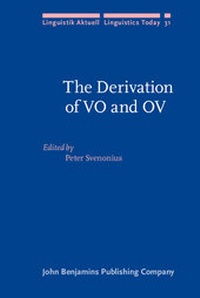
The Derivation of VO and OV
1st Edition
Published on 21. December 2000
VI, 372 pages
978-90-272-9924-6 (ISBN)
Description

The Derivation of VO and OV takes a new look at the relationship between head-final or OV structures and head-initial or VO ones, in light of recent work by Richard Kayne and others. The various papers in the volume take different positions with respect to whether one type of structure is derived from the other, and if so, which of the two orders is primary.
Different options explored include derivation of VO order by head movement from a basic OV structure, derivation of VO by fronting of a phrasal VP remnant containing only the verb, derivation of OV by fronting of a remnant VP which the verb has vacated, and others.
Each paper is thoroughly rooted in empirical observations about specific constructions drawn either from the Germanic languages or from others including Finnish, Hungarian, Japanese, and Malagasy.
The volume consists of eleven original papers by Sjef Barbiers, Michael Brody, Naoki Fukui & Yuji Takano, Liliane Haegeman, Hubert Haider, Roland Hinterhölzl, Anders Holmberg, Thorbjorg Hróarsdóttir, Matthew Pearson, Peter Svenonius, and Knut Tarald Taraldsen, plus an introduction by the editor.
Different options explored include derivation of VO order by head movement from a basic OV structure, derivation of VO by fronting of a phrasal VP remnant containing only the verb, derivation of OV by fronting of a remnant VP which the verb has vacated, and others.
Each paper is thoroughly rooted in empirical observations about specific constructions drawn either from the Germanic languages or from others including Finnish, Hungarian, Japanese, and Malagasy.
The volume consists of eleven original papers by Sjef Barbiers, Michael Brody, Naoki Fukui & Yuji Takano, Liliane Haegeman, Hubert Haider, Roland Hinterhölzl, Anders Holmberg, Thorbjorg Hróarsdóttir, Matthew Pearson, Peter Svenonius, and Knut Tarald Taraldsen, plus an introduction by the editor.
More details
Other editions
Additional editions
Peter Svenonius
The Derivation of VO and OV
Book
12/2000
John Benjamins Publishing Co
€137.80
Shipment within 10-15 days
Person
Content
- THE DERIVATION OF VO AND OV
- Editorial page
- Title page
- LCC page
- Table of Contents
- Introduction
- Word Order, Restructuring and Mirror Theory
- OV is More Basic than VO
- Remnant Movement and OV Order
- V-movement and VP-movement in Derivations Leading to VO order
- Deriving OV Order in Finnish
- Parameter Change in Icelandic
- The Right Periphery in SOV Languages: English and Dutch
- Nominal Structure: An Extension of the Symmetry Principle
- Quantifier Movement in Icelandic
- Licensing Movement and Stranding in the West Germanic OV Languages
- Two Types of VO Languages
- Index
- The Series LINGUISTIK AKTUELL/LINGUISTICS TODAY
