

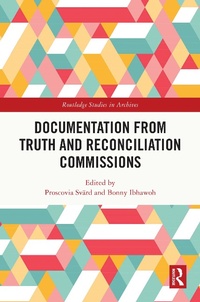
Documentation from Truth and Reconciliation Commissions
1st Edition
Published on 12. August 2024
224 pages
978-1-040-11062-1 (ISBN)
Description

Documentation from Truth and Reconciliation Commissions highlights the need for post-conflict societies to have access to - and to use - Truth Reconciliation Commissions (TRCs') documentation to achieve reconciliation and to work towards a democratic society.
Including international contributions from a range of disciplines, the volume discusses the challenges that surround TRCs' documentation. Considering the impact of the politicization of documentation, chapters also highlight the lack of political will to democratize information, the lack of dissemination and the preservation infrastructures that hinder access and its effective use and re-use. Arguing that TRCs' documentation should be used to inform policy, improve governance and to promote justice, healing and reconciliation, the volume considers the ethical challenges involved in disseminating such information. Contributing authors argue that information professionals should play a major role in the planning for the TRCs' information management infrastructures, if they are to facilitate access, effectively manage the generated documentation, deal with preservation of the compound records and promote the dissemination of the TRC findings.
Documentation from Truth and Reconciliation Commissions demonstrates that TRCs' documentation provides validation of human rights violations and that it helps to promote an understanding of the causes of conflict. As such, it will be essential reading for academics and students working in Archival Studies, Information Science, History, Transitional Justice, and Peace and Conflict Studies
Including international contributions from a range of disciplines, the volume discusses the challenges that surround TRCs' documentation. Considering the impact of the politicization of documentation, chapters also highlight the lack of political will to democratize information, the lack of dissemination and the preservation infrastructures that hinder access and its effective use and re-use. Arguing that TRCs' documentation should be used to inform policy, improve governance and to promote justice, healing and reconciliation, the volume considers the ethical challenges involved in disseminating such information. Contributing authors argue that information professionals should play a major role in the planning for the TRCs' information management infrastructures, if they are to facilitate access, effectively manage the generated documentation, deal with preservation of the compound records and promote the dissemination of the TRC findings.
Documentation from Truth and Reconciliation Commissions demonstrates that TRCs' documentation provides validation of human rights violations and that it helps to promote an understanding of the causes of conflict. As such, it will be essential reading for academics and students working in Archival Studies, Information Science, History, Transitional Justice, and Peace and Conflict Studies
More details
Series
Edition
1. Auflage
Language
English
Place of publication
London
United Kingdom
Publishing group
Taylor & Francis Ltd
Target group
College/higher education
Illustrations
3 Tables, black and white
ISBN-13
978-1-040-11062-1 (9781040110621)
Copyright in bibliographic data and cover images is held by Nielsen Book Services Limited or by the publishers or by their respective licensors: all rights reserved.
Schweitzer Classification
Other editions
Additional editions
Proscovia Svaerd | Bonny Ibhawoh
Documentation from Truth and Reconciliation Commissions
Book
approx. 12/2025
1st Edition
Routledge
€68.70
Not yet published

Proscovia Svard | Bonny Ibhawoh
Documentation from Truth and Reconciliation Commissions
Book
10/2024
Routledge
Unfortunately, price unknown
Available (delivery time upon request)
Proscovia Svaerd | Bonny Ibhawoh
Documentation from Truth and Reconciliation Commissions
Book
08/2024
1st Edition
Routledge
€178.40
Shipment within 10-20 days
Persons
Proscovia Svaerd is an Associate Professor at the Department of History, Sorbonne University, Abu Dhabi. She has formerly worked at the Faculty of Science, Technology and Media, Department of Information systems and Technology, Forum for Digitalization, Mid Sweden University. She is also a Research Fellow at the Department of Information Science, University of South Africa (Unisa) in Pretoria. She carried out her Post-doctoral Research at the School of Interdisciplinary Research and Postgraduate Studies, University of South Africa, between 2016-2017 and completed her PhD at the University of Amsterdam. She has a Licentiate Degree in Data and Systems Sciences, BA and MA in Archives and Information Science from Mid Sweden University, Sweden and a BSc in Media and Information Science from Uppsala University, Sweden.
Bonny Ibhawoh is a Professor and Senator William McMaster Chair in Global Human Rights at McMaster University, Canada. He is a United Nations Human Rights Expert with the UN Expert Mechanism on the Right to Development in the UN Human Rights Office in Geneva. With over 30 years of experience as a human rights educator, policy maker and practitioner, he has taught in Universities in Africa, Europe, the United States and Canada. He is the Project Director of Participedia, a global scholarly network on democratic innovation. He is also the Project Director of the Confronting Atrocity Project, a transnational project on restorative justice at McMaster University.
Bonny Ibhawoh is a Professor and Senator William McMaster Chair in Global Human Rights at McMaster University, Canada. He is a United Nations Human Rights Expert with the UN Expert Mechanism on the Right to Development in the UN Human Rights Office in Geneva. With over 30 years of experience as a human rights educator, policy maker and practitioner, he has taught in Universities in Africa, Europe, the United States and Canada. He is the Project Director of Participedia, a global scholarly network on democratic innovation. He is also the Project Director of the Confronting Atrocity Project, a transnational project on restorative justice at McMaster University.
Content
Introduction; Section 1: Access to Information and Transitional Justice; Chapter 1: Archives and Transitional Justice: Lessons from Colombia's Truth Commission; Chapter 2: Truth Commissions, Vitriol Memory and Governance Failure in Nigeria; Chapter 3: Democracy and Access to Information on Human Rights Violations in Nigeria (1999 - 2002); Chapter 4: The Ivorian 2011-2013 Truth Commission as a Practice of Securitising Truth; Section 2: Navigating Archives and Issues of Access and Ownership; Chapter 5: The Exiled Liberian Truth and Reconciliation Commission's Documentation; Chapter 6: Full Access for Full Truth - The Canadian TRC and its Records; Chapter 7: Truth Commissions? documentation in Brazil: challenges and legacy; Chapter 8: Decolonizing Copyright: Appropriation, Intellectual Property, and Cultural Heritage: Copyright; Section 3: Memorialization and Commemoration; Chapter 9: States of Apology: The Politics of Memory, Access, and Irish Archives Legislation Barry Houlihan and Eliscia Kinder; Chapter 10: The Crisis of Memory: The Ethics of Managing Traumatic Adverse Events in Truth Commissions Research; Chapter 11: From television news broadcast to online archive: Truth Commission Special Report's documentation of perpetratorship and political transition in South Africa; Chapter 12: Democratizing Digital Discourses: Considerations for the Use of Truth Commission Testimony in Virtual Museums
