

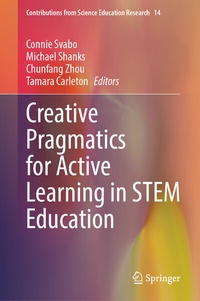
Creative Pragmatics for Active Learning in STEM Education
Description

This edited volume is an invitation to redesign STEM higher education . It shows the way to active learning in diverse scenarios and provides educators, leaders and policymakers with a visionary approach to active learning and hands - on examples of how education can help students navigate complexity and unpredictability-the challenges of contemporary society.
Featuring contributions from a diverse array of scholars and practitioners, this book explores:
· Creative learning strategies
· Dynamic teacher-student interactions
· Innovative assessment methods
· The design of engaging learning environments
Integrating science education with perspectives from pragmatism, science and technology studies, the humanities, art and design, this book presents a framework for understanding knowledge as an evolving, performative process. Through insightful case studies, the book emphasises agency and creativity as essential elements of learning, promoting interdisciplinary collaboration and flexible problem-solving.
Chapters 1 and 7 are available open access under a Creative Commons Attribution 4.0 International License via link. springer.com
More details
Other editions
Additional editions
Persons
Dr. Connie Svabo is a Professor of STEM Education and Science Communication at the University of Southern Denmark, leading the Centre for Research in Science Education and Communication (FNUG). Her work spans interdisciplinary collaboration, active learning, and innovative education practices. A transformative leader, she shapes academia, fostering impactful learning experiences.
Dr. Michael Shanks is an Archaeologist and Professor at Stanford University, USA. With a master's in education, a member of Stanford's design community, and as the world's leader in applied archaeology, he brings long-term insight into learning, creativity and innovation to bear on matters of concern in contemporary policy and practice. He consults widely in strategic foresight for global tech corporations.
Dr. Chunfang Zhou is an Associate Professor at the University of Southern Denmark. She is a cross-cultural expert in STEM education and creativity, board member for the Danish Development Research Network, as well as a Senior consultant at Northeastern University, China. She is editor of the Handbook of Research on Creative Problem-Solving Skill Development in Higher Education.
Dr. Tamara Carleton is a global expert in radical innovation, holding faculty roles at multiple universities worldwide and overseeing an international innovation practice. She has developed various methods in strategic foresight and has written several books, including
Building Moonshots: 50+ Ways to Turn Radical Ideas into Reality
.
Content
Chapter 1.Introduction: Creative Pragmatics in a Complex World.- Chapter 2.Participatory Design for STEM Education.- Chapter 3.Creative Learning and Artefacts in Mathematics Education.- Chapter 4. Active and Agentic: Student-Centred Learning in a 2-Year Introductory Science Program.- Chapter 5. Spaces for Active Learning in University Science Education.- Chapter 6. Tackling Global Design Innovation Challenges through Project-Based Learning: Stanford ME310 and the SUGAR Network.- Chapter 7. FabLabs and the Maker Movement: Learning through Making.- Chapter 8. Studio-based Learning for Design Practice.- Chapter 9. Evaluating STEM-Education: Developing Teaching through Assessment with Emotion.- Chapter 10. A Pedagogy of Enactment: On Active Learning in Science Teacher Education.- Chapter 11. Innovating Science Education at a National Level.- Chapter 12. Rethinking 'Creative Pragmatics' and Future STEM Education.
