

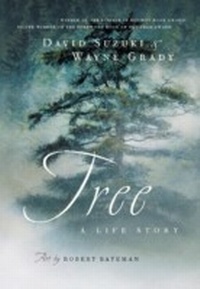
Tree
A Life Story
Published on 1. July 2009
200 pages
978-1-926685-53-3 (ISBN)
Description

"Only God can make a tree,” wrote Joyce Kilmer in one of the most celebrated of poems. In Tree: A Life Story, authors David Suzuki and Wayne Grady extend that celebration in a "biography” of this extraordinary - and extraordinarily important - organism. A story that spans a millennium and includes a cast of millions but focuses on a single tree, a Douglas fir, Tree describes in poetic detail the organism's modest origins that begin with a dramatic burst of millions of microscopic grains of pollen. The authors recount the amazing characteristics of the species, how they reproduce and how they receive from and offer nourishment to generations of other plants and animals. The tree's pivotal role in making life possible for the creatures around it - including human beings - is lovingly explored. The richly detailed text and Robert Bateman's original art pay tribute to this ubiquitous organism that is too often taken for granted.
More details
Other editions
Additional editions
Book
03/2007
Greystone Books,Canada
€14.50
Article exhausted; check different version
Persons
David Suzuki is an acclaimed geneticist and environmentalist and the host of "The Nature of Things". He has written numerous books, including Good News for a Change, From Naked Ape to Superspecies (both co-authored with Holly Dressel), and The Sacred Balance (co-authored with Amanda McConnell), and he is the founder and chair of the David Suzuki Foundation. He is the recipient of the Kalinga Prize for Science, the United Nations Environmental Medal, and the Global 500 award. He holds twelve honorary degrees. Suzuki lives in Vancouver, British Columbia.
Wayne Grady has written eight books of nonfiction, including the critically acclaimed The Bone Museum, The Quiet Limit of the World, Toronto the Wild, and The Nature of Coyotes. He has also translated seven novels and edited six anthologies of short stories, travel, and natural history. In addition, he has written feature articles for most of Canada's major magazines, including Saturday Night, Toronto Life, Canadian Geographic, Equinox, and Harrowsmith. Grady has received the John Glassco Prize (for translation), several National Magazine Awards, the Brascan Award, and three Science Writers of Canada Awards. He is married to the writer Merilyn Simonds and lives in Kingston, Ontario.
Robert Bateman is an internationally renowned wildlife artist. His work has appeared most recently in Birds of Heaven by Peter Matthiessen. He is also the author of Thinking Like a Mountain. He lives on Saltspring Island in British Columbia.
Wayne Grady has written eight books of nonfiction, including the critically acclaimed The Bone Museum, The Quiet Limit of the World, Toronto the Wild, and The Nature of Coyotes. He has also translated seven novels and edited six anthologies of short stories, travel, and natural history. In addition, he has written feature articles for most of Canada's major magazines, including Saturday Night, Toronto Life, Canadian Geographic, Equinox, and Harrowsmith. Grady has received the John Glassco Prize (for translation), several National Magazine Awards, the Brascan Award, and three Science Writers of Canada Awards. He is married to the writer Merilyn Simonds and lives in Kingston, Ontario.
Robert Bateman is an internationally renowned wildlife artist. His work has appeared most recently in Birds of Heaven by Peter Matthiessen. He is also the author of Thinking Like a Mountain. He lives on Saltspring Island in British Columbia.
Content
Chapter 1: Birth
This chapter begins in the 13th century as a seed from a Douglas-fir falls to the ground and lands on a patch of soil, where it lies dormant through the winter. The chapter also describes how millions of years ago the first primitive plants invaded land from the sea and how some of them, in their Darwinian struggle for light, became trees.
Chapter 2: Taking Root
In spring the seed takes root and begins to form xylem and phloem. This chapter examines this miraculous system of transport within the tree, as well as the development of the tree's stem and leaves and the vital process of photosynthesis.
Chapter 3: Growth
At the beginning of this chapter, the tree's root system has expanded and has begun its relationship with underground fungi, which connect the roots of the tree to nearby trees. This chapter also discusses the many types of insects, birds, and mammals that now make their homes in the tree or use it for temporary refuge and explains the reproductive process, which begins after the growing tree has developed male and female cones.
Chapter 4: Maturity
The tree is now 250 years old and, like all trees of its age, has developed rich, complex relationships with other members of the forest, which are described in this chapter. It has also made good use of its complex arsenal of weapons against drought, insects, fungal infestations, wind, fire, and other stresses, and the chapter discusses this incredible defense system as well. By the end of the chapter, the tree is 500 years old and has reached maturity.
Chapter 5: Death
In the final chapter, the tree begins to decay and die. This chapter looks at the last stages in the tree's life; as a snag, it is home to many species, and after it falls to the ground it becomes a nurse log for other species of trees. At the end of the chapter, a new seed sends its roots into the ground and begins a new story.
This chapter begins in the 13th century as a seed from a Douglas-fir falls to the ground and lands on a patch of soil, where it lies dormant through the winter. The chapter also describes how millions of years ago the first primitive plants invaded land from the sea and how some of them, in their Darwinian struggle for light, became trees.
Chapter 2: Taking Root
In spring the seed takes root and begins to form xylem and phloem. This chapter examines this miraculous system of transport within the tree, as well as the development of the tree's stem and leaves and the vital process of photosynthesis.
Chapter 3: Growth
At the beginning of this chapter, the tree's root system has expanded and has begun its relationship with underground fungi, which connect the roots of the tree to nearby trees. This chapter also discusses the many types of insects, birds, and mammals that now make their homes in the tree or use it for temporary refuge and explains the reproductive process, which begins after the growing tree has developed male and female cones.
Chapter 4: Maturity
The tree is now 250 years old and, like all trees of its age, has developed rich, complex relationships with other members of the forest, which are described in this chapter. It has also made good use of its complex arsenal of weapons against drought, insects, fungal infestations, wind, fire, and other stresses, and the chapter discusses this incredible defense system as well. By the end of the chapter, the tree is 500 years old and has reached maturity.
Chapter 5: Death
In the final chapter, the tree begins to decay and die. This chapter looks at the last stages in the tree's life; as a snag, it is home to many species, and after it falls to the ground it becomes a nurse log for other species of trees. At the end of the chapter, a new seed sends its roots into the ground and begins a new story.
