

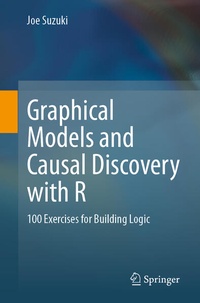
Graphical Models and Causal Discovery with R
Description

Beginning with a gentle introduction to causal discovery and the foundations of probability and statistics, this textbook is written in a highly pedagogical way. By uniting probability theory, statistical inference, and graph theory, the book offers a systematic pathway from foundational principles to cutting-edge algorithms, including independence tests, the PC algorithm, LiNGAM, information criteria, and Bayesian methods. Far more than a theoretical treatment, this volume emphasizes hands-on learning through R implementations, carefully designed exercises with solutions, and intuitive graphical illustrations. Readers will gain the ability to see, run, and understand causal discovery methods in practice.
Key features of this book include:
- A clear and self-contained introduction, bridging probability, statistics, and modern causal discovery techniques
- 100 exercises with solutions, supporting self-study and classroom use
- Reproducible R code, allowing readers to implement and extend the methods themselves
- Intuitive figures and visual explanations that clarify abstract concepts
- Broad coverage of applications within statistics and data science, connecting rigorous theory with modern machine learning and causal inference
More details
Other editions
Additional editions
Person
Joe Suzuki is a professor of statistics at Osaka University, Japan
Content
A Gentle Introduction to Causal Discovery.- Foundations of Probability and Statistics.- Graphical Models.- Testing Independence and Conditional Independence with Kernels.- The PC Algorithm.- LiNGAM.- Information Criteria and Marginal Likelihood.- Score-Based Structure Learning.
