

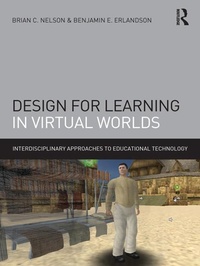
Design for Learning in Virtual Worlds
1st Edition
Published on 22. May 2012
240 pages
978-1-136-86303-5 (ISBN)
Description

Design for Learning in Virtual Worlds, the first book focused specifically on how to design virtual worlds for educational purposes, explores:
* the history and evolution of virtual worlds
* the theories behind the use of virtual worlds for learning
* the design of curricula in virtual worlds
* design guidelines for elements experienced in virtual worlds that support learning
* design guidelines for learning quests and activities in virtual worlds.
The authors also examine the theories and associated design principles used to create embedded assessments in virtual worlds. Finally, a framework and methodology is provided to assist professionals in evaluating "off-the-shelf" virtual worlds for use in educational and training settings. Design for Learning in Virtual Worlds will be invaluable both as a professional resource and as a textbook for courses within Educational Technology, Learning Sciences, and Library Media programs that focus on gaming or online learning environments.
* the history and evolution of virtual worlds
* the theories behind the use of virtual worlds for learning
* the design of curricula in virtual worlds
* design guidelines for elements experienced in virtual worlds that support learning
* design guidelines for learning quests and activities in virtual worlds.
The authors also examine the theories and associated design principles used to create embedded assessments in virtual worlds. Finally, a framework and methodology is provided to assist professionals in evaluating "off-the-shelf" virtual worlds for use in educational and training settings. Design for Learning in Virtual Worlds will be invaluable both as a professional resource and as a textbook for courses within Educational Technology, Learning Sciences, and Library Media programs that focus on gaming or online learning environments.
More details
Series
Language
English
Place of publication
London
United Kingdom
Publishing group
Taylor & Francis Ltd
Product notice
Reflowable
Illustrations
8 s/w Tabellen, 50 s/w Zeichnungen
8 Tables, black and white; 50 Line drawings, black and white
File size
19,25 MB
ISBN-13
978-1-136-86303-5 (9781136863035)
Copyright in bibliographic data and cover images is held by Nielsen Book Services Limited or by the publishers or by their respective licensors: all rights reserved.
Schweitzer Classification
Other editions
Additional editions

Brian C. Nelson | Benjamin E. Erlandson
Design for Learning in Virtual Worlds
Book
03/2012
1st Edition
Routledge
€222.84
Shipment within 15-20 days
Brian C. Nelson | Benjamin E. Erlandson
Design for Learning in Virtual Worlds
Book
03/2012
1st Edition
Routledge
€78.17
Shipment within 15-20 days
Person
Brian C. Nelson is Associate Professor of Educational Technology at Arizona State University. An instructional designer and learning theorist, he has published and presented extensively on the viability of educational virtual worlds for situated inquiry learning and assessment. Dr. Nelson's recent writing addresses issues related to the design and evaluation of educational games, with a focus on theory-based design principles. He is currently a Co-Principal Investigator on the SAVE Science Virtual World project, and was the Project Designer on the River City project. He was a Co-Principal Investigator on two MacArthur Foundation Digital Learning grants and was also a Co-Principal Investigator on the SURGE project, creating video games to teach high school physics.
Benjamin E. Erlandson is Assistant Professor of Instructional Science and Technology with an emphasis in Digital Media in the School of Information, Technology, and Communication Design (ITCD) at California State University, Monterey Bay. In addition to teaching several courses in interactive media design/development and instructional design, Dr. Erlandson runs the Virtual Environments for Situated Inquiry of Complexity (VESIC) Lab, conducting various research studies investigating the usefulness of meso-immersive 2D and 3D virtual environments-much like those used for many popular computer games-for learning about complex systems.
Benjamin E. Erlandson is Assistant Professor of Instructional Science and Technology with an emphasis in Digital Media in the School of Information, Technology, and Communication Design (ITCD) at California State University, Monterey Bay. In addition to teaching several courses in interactive media design/development and instructional design, Dr. Erlandson runs the Virtual Environments for Situated Inquiry of Complexity (VESIC) Lab, conducting various research studies investigating the usefulness of meso-immersive 2D and 3D virtual environments-much like those used for many popular computer games-for learning about complex systems.
Content
PART I - INTRODUCTION AND OVERVIEW Chapter 1: Definition and History of Virtual Worlds for Education What's a virtual world? A (Very) Brief History of Educational Virtual Worlds Conclusion Test your understanding Learning Activities References Links Other Resources Chapter 2: Mechanics of Virtual Worlds: The World Introduction The World Where is the World? Living on the Edge Multiple Worlds Networked Worlds Conclusion Test Your Understanding Learning Activities Links Other Resources Chapter 3: Mechanics of Virtual Worlds: The GUI Introduction The World and The GUI Defined The GUI What the GUI Is What the GUI Isn't How Does the GUI Work? Between the GUI and the World Conclusion Test your Understanding Learning Activities Other Resources PART 2 - THEORETICAL BASIS FOR LEARNING AND ASSESSMENT IN VIRTUAL WORLDS Chapter 4: Theoretical Basis for Learning in Virtual Worlds Introduction Theoretical basis for learning in virtual worlds Conclusion Test your understanding Learning Activities References Links Other Resources Chapter 5: Defining the Context of Virtual Worlds Introduction, Subject Domain, Learner Population World Boundaries Participant Roles Conclusion Test Your Understanding Learning Activities References Other Resources Chapter 6: Measurement and Assessment with Virtual Worlds Introduction Measurement and Assessment Reliability and Validity Choosing Constructs to be Measured in Virtual Worlds Conclusion Test Your Understanding Learning Activities References Other Resources PART III - THEORETICAL PERSPECTIVES: DESIGN FOR LEARNING IN VIRTUAL WORLDS Chapter 7: Critiquing Virtual Worlds and Virtual World-based Curricula Introduction, Critiquing Virtual Worlds Conclusion Test your understanding Learning Activities References Links Other Resources Chapter 8: Designing Curricula for Virtual Worlds Introduction, Virtual World Curriculum Design Document, Part 1: Design Overview Part 2: Design Details Conclusion, Test your understanding Learning Activities References Links Other Resources Chapter 9: Designing Measures for Assessment with Virtual Worlds Introduction Designing Virtual Worlds for Evaluation Designing Assessments for Implementation With or Within Virtual Worlds Designing Measures for Use in Virtual Worlds Implementing Existing Measures for Assessment in Virtual Worlds Conclusion Test Your Understanding Learning Activities Other Resources PART IV - BEYOND DESIGN: DEVELOPMENT AND IMPLEMENTATION OF VIRTUAL WORLDS Chapter 10: Developing Virtual Worlds for Learning Introduction Development Process The Development Team A Basic Development Process Conclusion Test your understanding Learning Activities Links Other Resources Chapter 11: Implementation and Evaluation of Virtual Worlds in Multiple Contexts Introduction Implementation Test your understanding Evaluation Formative Evaluation of a Virtual World Implementation Summative Evaluation of a Virtual World Implementation Conclusion Test Your Understanding Learning Activities References Links Other Resources
