

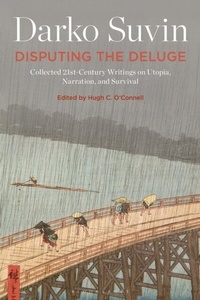
Disputing the Deluge
Collected 21st-Century Writings on Utopia, Narration, and Survival
1st Edition
Published on 2. December 2021
376 pages
978-1-5013-8478-3 (ISBN)
Description

Featured on the 2021 Locus Recommended Reading List
For over 50 years, Darko Suvin has set the agenda for science fiction studies through his innovative linking of scifi to utopian studies, formalist and leftist critical theory, and his broader engagement with what he terms "political epistemology." Disputing the Deluge joins a rapidly growing renewal of critical interest in Suvin's work on scifi and utopianism by bringing together in a single volume 24 of Suvin's most significant interventions in the field from the 21st century, with an Introduction by editor Hugh O'Connell and a new preface by the author.
Beginning with writings from the early 2000s that investigate the function of literary genres and reconsider the relationship between science fiction and fantasy, the essays collected here--each a brilliant example of engaged thought--highlight the value of scifi for grappling with the key events and transformations of recent years. Suvin's interrogations show how speculative fiction has responded to 9/11, the global war on terror, the 2008 economic collapse, and the rise of conservative populism, along with contemporary critical utopian analyses of the Capitalocene, the climate crisis, COVID-19, and the decline of democracy. By bringing together Suvin's essays all in one place, this collection allows new generations of students and scholars to engage directly with his work and its continuing importance and timeliness.
For over 50 years, Darko Suvin has set the agenda for science fiction studies through his innovative linking of scifi to utopian studies, formalist and leftist critical theory, and his broader engagement with what he terms "political epistemology." Disputing the Deluge joins a rapidly growing renewal of critical interest in Suvin's work on scifi and utopianism by bringing together in a single volume 24 of Suvin's most significant interventions in the field from the 21st century, with an Introduction by editor Hugh O'Connell and a new preface by the author.
Beginning with writings from the early 2000s that investigate the function of literary genres and reconsider the relationship between science fiction and fantasy, the essays collected here--each a brilliant example of engaged thought--highlight the value of scifi for grappling with the key events and transformations of recent years. Suvin's interrogations show how speculative fiction has responded to 9/11, the global war on terror, the 2008 economic collapse, and the rise of conservative populism, along with contemporary critical utopian analyses of the Capitalocene, the climate crisis, COVID-19, and the decline of democracy. By bringing together Suvin's essays all in one place, this collection allows new generations of students and scholars to engage directly with his work and its continuing importance and timeliness.
Reviews / Votes
An excellent reminder of how and why [Suvin] gained...the well-earned reputation as the field's premier Marxist critic and historian can be found in the 24 pieces that make up Disputing the Deluge... It is a reminder that, for all his reputation as a fiercely rigorous (and sometimes rigid) theorist, Suvin has never been less than an activist, and never less than passionate. * Science Fiction Studies * Everything in here is of note, from the essays early in this century on fascism and on fantasy to the most recent pieces on the enduring importance of communism; the growing danger of anti-utopian discourse; and especially the totalizing environmental, economic, political, and cultural terror and destruction brought on by the systemic operations of the Capitalocene. * Tom Moylan, Glucksman Professor Emeritus at the University of Limerick, Ireland, and author of Becoming Utopian: The Culture and Politics of Radical Transformation (Bloomsbury, 2020) * Darko Suvin is an erudite and an insightful scholar of the stories and narrative forms of utopia but he is also a utopian writer, a stylist of such brio and finesse that he can balance anger and insight in the most delicate and yet the most piercing of interpretations. The openness and the energy, critical always but never prescriptive, are the features of a stylistic practice which insists on cognizing the forces which constitute anti-utopia, and of yielding them their due in analytic rigour and seriousness yet never yielding to them the entirety of the intellectual ground. This collection of essays, stretching from 2000 to the naming of our own 'Coronisation Times,' is both a great addition to existing volumes of Suvin's work, and a contribution to a reinterpretation of some of the core concepts and arguments of that previous work, a repurposing of them so as to sharpen how they can help us catch the historical continuities and discontinuities which mark the 21st century. The essays by Suvin dramatize in detail both a mode of argumentation as well as the riches that mode can generate. It is a mode we all need--a Suvian mode--if we are to recognize and overcome the antiutopian imperatives which constitute our current deluge. * Patricia McManus, Senior Lecturer in English, University of Brighton, UK * With so many scales of crisis simultaneously unfolding around us, we need today more than ever militant, engaged, and hopeful scholarship that brushes against the grain of the 'new modesties' in critical thought and provides signposts for navigating the increasingly perilous terrain of contemporary planetary life. A disputation in the truest sense of the word--a refusal of the complacencies of the status quo and a willingness to seek truth wherever it may lead--this scintillating collection of Darko Suvin's most significant interventions published in the first two decades of our millennium offers an exemplary case of just such a necessary scholarship. This timely collection should be of tremendous import not only to students of science fiction and Utopian studies, but to anyone interested in a sobering and clear-eyed assessment of our contemporary 'dark times' and an inspiring call-to-arms for developing the strategies necessary if we are to 'emerge from the flood' of our once again grim but still hope-filled present. * Phillip E. Wegner, Professor and Marston-Milbauer Eminent Scholar, University of Florida, USA, and author of Invoking Hope: Theory and Utopia in Dark Times (2020) *More details
Edition
1. Auflage
Language
English
Place of publication
New York
United States
Publishing group
Bloomsbury Publishing PLC (Digital)
ISBN-13
978-1-5013-8478-3 (9781501384783)
Copyright in bibliographic data and cover images is held by Nielsen Book Services Limited or by the publishers or by their respective licensors: all rights reserved.
Schweitzer Classification
Other editions
Additional editions
Darko Suvin | Hugh C. O'Connell
Disputing the Deluge
Collected 21st-Century Writings on Utopia, Narration, and Survival
Book
01/2022
Bloomsbury Academic USA
€40.00
Shipment within 15-20 days
Persons
Darko Suvin is Emeritus Professor of English at McGill University, Canada, and has been a Fellow of the Royal Society of Canada, Academy of Humanities and Social Sciences, since 1986. He is author of 25 books, including the foundational study in science fiction Metamorphoses of Science Fiction: On the Poetics and History of a Literary Genre (1979, 2016), Victorian Science Fiction in the U. K.: The Discourses of Knowledge and of Power (1983), Positions and Presuppositions in Science Fiction (1988), and In Leviathan's Belly: Essays for a Counter-Revolutionary Time (2012).
Hugh C. O'Connell is Assistant Professor of English at University of Massachusetts-Boston, USA. He is editor of Legacies of Blade Runner, special issue of Science Fiction Film and Television (2020; with Sarah Hamblin); Speculative Finance/Speculative Fiction, special issue of CR: The New Centennial Review (2019; with David M. Higgins); and The British SF Boom, special issue of CR: The New Centennial Review (2013).
Hugh C. O'Connell is Assistant Professor of English at University of Massachusetts-Boston, USA. He is editor of Legacies of Blade Runner, special issue of Science Fiction Film and Television (2020; with Sarah Hamblin); Speculative Finance/Speculative Fiction, special issue of CR: The New Centennial Review (2019; with David M. Higgins); and The British SF Boom, special issue of CR: The New Centennial Review (2013).
Content
Acknowledgments
Editor's Preface: There Is No Alternative: Non-Reading Suvin, Anti-Antiutopianism, Science Fiction, and Communism
Author's Introduction: Words, Shapes, and Our Common World
1. Kick-Off: An Introduction to Narrative Genres, with a View to SF (2007, 2020)
2. Fantasy as Critique and Cognition: Marx's Black Metamorphoses of Living Labour (1999-2003)
3. A Note on Fascism as Well-Meaning Utopia (2000)
4. Considering the Sense of "Fantasy" or "Fantastic Fiction": On Ahistorical Alternate Worlds (1999-2001)
5. Going into a New Century: Sociopolitical Prospects for Utopia (2000)
6. A Colloquium with Darko Suvin: Interview with Science Fiction Magazine, Australia (2000-02)
7. Poems of Old Age I (2000-04)
8. Circumstances and Stances: A Retrospect (2004)
9. Of Starship Troopers and Refuseniks: War and Militarism in US Science Fiction (An Overview) (2005)
10. To Remember Stanislaw Lem (2006)
11. On U.K. Le Guin's "Second Earthsea Trilogy" and Its Cognitions: A Commentary (2006)
12. Poems of Old Age II (2006-10)
13. Literature, Politics, Brecht, Science Fiction vs. Fantasy: Interview with Maria Xilouri (2008)
14. Darwinism, Left and Right: And Some S-F Probes (2010)
15. Ideologies and Criticism: An Interview with Andres Lomena (2011)
16. On Climbing the Mountain of Life (2011)
17. Some Grateful Memories of Fred Pohl (2014)
18. A Note on Ursula K. Le Guin's Declaration of the Arts' Independence from Capitalism (2015)
19. Cognition Is the Esthetic Measure of Estranged Genres: An Interview with Zorica ?ergovic-Joksimovic (2016)
20. On Splitting Notions: Communism, Science Fiction (The Blagoevgrad Theses, 2018)
21. Poems of Old Age III (2014-20)
22. Orwell and 1984 Today: Genius and Tunnel Vision (2019)
23. Utopia or Bust: Capitalocene and Our Existential Antiutopia (2019)
24. Antiutopia in Coronisation Times: Capitalocene and Death (2020)
Appendix: D. Suvin: Publications after 2000 on SF and Utopia/nism
Index
Editor's Preface: There Is No Alternative: Non-Reading Suvin, Anti-Antiutopianism, Science Fiction, and Communism
Author's Introduction: Words, Shapes, and Our Common World
1. Kick-Off: An Introduction to Narrative Genres, with a View to SF (2007, 2020)
2. Fantasy as Critique and Cognition: Marx's Black Metamorphoses of Living Labour (1999-2003)
3. A Note on Fascism as Well-Meaning Utopia (2000)
4. Considering the Sense of "Fantasy" or "Fantastic Fiction": On Ahistorical Alternate Worlds (1999-2001)
5. Going into a New Century: Sociopolitical Prospects for Utopia (2000)
6. A Colloquium with Darko Suvin: Interview with Science Fiction Magazine, Australia (2000-02)
7. Poems of Old Age I (2000-04)
8. Circumstances and Stances: A Retrospect (2004)
9. Of Starship Troopers and Refuseniks: War and Militarism in US Science Fiction (An Overview) (2005)
10. To Remember Stanislaw Lem (2006)
11. On U.K. Le Guin's "Second Earthsea Trilogy" and Its Cognitions: A Commentary (2006)
12. Poems of Old Age II (2006-10)
13. Literature, Politics, Brecht, Science Fiction vs. Fantasy: Interview with Maria Xilouri (2008)
14. Darwinism, Left and Right: And Some S-F Probes (2010)
15. Ideologies and Criticism: An Interview with Andres Lomena (2011)
16. On Climbing the Mountain of Life (2011)
17. Some Grateful Memories of Fred Pohl (2014)
18. A Note on Ursula K. Le Guin's Declaration of the Arts' Independence from Capitalism (2015)
19. Cognition Is the Esthetic Measure of Estranged Genres: An Interview with Zorica ?ergovic-Joksimovic (2016)
20. On Splitting Notions: Communism, Science Fiction (The Blagoevgrad Theses, 2018)
21. Poems of Old Age III (2014-20)
22. Orwell and 1984 Today: Genius and Tunnel Vision (2019)
23. Utopia or Bust: Capitalocene and Our Existential Antiutopia (2019)
24. Antiutopia in Coronisation Times: Capitalocene and Death (2020)
Appendix: D. Suvin: Publications after 2000 on SF and Utopia/nism
Index
