

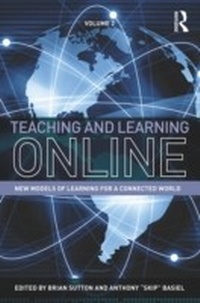
Teaching and Learning Online
New Models of Learning for a Connected World, Volume 2
1st Edition
Published on 29. August 2013
312 pages
978-1-136-27700-9 (ISBN)
Description

Teaching and Learning Online, Volume 2, provides practical advice from academics, researchers, practitioners and designers who are currently engaged in defining, creating and delivering the increasingly important world of online learning. This powerful guide avoids trends in technology, instead focusing on the articulation and development of the learning theories that underpin the use of technology.
Topics covered include:
* Theory that informs practice - emerging models and understanding from academia;
* Research - new understandings of learning, collaborative sense-making, and learning preferences;
* The Practitioner view - real examples from around the world of ground-breaking developments in online learning that are transforming education, adult learning and corporate training;
* Guidance for designers and producers - pedagogical advice and skills for a range of people who may have had little exposure to the body of knowledge surrounding learning design;
* Looking to the future - what to expect in the next 5 to 10 years and how to prepare to take full advantage of the opportunities that an increasingly connected society will provide for learner-managed learning.
The second volume of this bestselling guide addresses key gaps in the available literature including the inequality of access to technologically enabled learning and cutting-edge design issues and pedagogies that will take us into the next decade of eLearning and future Web 3.0+ approaches.
Topics covered include:
* Theory that informs practice - emerging models and understanding from academia;
* Research - new understandings of learning, collaborative sense-making, and learning preferences;
* The Practitioner view - real examples from around the world of ground-breaking developments in online learning that are transforming education, adult learning and corporate training;
* Guidance for designers and producers - pedagogical advice and skills for a range of people who may have had little exposure to the body of knowledge surrounding learning design;
* Looking to the future - what to expect in the next 5 to 10 years and how to prepare to take full advantage of the opportunities that an increasingly connected society will provide for learner-managed learning.
The second volume of this bestselling guide addresses key gaps in the available literature including the inequality of access to technologically enabled learning and cutting-edge design issues and pedagogies that will take us into the next decade of eLearning and future Web 3.0+ approaches.
Reviews / Votes
"I think you will find as many online learning nuggets in this second round of Teaching and Learning Online: Pedagogies for New Technologies as were made available in the first. . . . As the chapters in this book make apparent, there will be greater opportunities in the coming decade for experiential learning, game-based learning, inquiry-based learning, learner-learner connectivity, and still other novel learning formats."- From the Foreword by Curt Bonk, President of CourseShare, LLC, and Professor of Instructional Systems Technology in the School of Education at Indiana University, USAMore details
Language
English
Place of publication
London
United Kingdom
Publishing group
Taylor & Francis Ltd
Target group
Professional and scholarly
Product notice
Reflowable
Illustrations
11 s/w Tabellen
11 Tables, black and white
File size
12,08 MB
ISBN-13
978-1-136-27700-9 (9781136277009)
Copyright in bibliographic data and cover images is held by Nielsen Book Services Limited or by the publishers or by their respective licensors: all rights reserved.
Schweitzer Classification
Other editions
Additional editions

Brian Sutton | Anthony Basiel
Teaching and Learning Online
New Models of Learning for a Connected World, Volume 2
Book
10/2013
1st Edition
Routledge
€242.30
Shipment within 15-20 days
Brian Sutton | Anthony Basiel
Teaching and Learning Online
New Models of Learning for a Connected World, Volume 2
Book
09/2013
1st Edition
Routledge
€65.80
Shipment within 15-20 days
Persons
Brian Sutton is the founder and director of Learning4Leaders, an educational consulting group in the UK. Brian@Learning4Leaders.com
Anthony "Skip" Basiel is an e-learning thought leader and freelance consultant as an Adobe Education Leader (alumnus), London, UK. abasiel@gmail.com, http://abasiel.wordpress.com
Anthony "Skip" Basiel is an e-learning thought leader and freelance consultant as an Adobe Education Leader (alumnus), London, UK. abasiel@gmail.com, http://abasiel.wordpress.com
Content
Contents
Foreword
Introduction
Part 1 - Contextual positioning
1 Merging the Best of Both Worlds: Introducing the CoI-TLP Model
Melissa Layne and Phil Ice
2 Online Learning: Models and Impact in the 21st Century
Len Cairns and Khalid Alshahrani
Part 2 - Theory that informs practice
3 Strategies for Supporting Students' Metacognitive Processes in Ill-Structured Problem Solving in Online Environments
Yun-Jo An
4 Coping Together: Collective Self-Regulation in a Web-Based Course
Jackie Hee-Young Kim
Part 3 - Researchers
5 Learner Use of Online Content
Paul Bacsich and Giles Pepler
6 Open Educational Resources: Understanding Barriers to Adoption and Use
Gabriel Reedy
7 Designing Dynamic Online Learning Environments That Support Knowledge Construction
Mark Weyers
Part 4 - Practitioners
8 Explorations in self managed online learning
Ian Cunningham
9 People's Open Access Education Initiative: Peoples-uni
Richard F Heller
10 A case study of the tensions and triumphs in building an online learning community.
Ian Terrell and Tarek Zoubir
11 Metaphor and neuroscience: implications for online learning
Mike Howarth
Part 5 - Transition
12 Virtual and Virtuous: creating new pedagogies for a new South Africa
Narend Baijnath and Pamela Ryan
13 Online learning in Virtual Academia
Pamela McLean
Part 6 - Designers and Producers
14 Gaming Learning
Clark Quinn
15 Lights, Camera, Action: Experiential Learning with Digital Media Simulations
David James Clarke IV and Douglas Beckwith
16 Towards a Method of Improving Participation in Online Collaborative Learning: Curatr
Ben Betts
Endpiece:
Putting the learner in charge
- a pedagogy for online learning comes of age
Brian Sutton and Anthony 'Skip' Basiel
About the Authors
Index
Foreword
Introduction
Part 1 - Contextual positioning
1 Merging the Best of Both Worlds: Introducing the CoI-TLP Model
Melissa Layne and Phil Ice
2 Online Learning: Models and Impact in the 21st Century
Len Cairns and Khalid Alshahrani
Part 2 - Theory that informs practice
3 Strategies for Supporting Students' Metacognitive Processes in Ill-Structured Problem Solving in Online Environments
Yun-Jo An
4 Coping Together: Collective Self-Regulation in a Web-Based Course
Jackie Hee-Young Kim
Part 3 - Researchers
5 Learner Use of Online Content
Paul Bacsich and Giles Pepler
6 Open Educational Resources: Understanding Barriers to Adoption and Use
Gabriel Reedy
7 Designing Dynamic Online Learning Environments That Support Knowledge Construction
Mark Weyers
Part 4 - Practitioners
8 Explorations in self managed online learning
Ian Cunningham
9 People's Open Access Education Initiative: Peoples-uni
Richard F Heller
10 A case study of the tensions and triumphs in building an online learning community.
Ian Terrell and Tarek Zoubir
11 Metaphor and neuroscience: implications for online learning
Mike Howarth
Part 5 - Transition
12 Virtual and Virtuous: creating new pedagogies for a new South Africa
Narend Baijnath and Pamela Ryan
13 Online learning in Virtual Academia
Pamela McLean
Part 6 - Designers and Producers
14 Gaming Learning
Clark Quinn
15 Lights, Camera, Action: Experiential Learning with Digital Media Simulations
David James Clarke IV and Douglas Beckwith
16 Towards a Method of Improving Participation in Online Collaborative Learning: Curatr
Ben Betts
Endpiece:
Putting the learner in charge
- a pedagogy for online learning comes of age
Brian Sutton and Anthony 'Skip' Basiel
About the Authors
Index
