

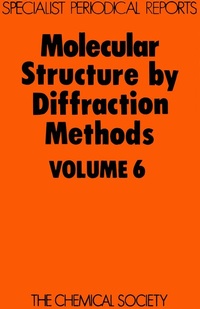
Molecular Structure by Diffraction Methods
Volume 6
1st Edition
Published on 31. October 2007
320 pages
978-1-84755-679-0 (ISBN)
Description

Specialist Periodical Reports provide systematic and detailed review coverage of progress in the major areas of chemical research. Written by experts in their specialist fields the series creates a unique service for the active research chemist, supplying regular critical in-depth accounts of progress in particular areas of chemistry. For over 80 years the Royal Society of Chemistry and its predecessor, the Chemical Society, have been publishing reports charting developments in chemistry, which originally took the form of Annual Reports. However, by 1967 the whole spectrum of chemistry could no longer be contained within one volume and the series Specialist Periodical Reports was born. The Annual Reports themselves still existed but were divided into two, and subsequently three, volumes covering Inorganic, Organic and Physical Chemistry. For more general coverage of the highlights in chemistry they remain a 'must'. Since that time the SPR series has altered according to the fluctuating degree of activity in various fields of chemistry. Some titles have remained unchanged, while others have altered their emphasis along with their titles; some have been combined under a new name whereas others have had to be discontinued. The current list of Specialist Periodical Reports can be seen on the inside flap of this volume.
More details
Series
Edition
1. Auflage
Language
English
Place of publication
Cambridge
United Kingdom
Target group
Professional and scholarly
ISBN-13
978-1-84755-679-0 (9781847556790)
DOI
10.1039/9781847556790
Copyright in bibliographic data and cover images is held by Nielsen Book Services Limited or by the publishers or by their respective licensors: all rights reserved.
Schweitzer Classification
Other editions
Additional editions
Book
01/1978
Royal Society of Chemistry
€398.50
Shipment within 3-4 weeks
Persons
Content
- Molecular Structure By Diffraction Methods
- Contents
- Chapter 1 Electron Diffraction Determinations of Gas-phase Molecular Structures
- 1 Some Current Trends in Gas-phase Electron Diffraction Procedures
- 2 Structured Results from GED Studies of Individual Molecules
- Tabulated Results
- (a) Inorganic Molecules
- (b) Organic and Organometallic Molecules
- 3 GED Papers of a General Nature without a Specific Molecule
- 4 Some Selected Topics from the Structural Results
- 5 A Comparison of Two Independent Studies of (CH3)3N-BF3
- Chapter 2 Molecular Mechanics Calculations
- 1 Introduction
- 2 Generation of Trial Cartesian Co-ordinates
- 3 Force Fields
- Bond Stretching
- Angle Bending
- Bond Torsion
- Non-bonded Interactions
- Cross Terms
- Derivatives of Force Field
- 4 Local Minimization
- 5 Global Minimization
- 6 Minimization in Reduced Parameter Spaces
- 7 Derivation of Molecular Parameters other than Geometry
- Heats of formation
- Vibrational Frequencies
- Steric Accessibility of Reaction Centres
- Reaction Rates
- Reaction Mechanisms
- 8 Computer Programs
- Chapter 3 Structures Calculated by the Molecular Mechanics Method
- 1 Introduction
- Glossary of Abbreviations
- 2 Alkanes
- 3 Non-conjugated Alkenes and Alkynes
- 4 Conjugated Hydrocarbons
- 5 Other Molecules
- 6 Molecules in Crystals
- Chapter 4 Chemists' Guide to Discovering Information about Molecular Structures in Crystalline Solids
- 1 Introduction
- 2 Annual Compilation of Crystal Structures Determined
- Molecular Structures and Dimensions (MSD)
- Bond Index to the Determination of Inorganic Crystal Structures (BIDICS)
- Structure Reports
- 3 Current Awareness
- 4 Retrospective Searching by Computer
- Examples of Searches on BIB File, Bibliographic
- Examples of Searches on the CONN File
- 5 Summary
- Chapter 5 Neutron Diffraction
- 1 Introduction
- 2 Hydrogen Bonding
- 3 Inorganic Compounds
- 4 Organic Compounds
- 5 Miscellaneous Topics
- Chapter 6 Silicates and Related Compounds
- 1 Introduction
- 2 Keys to the Literature
- 3 General Principles
- 4 Details of Anion Types
- Early Work
- Metasilicates of Large and Small Cations
- Double Chains and Rings
- Multiple Chains
- Sheets
- Frameworks
- Small Finite Anions
- Other Arrangements
- 5 Hydrates
- The Role of Water
- 6 Organic Silicates
- Condensed Silicates with Organic Inclusions
- Finite Silicate Groups with Organic Cations
- 7 Silicates Containing Octahedrally Co-ordinated Si
- 8 High Temperature Studies
- 9 Theories of Bonding in Silicates
- Chapter 7 Molecular Interactions
- 1 Introduction
- 2 The Bond-Valence Approach
- 3 Donor-Acceptor (Charge-transfer) Complexes
- 4 Secondary Bonding
- 5 Structural Correlation (Reaction Pathways)
- 6 Interatomic Distances and the CCDC File
- 7 Descriptions of Bonding
- Chapter 8 Mono-, Oligo-, and Poly-saccharide Crystal Structures
- 1 Introduction
- 2 Monosaccharides
- Pyranoses and Methyl Pyranosides
- Acetylated Sugars
- Pyranosyl Halides
- Cyclic Acetals and Related Compounds
- Calcium Halide Complexes and Salts
- Ascorbic Acid, Derivatives, and Isomers
- 3 Oligosaccharides
- 1,4-Linked a-D-glucose Oligosaccharides
- 1,6-a-Linked Pyranose Residues and 1,6-a-Linked Pyranosyl Furanose Residues
- 4 Polysaccharides
- Amylose
- Amylose Derivatives
- Cellulose
- Alkali Cellulose
- Cellulose Derivatives
- Chitin
- ß-1,3-Glucan
- ß-1,3-Glucan Triacetate
- Heteropolysaccharides
- Chapter 9 Nucleic Acids and Their Constituents
- 1 Introduction
- 2 Bases
- Purines
- Pyrimidines
- 3 Nucleosides
- Purine Nucleosides
- Pyrimidine Nucleosides
- 4 Mononucleotides
- 5 Oligonucleotides
- 6 Drug-Oligonucleotide Complexes
- 7 Transfer RNA
- 8 Polynucleotides
- 9 Metal Complexes of Nucleic Acid Fragments
- Base Complexes
- Nucleoside and Nucleotide Complexes
- Chapter 10 The Structure of Globular Proteins
- 1 Introduction
- 2 Principles of Protein Structure
- 3 Oxidoreductases
- 4 Hydrolases
- 5 Transferases
- 6 Lyases
- 7 Isomerases
- 8 Redox Proteins
- 9 Transport and Storage Proteins
- 10 Protein Hormones, Toxins, and Lectins
- 11 Proteins of Immune Response: Antibodies and Homologous Proteins
- 12 Structural and Other Proteins
- 13 Proteins that Bind Nucleic Acids
- Chapter 11 Pharmaceutically Active Small Molecules
- 1 Introduction
- 2 Neurotransmitters
- Adrenergic and Dopaminergic
- Opiates
- Histaminic
- Cholinergic
- 3 Steroids
- 1,3,5(10)-Triene Composition
- 5(10)-Ene Composition
- 4-Ene and 4-En-3-one Composition
- 2-Ene Composition
- 5-Ene Composition
- Miscellaneous Unsaturated Steroids
- Saturated Steroids
- Vitamin D and Related Structures
- Miscellaneous
- The Cholesterol Side Chain
- 4 Tetracycline Antibiotics
- 5 Thyroid Hormones
- Author Index
