

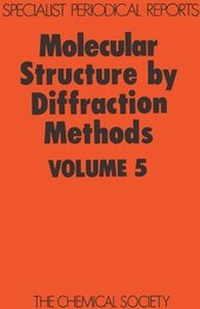
Molecular Structure by Diffraction Methods
Volume 5
1st Edition
Published on 31. October 2007
455 pages
978-1-84755-678-3 (ISBN)
Description

Specialist Periodical Reports provide systematic and detailed review coverage of progress in the major areas of chemical research. Written by experts in their specialist fields the series creates a unique service for the active research chemist, supplying regular critical in-depth accounts of progress in particular areas of chemistry. For over 80 years the Royal Society of Chemistry and its predecessor, the Chemical Society, have been publishing reports charting developments in chemistry, which originally took the form of Annual Reports. However, by 1967 the whole spectrum of chemistry could no longer be contained within one volume and the series Specialist Periodical Reports was born. The Annual Reports themselves still existed but were divided into two, and subsequently three, volumes covering Inorganic, Organic and Physical Chemistry. For more general coverage of the highlights in chemistry they remain a 'must'. Since that time the SPR series has altered according to the fluctuating degree of activity in various fields of chemistry. Some titles have remained unchanged, while others have altered their emphasis along with their titles; some have been combined under a new name whereas others have had to be discontinued. The current list of Specialist Periodical Reports can be seen on the inside flap of this volume.
More details
Series
Edition
1. Auflage
Language
English
Place of publication
Cambridge
United Kingdom
Target group
Professional and scholarly
ISBN-13
978-1-84755-678-3 (9781847556783)
DOI
10.1039/9781847556783
Copyright in bibliographic data and cover images is held by Nielsen Book Services Limited or by the publishers or by their respective licensors: all rights reserved.
Schweitzer Classification
Other editions
Additional editions
Book
01/1977
Royal Society of Chemistry
€398.50
Shipment within 3-4 weeks
Persons
Content
- Molecular Structure By Diffraction Methods
- Contents
- Part I Electron Diffraction
- Introduction to Part I
- Chapter 1 Electron Diffraction Determinations of Gas-phase Molecular Structures
- 1 Introduction
- 2 Main-group Inorganic Compounds
- Group III
- Group IV
- Group V
- Group VI
- Group VIII
- 3 Transition-metal Compounds
- 4 Organic Compounds
- Hydrocarbons
- Carbon-Nitrogen Compounds
- Carbon-Oxygen and Carbon-Sulphur Compounds
- Carbon-Halogen Compounds
- Chapter 2 Electron Diffraction Studies of Molecular Conformation
- 1 Recent Advances in Electron Diffraction Relevant to Conformational Analysis
- Temperature of the Gas Sample
- Error Limits and Data Analysis
- Supplementing Electron Diffraction Data with Force-field Information
- 2 Conformations of Acyclic Molecules
- Saturated Compounds
- Organic Compounds with a Single Internal Rotor
- Organic Compounds with Multiple Internal Rotors
- Inorganic Compounds
- Unsaturated Compounds
- Organic Compounds with One Double Bond
- Phenyl Compounds
- Acid Anhydrides, Acetylacetone, and Related Compounds
- Amides
- Conjugated Compounds
- Biphenyl and Related Compounds
- Miscellaneous Acyclic Compounds
- Ethers and Thioethers
- Acyclic Phosphite and Phosphate Esters
- Nitromethanes
- 3 Conformations of Cyclic Molecules
- Four-membered Ring Compounds
- Five-membered Ring Compounds
- Six-membered Ring Conformations
- Cyclohexane and Related Compounds
- Saturated Heteronuclear and Inorganic Six-membered Ring Compounds
- Unsaturated Six-membered Ring Compounds
- Seven- and Higher-membered Ring Compounds
- 4 Conformations of Sandwich Compounds and Cyclopentadienyldimethylaluminium
- Introduction to Parts II and III
- Part II Neutron Diffraction
- 1 Introduction
- 2 Hydrogen Bonding
- 3 Inorganic Compounds
- 4 Miscellaneous Structures
- 5 Organic Compounds
- Part III X-Ray Diffraction
- Chapter 1 Aromatic and Analogous Unsaturated Molecules
- 1 Introduction
- 2 Phenyl Derivatives
- 3 Polyphenyls and Condensed Aromatic Systems
- 4 Heterocyclic Compounds
- 5 Quinones and Coumarins
- 6 Phenothiazines and Related Compounds
- Chapter 2 Non-aromatic Hydrocarbons and Analogous Compounds
- 1 Derivatives and Analogues of the Simple Alkanes, Ylides, and Related Compounds
- 2 Cyclopropane and Cyclobutane Derivatives
- 3 Cyclopentyl Derivatives and Heterocyclic Analogues
- 4 Derivatives and Analogues of Cyclohexane and Similar Molecules
- 5 Polycyclic and Bridged-ring Systems
- 6 Seven-membered, Eight-membered, and Larger-ring Compounds
- Chapter 3 Natural Products and Related Compounds
- 1 Alkaloids and Amines
- 2 Amino Acids and Peptides
- 3 Nitrogen Heterocycles
- Porphyrins
- Flavins
- ß-Lactam and Thiazole Derivatives
- Pyrimidine Heterocycles
- Nucleosides and Nucleotides
- Metal Complexes of Nucleic Acid Fragments
- 4 sugars
- 5 Terpenoids
- Monoterpenoids
- Sesquiterpenoids
- Diterpenoids
- Seterterpenoids
- Triterpenoids
- 6 Steroids
- 7 Antibiotics and Miscellaneous Natural Products
- Chapter 4 The Structure of Globular Proteins and Nucleic Acids
- 1 Introduction
- 2 Principles of Protein Structure
- 3 X-Ray Cryoenzymology
- 4 Hydrolases
- 5 Synthetases
- 6 Transferases
- 7 Isomerases
- 8 Oxidoreductases
- 9 Electron-transport Proteins
- 10 Oxygen-binding Proteins
- 11 Hormones
- 12 Immunoglobulins
- 13 Virus Coat Proteins
- 14 Other Proteins
- 15 Transfer RNA
- Chapter 5 Scandium, Yttrium, Lanthanides, and Actinides
- 1 Scandium, Yttrium, and Lanthanides
- Inorganic Compounds
- Organometallic Complexes
- 2 Actinides
- Thorium
- Uranium
- Organometallic Complexes
- Chapter 6 Titanium, Zirconium, and Hafnium
- 1 Titanium
- Inorganic Compounds
- Organometallic Compounds
- 2 Zirconium and Hafnium
- Organometallic Compounds
- Inorganic Compounds
- Chapter 7 Vanadium, Niobium, and Tantalum
- 1 Vanadium
- Inorganic Compounds
- Organometallic Complexes
- 2 Niobium and Tantalum
- Inorganic Complexes
- Organometallic Compounds
- Chapter 8 Chromium, Molybdenum, and Tungsten
- 1 Chromium
- Inorganic Compounds
- Oxides
- Complexes
- Organometallic Compounds
- Carbonyl and Carbyne Complexes
- p-Complexes of Carbocyclic and Heterocyclic Ligands
- 2 Molybdenum and Tungsten
- Polyanions and Oxides
- Sulphides, Halides, Oxohalides, and Sulphurohalides
- Other Compounds containing Oxygen and/or Sulphur
- Other Complexes
- Organometallic Complexes
- Carbonyl Complexes
- s-Phenyl, Vinylidene, Isocyanide, Cyanide, and Carbyne Complexes
- p-Olefin and p-Allyl Complexes
- Complexes with Carbocyclic Ligands
- Chapter 9 Manganese, Technetium, and Rhenium
- 1 Manganese
- Inorganic Compounds
- Organometallic Compounds
- Carbonyls
- Complexes with Other One-carbon-donor Ligands and with Two-carbon-donor Ligands
- Complexes with Carbocyclic Ligands
- 2 Technetium and Rhenium
- Inorganic Compounds
- Oxides
- Complexes
- Organometallic Compounds
- Chapter 10 Iron, Ruthenium, and Osmium
- 1 Iron
- Organo-iron Compounds
- Mononuclear Species
- Polynuclear Species
- Mononuclear Co-ordination Complexes of Iron
- Polynuclear Co-ordination Complexes of Iron
- 2 Ruthenium and Osmium
- Organo-compounds
- Mononuclear Species
- Polynuclear Species
- Mononuclear Co-ordination Complexes of Ruthenium and Osmium
- Polynuclear Co-ordination Complexes of Ruthenium and Osmium
- Chapter 11 Cobalt, Rhodium, and Iridium
- 1 Introduction
- 2 Cobalt
- Complexes of Cobalt(I)
- Complexes of Cobalt(II)
- Four-co-ordinate Complexes
- Five-co-ordinate Complexes
- Six-co-ordinate Complexes
- Complexes of Cobalt(III)
- Organocobalt Complexes
- 3 Rhodium and Iridium
- Rhodium(I) and Iridium(I)
- Rhodium(III) and Iridium(III)
- Organometallic Compounds of Rhodium and Iridium
- Chapter 12 Nickel, Palladium, and Platinum
- 1 Introduction
- 2 Nickel
- Oxidation States less than (II)
- Complexes of Nickel(II)
- Four-co-ordinate Complexes
- Square-planar Complexes
- Five-co-ordinate Complexes
- Octahedral Complexes
- Higher Oxidation States
- Organonickel Complexes
- 3 Palladium and Platinum
- Oxidation States less than (II)
- Complexes of Palladium(II) and Platinum(II)
- Platinum(IV) Complexes
- Organometallic Complexes of Palladium and Platinum
- Chapter 13 Copper, Silver, and Gold
- 1 Introduction
- Carefully Designed Comparative Studies
- Structure-Property Correlations
- Structural Correlation (Reaction Pathways)
- The Cambridge Crystallographic Data File
- 2 Copper
- Copper(I) Complexes
- Polynuclear Complexes
- Phosphine Complexes
- Other Complexes
- Copper(II) Complexes
- Oxysalts
- Halide Complexes
- Non-chelate Complexes
- Oxygen Ligands
- Nitrogen Chelates
- Mixed Nitrogen and Oxygen Chelates
- Ligands with Delocalization
- Other Ligands
- Ligands of Biological Interest
- 3 Silver
- 4 Gold
- Chapter 14 Zinc, Cadmium, and Mercury
- 1 Zinc
- 2 Cadmium
- 3 Mercury
- Chapter 15 Boron, Aluminium, Gallium, Indium, and Thallium
- 1 Boron
- 2 Aluminium
- 3 Gallium
- 4 Indium
- 5 Thallium
- Chapter 16 Carbon, Silicon, Germanium, Tin, and Lead
- 1 Carbon
- 2 Silicon
- 3 Germanium
- 4 Tin
- 5 Lead
- Chapter 17 Nitrogen, Phosphorus, Arsenic, Antimony, and Bismuth
- 1 Nitrogen
- 2 Phosphorus
- 3 Arsenic
- 4 Antimony
- 5 Bismuth
- Chapter 18 Oxygen, Sulphur, Selenium, and Tellurium
- 1 Sulphur
- 2 Selenium and Tellurium
- Chapter 19 The Halogens
- Chapter 20 Lithium, Beryllium, Magnesium, and the Alkali-metal and Alkaline-earth Elements
- 1 Organometallic Compounds
- 2 Complexes
- Author Index
