

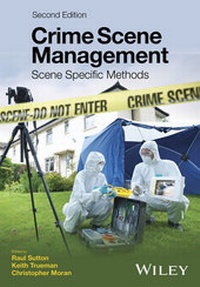
Crime Scene Management
Description

More details
Other editions
Additional editions
Persons
Raul Sutton, Head of School, Biology, Chemistry and Forensic Science, School of Applied Science, University of Wolverhampton, UK. Raul's research includes the way that we identify people from finger marks and palm marks left at scenes of crime, and also methods to improve the accuracy of post mortem interval determination using cartilage as a marker tissue.
Keith Trueman is a retired West Midlands Police officer
Christopher Moran, University of Wolverhampton, UK Chris has extensive practical experience in the management of forensic investigations into serious and complex crime. He was a Forensic Scene Manager with West Midlands Police, has been responsible for the training and mentoring of newly appointed forensic investigators and the provision of training to police investigative officers from trainee detectives to SIOs.
Content
Introduction and Use of this Text xi
List of Contributors xiv
About the Companion Website xv
PART I Crime Scene Principles 1
1 The Crime Scene Context 3
Raul Sutton
1.1 Introduction 3
1.2 What is a crime? 4
1.3 The nature of the UK legal system 6
1.4 The legal system in England and Wales 7
1.5 Other courts 9
1.6 The judicial system in Northern Ireland 9
1.7 The Scottish legal system 11
1.8 Judicial processes that deal with causes of death 12
1.9 What constitutes evidence? 14
1.10 The chain of events in evidence gathering 15
1.11 The relationship between evidence gatherers and analysts 19
1.12 Health and safety considerations 20
Suggested further reading 21
2 First Officer Attending 22
Keith Trueman and Christopher Moran
2.1 Introduction 22
2.2 Response to incident report 23
2.3 Personnel involved in the investigative process 24
2.4 Recording and recovery of scientific evidence 25
2.5 Initial considerations of the First Officer Attending (FOA) 25
2.6 Dealing with the victim 27
2.7 Dealing with witnesses 28
2.8 Dealing with suspects 29
2.9 Dealing with the crime scene(s) 29
2.10 Documentation 35
2.11 Dealing with violent crime 35
2.12 Summary and conclusion 36
3 The Role of the Crime Scene Investigator 38
Keith Trueman and Christopher Moran
3.1 Introduction 38
3.2 Training the CSI 39
3.3 The responsibilities of a CSI 40
3.4 Forensic evidence 42
3.5 Request for CSI attendance at crime scenes 46
3.6 Actions when attending the crime scene 47
3.7 Initial scene assessment (including health and safety considerations) 48
3.8 Planning evidence recovery 51
3.9 Recording the evidence 52
3.10 The elimination process 58
3.11 Details of evidence recovered 58
3.12 Integrity, continuity and contamination 59
3.13 Packaging materials 64
3.14 Conclusion 68
PART II Evidence-gathering Techniques 71
4 Police Photography, Video Recording,3D Laser Scanning 73
Chris Crowe and Christopher Moran
4.1 Introduction 73
4.2 General guidelines 74
4.3 Equipment 75
4.4 Exposure 76
4.5 Image quality/size 80
4.6 Depth of field 81
4.7 White balance 83
4.8 Image data 83
4.9 Flash photography 84
4.10 Room interiors 85
4.11 Vehicles 85
4.12 Evidential items 85
4.13 Recording injuries to the person 86
4.14 Night photography 88
4.15 Footwear impressions 89
4.16 Fingerprints 90
4.17 Recording video evidence at crime scenes 92
4.18 The use of digital images in court 94
4.19 3D laser scanning of scenes 95
Suggested further reading 96
5 Fingerprints 97
David Charlton
5.1 Introduction 97
5.2 The nature of friction ridge skin 99
5.3 The structure of friction ridge skin 100
5.4 Friction ridge growth 100
5.5 Principles of friction ridge identification 102
5.6 Comparison methodology 103
5.7 Chemical composition of latent prints 105
5.8 Identification of common locations for prints 107
5.9 The use of powdering techniques to enhance latent finger marks 109
5.10 Chemical development techniques 112
5.11 Laboratory and scene applications 113
5.12 Fingerprints in bodily fluids 115
5.13 Scenes of fire 118
5.14 Optical methods to reveal fingerprints (laser and other light sources) 119
5.15 New and emerging techniques 122
5.16 Remote transmission 122
5.17 Chapter summary 123
Acknowledgements 125
Selected further reading 126
6 DNA-rich Evidence 128
Terry Bartlett and Sara Short
6.1 Introduction and historical background 128
6.2 The structure and properties of DNA 129
6.3 DNA analysis 130
6.4 Types of DNA testing 130
6.5 Biological evidence 134
6.6 Procedures for collection of biological evidence: general considerations 136
6.7 Limitations of DNA evidence 147
6.8 Elimination and reference samples 148
6.9 Summary 148
References 149
7 Blood Pattern Analysis 151
Raul Sutton and Terry Bartlett
7.1 Introduction 151
7.2 History of the development of blood spatter as a scientific discipline 152
7.3 Composition of blood 153
7.4 Physical properties of blood 154
7.5 Causes of bleeding 156
7.6 Blood dynamics 157
7.7 Drop-surface impact and droplet pattern 157
7.8 Determination of area of origin of spatter 161
7.9 Cast-off patterns 162
7.10 Arterial damage patterns 163
7.11 Non-spatter patterns 166
7.12 Physiologically altered bloodstains 169
7.13 Volume bloodstains 173
7.14 Composite patterns 175
7.15 Investigative transfer and contamination issues 176
7.16 Recording traces 176
7.17 Summary 178
Suggested further reading 178
8 Physical Evidence 180
Craig Williams
8.1 Introduction 180
8.2 Tool marks 180
8.3 Clothing 182
8.4 Fibres 183
8.5 Footwear impressions 186
8.6 Glass fragments 188
8.7 Glass fragmentation 190
8.8 Soils 192
8.9 Firearms 193
8.10 Scene recovery of firearms 197
8.11 Gunshot residues (GSR) 199
8.12 Drugs of abuse (DOA) 200
8.13 The crime scene characteristics of various DOA 202
8.14 Presumptive tests for drugs 203
8.15 Amateur explosives 206
8.16 Summary 206
Suggested further reading 207
PART III Specialised Scenes and Report Writing 209
9 Fire Scene Examination 211
Chris Perry and Mark McCabe
9.1 Introduction 211
9.2 The nature of fire 212
9.3 The oxygen demand of fuels 214
9.4 Flame and fire classifications; fire development 217
9.5 Types of evidence specific to fire scenes 219
9.6 Locating the origin of the fire 220
9.7 Fire cause determination and evidence-gathering methods 223
9.8 Methods for ascertaining whether a crime has been committed 226
9.9 Health and safety considerations 228
9.10 Summary 229
Suggested further reading 230
10 Examination of Recovered Stolen Motor Vehicles 231
Keith Trueman
10.1 Introduction 231
10.2 What is a motor vehicle? 233
10.3 The definition of an auto crime 233
10.4 Auto crime scene examinations 237
10.5 Requests to attend an auto crime scene 238
10.6 The examination process 241
10.7 Conclusion 251
11 Managing Complex Scenes and Multiple or Mass Fatality Scenes 252
Christopher Moran and Derek Forest
11.1 Introduction 252
11.2 Self-briefing 254
11.3 Communication 255
11.4 Establishing priorities 255
11.5 Avoidance of contamination 256
11.6 The forensic strategy 257
11.7 'Defence' case review meeting 259
11.8 Incident debrief 259
11.9 Introduction to mass fatality incidents 260
11.10 The range and nature of mass fatality incidents 261
11.11 The type of investigation conducted 261
11.12 Sequence of events in managing disaster victim identification scenes 262
11.13 Recovery of mortal remains 264
Suggested further reading 266
12 Preparing Reports and Statements 267
Keith Trueman
12.1 Introduction 267
12.2 Documentation at the crime scene 268
12.3 Photography 269
12.4 Plans, sketches and diagrams 269
12.5 The exhibit label 271
12.6 Handling the evidence 275
12.7 Statements of evidence 278
12.8 Criminal Justice Act 1967, section 9 278
12.9 Crime scene examination statements 279
12.10 Conclusion 281
13 Quality Assurance in Crime Scene Investigation 283
Christopher Moran
13.1 Introduction 283
13.2 Informal aspects of quality assurance 284
13.3 The development of formal quality assurance 284
13.4 The role of the Forensic Science Regulator 285
13.5 Responsibility for measuring quality assurance 286
13.6 The accreditation process 287
13.7 Organisational requirements for accreditation 288
13.8 Personnel requirements for accreditation 288
13.9 Resource requirements for accreditation 289
13.10 Process requirements for accreditation 289
13.11 Management requirements for accreditation 290
13.12 Maintaining accreditation 290
Suggested further reading 292
Appendices 293
Index 303
1
The Crime Scene Context
Raul Sutton
1.1 Introduction
The management of the process of scene recording and evidence recovery has in recent years been through some significant changes. The introduction of new technologies such as digital cameras, database storage systems for scene information management, automated three-dimensional scene reconstruction software, digital fingermark recovery systems, and real-time methods for trace analysis, amongst others, are changing the face of scene management. The development cost of introducing such equipment is high and the need to ensure the continuity and integrity of items gathered at the scene mean that these methodologies are being introduced gradually for use in major crimes. However, after the recovery of development costs, the cost of such equipment purchase will inevitably drop, making their introduction to the management of volume casework a realistic possibility.
In addition, there have been rapid changes to the way in which Crime Scene Investigators (CSIs) are trained in the UK. There has been a growth in forensic science courses in the United Kingdom. A proportion of these graduates are looking to gain employment within the area of crime scene investigation. Such graduates, if properly educated, will inevitably add scientific rigour and an advanced level of understanding to the crime scene aspect of forensic science. The Chartered Society of Forensic Sciences has acknowledged this by incorporating crime scene investigation into the criteria for its accreditation process.
There is a need for other stakeholders who may have to attend scenes of crime to be aware of the role and remit of scene processing, to understand the nature and types of evidence that can be found at scenes of crime and to take appropriate measures to preserve and protect such evidence. These may include persons such as paramedical personnel as well as serving police officers. Within the English legal system the increased role of forensic analysis in the successful prosecution of crimes has suggested that legal agencies need to be aware of the entire forensic process of which crime scenes form a part.
1.2 What is a crime?
Crimes by their definition are those acts which are deemed contrary to the criminal law governing the country of concern. Nation states operate the criminal legal system in different ways, but such systems are underpinned by a philosophical framework. In European legislation the articles of the European Convention of Human Rights 1953 define the overarching philosophy. In summary, this contains protection for the following:
- Article 1: Protection of property
- Article 2: Right to life
- Article 3: Prohibition of torture, inhumane or degrading treatment
- Article 5: The right to liberty and security of person
- Article 6: The right to a fair hearing or trial
- Article 8: The right to respect for private and family life
- Article 10: Freedom of expression.
These are embedded in various forms within the EU (European Union) member states by means of legislation, and the legal framework within which law enforcement takes place must meet these obligations. The UK has embedded this Convention by means of certain Acts of Parliament, the latest of which is the Human Rights Act 1998. The national bodies responsible for implementing legislation have qualified some of these rights by reference to the general wellbeing of society; thus the rights may be curtailed if any of the following conditions are met:
- if the action is prohibited by law and
- necessary actions within a democracy and
- for any of the following reasons
- - national security
- - territorial integrity
- - public safety
- - preventing disorder or crime
- - protecting health
- - protecting morals
- - protecting the rights of others.
For reasons concerning the strategic handling of offences that are deemed to be criminal acts within the UK, crimes are normally categorised into two types: volume and major. Crimes that are often categorised as major by a police service/force/constabulary, according to their seriousness, include:
- murder (common law)
- manslaughter (common law)
- infanticide (Infanticide Act 1938)
- rape (Sexual Offences Act 1956)
- serious wounding (Offences Against the Person Act 1861)
- armed robbery (Theft Act 1968)
- aggravated burglary (Theft Act 1968)
- kidnapping (common law)
- terrorist offences (Prevention of Terrorism Act 1989)
- any offence deemed 'major' by its significant impact on society (e.g. contamination of goods).
Many of these types of crime have a high media profile and so the treatment of the investigation assumes a priority and more time, effort and financial resources will go into investigating them.
Minor crimes make up the majority of police service/force/constabulary work and encompass anything not deemed to be a major crime. A small range of these criminal offences are called volume crime. The definition of volume crime includes:
- street robbery
- burglary - dwelling
- burglary - non-dwelling
- theft (including shoplifting)
- vehicle crime - theft of
- vehicle crime - theft from
- criminal damage
- minor drugs offences that are linked with acquisitive crimes
as defined by the Association of Chief Police Officers (ACPO) (Garvin, 2002). At the end of 2014 ACPO were reformed into the National Police Chiefs' Council (NPCC). The intensity with which minor and volume crimes are investigated will vary from force to force depending on available resources, initiatives etc. This situation, whilst not ideal, represents the best available use of resources within a police service/force/constabulary.
Self-assessed questions
- 1.1
- (a) Describe what makes burglary a crime in the United Kingdom.
- (b) Which article(s) of the European Convention on Human Rights does burglary infringe?
- 1.2 Describe the major difference between volume and major crimes.
1.3 The nature of the UK legal system
The legal system in the United Kingdom is based upon common law and statute. Within the United Kingdom there are three separate but similar jurisdictions: England and Wales; Scotland; and Northern Ireland. Whilst the laws are similar in each jurisdiction, they are not identical. The system is a balance between three interacting organs of the state, the executive (government), the legislature (parliament) and the judiciary (courts). In ideal circumstances these three organs of the state should be independent, but in the United Kingdom the functions overlap (particularly the executive). In Western-style democracies, the role of the organs of state is to maintain the rule of law. In many states these rules are underpinned by a series of articles, often called a constitution, which are seen to be the basis for the operation of a civilised society. The United States of America is an example of a nation state with just such a constitution. The United Kingdom has no such underpinning articles of state and the rule of law is defined by the enacting of the wishes of the elected representatives of the people. Whilst there is no official constitution in the United Kingdom, it can be argued that the precedent of Acts of Parliament, legislative assemblies such as exist in Wales, Northern Ireland and Scotland, and judicial rulings, have bestowed a pseudo-constitution in the United Kingdom.
Laws are put into practice that will affect the way society regards itself. Broadly these laws can be broken down into two types, civil and criminal. Individuals can choose to flout the given laws (by not paying bills, for example) and may face civil proceedings (in order to recover monies due etc.) or criminal prosecution (in the case of grievous bodily harm, for example) as a consequence. The crime scene forms part of the criminal side of this process.
1.4 The legal system in England and Wales
1.4.1 Her Majesty's Courts and Tribunals Service
The operation of all the courts within England and Wales was brought under one overarching organisation, Her Majesty's Courts Service (HMCS), on 1 April 2005. In 2011 this organisation was merged with the Tribunals Service to form Her Majesty's Courts and Tribunals Service (HMCTS). This organisation includes the Magistrates' Courts Service and the Courts Service. The HMCTS is an executive agency of the Department for Constitutional Affairs (DCA); it has stated: 'Our purpose is to deliver justice effectively and efficiently to the public. We are responsible for the administration of the civil, family and criminal courts in England and Wales.'
1.4.2 The Crown Prosecution Service
The Crown Prosecution Service (CPS) is a government agency that decides whether criminal investigations, which have been started by the police, should progress to court. If a case is progressed, the CPS prepares and conducts prosecution court proceedings, provides prosecution barristers and arranges for prosecution witnesses to attend court.
1.4.3 The judiciary
The judiciary sit within a system that is the result of several centuries of development. There are a tiered series of courts to...
