

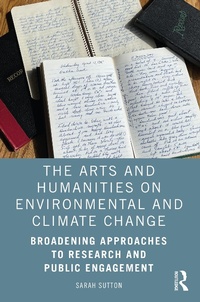
The Arts and Humanities on Environmental and Climate Change
Broadening Approaches to Research and Public Engagement
1st Edition
Published on 18. October 2022
120 pages
978-1-000-73733-2 (ISBN)
Description

The Arts and Humanities on Environmental and Climate Change examines how cultural institutions and their collections can support a goal shared with the scientific community: creating a climate-literate public that engages with environmental issues and climate change in an informed way.
When researchers, curators, and educators use the arts and humanities to frame discussions about environmental and climate change, they can engage a far wider public in learning, conversation, and action than science can alone. Demonstrating that archival and object-based resources can act as vital evidence for change, Sutton shows how the historical record, paired with contemporary reality, can create more personal connections to what many consider a remote experience: the changing climate. Providing valuable examples of museum collections used in discussions of environmental and climate change, the book shares how historic images and landscape paintings demonstrate change over time; and how documentary evidence in the form of archaeological reports, ships logs, Henry David Thoreau's journals, and local reports of pond hockey conditions are being used to render climate data more accessible. Images, personal records, and professional documents have critical roles as boundary objects and proxy data. These climate resources, Sutton argues, are valuable because they make climate change personal and attract a public less interested in a scientific approach. This approach is underused by museums and their research allies for public engagement and for building institutional relevancy.
The Arts and Humanities on Environmental and Climate Change will be most interesting to readers looking for ways to broaden engagement with environmental and climate issues. The ideas shared here should also act as inspiration for a broad spectrum of practitioners, particularly those writing, designing, and curating public engagement materials in museums, for wider research, and for the media.
When researchers, curators, and educators use the arts and humanities to frame discussions about environmental and climate change, they can engage a far wider public in learning, conversation, and action than science can alone. Demonstrating that archival and object-based resources can act as vital evidence for change, Sutton shows how the historical record, paired with contemporary reality, can create more personal connections to what many consider a remote experience: the changing climate. Providing valuable examples of museum collections used in discussions of environmental and climate change, the book shares how historic images and landscape paintings demonstrate change over time; and how documentary evidence in the form of archaeological reports, ships logs, Henry David Thoreau's journals, and local reports of pond hockey conditions are being used to render climate data more accessible. Images, personal records, and professional documents have critical roles as boundary objects and proxy data. These climate resources, Sutton argues, are valuable because they make climate change personal and attract a public less interested in a scientific approach. This approach is underused by museums and their research allies for public engagement and for building institutional relevancy.
The Arts and Humanities on Environmental and Climate Change will be most interesting to readers looking for ways to broaden engagement with environmental and climate issues. The ideas shared here should also act as inspiration for a broad spectrum of practitioners, particularly those writing, designing, and curating public engagement materials in museums, for wider research, and for the media.
More details
Edition
1. Auflage
Language
English
Place of publication
London
United Kingdom
Publishing group
Taylor & Francis Ltd
Target group
College/higher education
Professional and scholarly
Illustrations
10 Halftones, black and white; 10 Illustrations, black and white
ISBN-13
978-1-000-73733-2 (9781000737332)
Copyright in bibliographic data and cover images is held by Nielsen Book Services Limited or by the publishers or by their respective licensors: all rights reserved.
Schweitzer Classification
Other editions
Additional editions
Sarah Sutton
The Arts and Humanities on Environmental and Climate Change
Broadening Approaches to Research and Public Engagement
Book
10/2022
1st Edition
Routledge
€59.40
Shipment within 15-20 days
Sarah Sutton
The Arts and Humanities on Environmental and Climate Change
Broadening Approaches to Research and Public Engagement
Book
10/2022
1st Edition
Routledge
€185.30
Shipment within 15-20 days
Person
Sarah Sutton is a long-time museum professional with significant expertise in environmental and climate issues. She is the CEO of Environment & Culture Partners, a nonprofit organization that accelerates change in the global cultural sector by designing and leading cooperative projects in climate action for global benefit. Sutton is also the author of Environment Sustainability at Historic Houses and Museums, and co-author of two editions (as Sarah Brophy) of The Green Museum, a Primer on Environmental Practice.
Content
Introduction: Museums' Humanities Resources as Allies for Science; Chapter One: How Collections Materials Can Document Change Over Time; Chapter Two: How Humanities Materials Are Proxies for Documenting Climate Change; Chapter Three: Basic Documentary Proxy Materials in Museums; Chapter Four: Untapped Potential for Public Engagement; Chapter Five: The Value of Cultural Heritage to Cultural, Climate Diplomacy; Chapter Six: Next Steps for Documentary Climate Proxy Data.
