

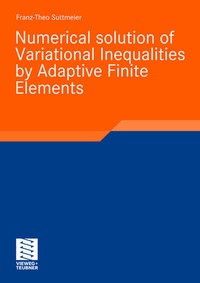
Numerical solution of Variational Inequalities by Adaptive Finite Elements
1st Edition
Published on 12. March 2009
X, 161 pages
978-3-8348-9546-2 (ISBN)
Description

This work describes a general approach to a posteriori error estimation and adaptive mesh design for ?nite element models where the solution is subjected to inequality constraints. This is an extension to variational inequalities of the so-called Dual-Weighted-Residual method (DWR method) which is based on a variational formulation of the problem and uses global duality arguments for deriving weighted a posteriori error estimates with respect to arbitrary functionals of the error. In these estimates local residuals of the computed solution are multiplied by sensitivity factors which are obtained from a - merically computed dual solution. The resulting local error indicators are used in a feed-back process for generating economical meshes which are tailored - cording to the particular goal of the computation. This method is developed here for several model problems. Based on these examples, a general concept is proposed, which provides a systematic way of adaptive error control for problems stated in form of variational inequalities. F¨ ur Alexandra, Katharina und Merle Contents 1 Introduction 1 2 Models in elasto-plasticity 13 2. 1 Governing equations . . . . . . . . . . . . . . . . . . . . . . . . 14 2. 2 Examples . . . . . . . . . . . . . . . . . . . . . . . . . . . . . . 20 3 The dual-weighted-residual method 23 3. 1 A model situation in plasticity . . . . . . . . . . . . . . . . . . 24 3. 2 A posteriori error estimate . . . . . . . . . . . . . . . . . . . . . 25 3. 3 Evaluation of a posteriori error bounds . . . . . . . . . . . . . . 26 3. 4 Strategies for mesh adaptation . . . . . . . . . . . . . . . . . . 28 3. 5 Example . . . . . . . . . . . . . . . . . . . . . . . . . . . . . . . 30 4 Extensions to stabilised schemes 33 4. 1 Discretisation for themembrane-problem . . . . . . . . . . . . 35 4. 2 A posteriori error analysis . . . . . . . . . . . . . . . . . . . . . 37 4. 3 Numerical tests . . . . . . . . . . . . . . . . . . . . . . . . . . .
More details
Other editions
Additional editions
Franz-Theo Suttmeier
Numerical solution of Variational Inequalities by Adaptive Finite Elements
Book
08/2008
1st Edition
Vieweg+Teubner Verlag
€53.49
Shipment within 7-9 days
Person
Dr. Franz-Theo Suttmeier is a professor of Scientific Computing at the Institute of Applied Analysis and Numerics at the University of Siegen.
Content
Models in elasto-plasticity.- The dual-weighted-residual method.- Extensions to stabilised schemes.- Obstacle problem.- Signorini's problem.- Strang's problem.- General concept.- Lagrangian formalism.- Obstacle problem revisited.- Variational inequalities of second kind.- Time-dependent problems.- Applications.- Iterative Algorithms.- Conclusion.
Algorithmic Aspects (S. 143-144)
The idea of the finite element method is quite universal since problems with di.erent characteristic properties can be treated. As examples we mention the .elds of reactive .ow, radiative transfer and continuum mechanics. Therefore an approach to finite element code should re.ect this universality. Most parts of the implementation of this method can be done problem independent. So it is advisable to use a program library, which for example supports the very complex task of grid-handling required for each special application. In 1991 Guido Kanschat and the author started at Bonn with the development of such library, namely DEAL (Differential Equation Analysis Library) (Becker, Kanschat &, Suttmeier [21]).
In Kanschat [42] there are mentioned four development aims which are important in a complex software project, namely computing speed, memory requirements, veriflability of code and .exibility. We discuss the aspect of flexibility of our library at the example of the representation of a linear operator. DEAL ofiers the possibility to balance computing time and memory requirements with respect to the problem under consideration. Due to our idea to represent an operator independent of boundary conditions and hanging nodes, these points have to be handled separately. At the end of this chapter we demonstrate our method of filtering techniques to take these points into account.
The finite element package As mentioned above the universality is an important point in the finite element method. This means, .rst we look for properties all problems have in common. As an example we remark, that one main part of a finite element program consists of the geometric description of the domain and its discretisation in form of a triangulation. DEAL uses the object oriented concept for the gridhandling.
A triangulation is regarded as an object, which consists of cells. These cells itself are described by their vertices. We use a straightforward approach to organise the re.nement process. In detail this is explained in Kanschat [42]. A triangle, for example, is divided into four congruent ones. The hierarchy is stored, i.e. all cells know their father and children. This enables us to do coarsening, which is a very important feature, especially in time dependent problems.
As an example we refer to the sequence of grids at the end of Chapter 13. The moving transition zone between the elastic and the plastic part of the solution is resolved by the adaptive algorithm. The complex problem of implementation of a triangulation is a good example to demonstrate the advantages of our approach. In a natural way the whole task is split into several small steps. These single steps are treated separately and therefore it is easy to improve the code locally. Furthermore, if it is necessary to change a concept we can reuse the single parts and we do not have to do changes within the whole library.
The idea of the finite element method is quite universal since problems with di.erent characteristic properties can be treated. As examples we mention the .elds of reactive .ow, radiative transfer and continuum mechanics. Therefore an approach to finite element code should re.ect this universality. Most parts of the implementation of this method can be done problem independent. So it is advisable to use a program library, which for example supports the very complex task of grid-handling required for each special application. In 1991 Guido Kanschat and the author started at Bonn with the development of such library, namely DEAL (Differential Equation Analysis Library) (Becker, Kanschat &, Suttmeier [21]).
In Kanschat [42] there are mentioned four development aims which are important in a complex software project, namely computing speed, memory requirements, veriflability of code and .exibility. We discuss the aspect of flexibility of our library at the example of the representation of a linear operator. DEAL ofiers the possibility to balance computing time and memory requirements with respect to the problem under consideration. Due to our idea to represent an operator independent of boundary conditions and hanging nodes, these points have to be handled separately. At the end of this chapter we demonstrate our method of filtering techniques to take these points into account.
The finite element package As mentioned above the universality is an important point in the finite element method. This means, .rst we look for properties all problems have in common. As an example we remark, that one main part of a finite element program consists of the geometric description of the domain and its discretisation in form of a triangulation. DEAL uses the object oriented concept for the gridhandling.
A triangulation is regarded as an object, which consists of cells. These cells itself are described by their vertices. We use a straightforward approach to organise the re.nement process. In detail this is explained in Kanschat [42]. A triangle, for example, is divided into four congruent ones. The hierarchy is stored, i.e. all cells know their father and children. This enables us to do coarsening, which is a very important feature, especially in time dependent problems.
As an example we refer to the sequence of grids at the end of Chapter 13. The moving transition zone between the elastic and the plastic part of the solution is resolved by the adaptive algorithm. The complex problem of implementation of a triangulation is a good example to demonstrate the advantages of our approach. In a natural way the whole task is split into several small steps. These single steps are treated separately and therefore it is easy to improve the code locally. Furthermore, if it is necessary to change a concept we can reuse the single parts and we do not have to do changes within the whole library.
