

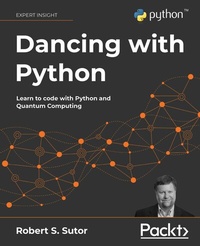
Dancing with Python
Learn to code with Python and Quantum Computing
1st Edition
Published on 3. June 2024
744 pages
978-1-80107-162-8 (ISBN)
Description

Develop skills in Python and Quantum Computing by implementing exciting algorithms, mathematical functions, classical searching, data analysis, plotting data, machine learning techniques, and quantum circuits.Key Features - Create quantum circuits and algorithms using Qiskit and run them on quantum computing hardware and simulators
- Learn the Pythonic way to write elegant and efficient code
- Delve into Python's advanced features, including machine learning, analyzing data, and searching
Book DescriptionDancing with Python helps you learn Python and quantum computing in a practical way. It will help you explore how to work with numbers, strings, collections, iterators, and files. The book goes beyond functions and classes and teaches you to use Python and Qiskit to create gates and circuits for classical and quantum computing. Learn how quantum extends traditional techniques using the Grover Search Algorithm and the code that implements it. Dive into some advanced and widely used applications of Python and revisit strings with more sophisticated tools, such as regular expressions and basic natural language processing (NLP). The final chapters introduce you to data analysis, visualizations, and supervised and unsupervised machine learning. By the end of the book, you will be proficient in programming the latest and most powerful quantum computers, the Pythonic way.What you will learn - Explore different quantum gates and build quantum circuits with Qiskit and Python
- Write succinct code the Pythonic way using magic methods, iterators, and generators
- Analyze data, build basic machine learning models, and plot the results
- Search for information using the quantum Grover Search Algorithm
- Optimize and test your code to run efficiently
Who this book is forThe book will help you get started with coding for Python and Quantum Computing. Basic familiarity with algebra, geometry, trigonometry, and logarithms is required as the book does not cover the detailed mathematics and theory of quantum computing. You can check out the author's Dancing with Qubits book, also published by Packt, for an approachable and comprehensive introduction to quantum computing.
- Learn the Pythonic way to write elegant and efficient code
- Delve into Python's advanced features, including machine learning, analyzing data, and searching
Book DescriptionDancing with Python helps you learn Python and quantum computing in a practical way. It will help you explore how to work with numbers, strings, collections, iterators, and files. The book goes beyond functions and classes and teaches you to use Python and Qiskit to create gates and circuits for classical and quantum computing. Learn how quantum extends traditional techniques using the Grover Search Algorithm and the code that implements it. Dive into some advanced and widely used applications of Python and revisit strings with more sophisticated tools, such as regular expressions and basic natural language processing (NLP). The final chapters introduce you to data analysis, visualizations, and supervised and unsupervised machine learning. By the end of the book, you will be proficient in programming the latest and most powerful quantum computers, the Pythonic way.What you will learn - Explore different quantum gates and build quantum circuits with Qiskit and Python
- Write succinct code the Pythonic way using magic methods, iterators, and generators
- Analyze data, build basic machine learning models, and plot the results
- Search for information using the quantum Grover Search Algorithm
- Optimize and test your code to run efficiently
Who this book is forThe book will help you get started with coding for Python and Quantum Computing. Basic familiarity with algebra, geometry, trigonometry, and logarithms is required as the book does not cover the detailed mathematics and theory of quantum computing. You can check out the author's Dancing with Qubits book, also published by Packt, for an approachable and comprehensive introduction to quantum computing.
All prices
More details
Other editions
Additional editions
Book
08/2021
Packt Publishing
€59.70
Shipment within 3-4 weeks
Person
Sutor Robert S. :
Robert S. Sutor has been a technical leader and executive in the IT industry for over 40 years. More than two decades of that were spent in IBM Research in Yorktown Heights, New York USA. During his time there, he worked on and led efforts in symbolic mathematical computation, mathematical programming languages, optimization, AI, blockchain, and quantum computing. He is the author of Dancing with Qubits: How quantum computing works and how it can change the world and Dancing with Python: Learn Python software development from scratch and get started with quantum computing, also with Packt. He is the published co-author of several research papers and the book Axiom: The Scientific Computation System with the late Richard D. Jenks. Sutor was an IBM executive on the software side of the business in areas including Java web application servers, emerging industry standards, software on Linux, mobile, and open source. He was the Vice President of Corporate Development and, later, Chief Quantum Advocate, at Infleqtion, a quantum computing and quantum sensing company based in Boulder, Colorado USA. He is currently an Adjunct Professor in the Department of Computer Science and Engineering at the University at Buffalo, New York, USA. He is a theoretical mathematician by training, has a Ph.D. from Princeton University, and an undergraduate degree from Harvard College. He started coding when he was 15 and has used most of the programming languages that have come along.
Robert S. Sutor has been a technical leader and executive in the IT industry for over 40 years. More than two decades of that were spent in IBM Research in Yorktown Heights, New York USA. During his time there, he worked on and led efforts in symbolic mathematical computation, mathematical programming languages, optimization, AI, blockchain, and quantum computing. He is the author of Dancing with Qubits: How quantum computing works and how it can change the world and Dancing with Python: Learn Python software development from scratch and get started with quantum computing, also with Packt. He is the published co-author of several research papers and the book Axiom: The Scientific Computation System with the late Richard D. Jenks. Sutor was an IBM executive on the software side of the business in areas including Java web application servers, emerging industry standards, software on Linux, mobile, and open source. He was the Vice President of Corporate Development and, later, Chief Quantum Advocate, at Infleqtion, a quantum computing and quantum sensing company based in Boulder, Colorado USA. He is currently an Adjunct Professor in the Department of Computer Science and Engineering at the University at Buffalo, New York, USA. He is a theoretical mathematician by training, has a Ph.D. from Princeton University, and an undergraduate degree from Harvard College. He started coding when he was 15 and has used most of the programming languages that have come along.
Content
Table of Contents - Doing The Things That Coders Do
- Working with Expressions
- Collecting Things Together
- Stringing You Along
- Computing and Calculating
- Defining and Using Functions
- Organizing Objects into Classes
- Working with Files
- Understanding Gates and Circuits
- Optimizing and Testing Your Code
- Searching for the Quantum Improvement
- Searching and Changing Text
- Creating Plots and Charts
- Analyzing Data
- Learning Briefly
- Appendix A Tools
- Appendix B. Staying Current
- Appendix C The Complete UniPoly Class
- Appendix D The Complete Guitar Class Hierarchy
- Appendix E. Notices
- Appendix F. Production Notes
- Working with Expressions
- Collecting Things Together
- Stringing You Along
- Computing and Calculating
- Defining and Using Functions
- Organizing Objects into Classes
- Working with Files
- Understanding Gates and Circuits
- Optimizing and Testing Your Code
- Searching for the Quantum Improvement
- Searching and Changing Text
- Creating Plots and Charts
- Analyzing Data
- Learning Briefly
- Appendix A Tools
- Appendix B. Staying Current
- Appendix C The Complete UniPoly Class
- Appendix D The Complete Guitar Class Hierarchy
- Appendix E. Notices
- Appendix F. Production Notes
