

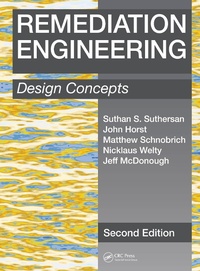
Remediation Engineering
Design Concepts, Second Edition
2nd Edition
Published on 25. November 2016
627 pages
978-1-4987-7336-2 (ISBN)
Description

"This second edition of Remediation Engineering will continue to be the seminal handbook that regulators must have on-hand to address any of the remediation issues they are grappling with daily. The book is wide-ranging, but specific enough to address any environmental remediation challenge."
-Patricia Reyes, Interstate Technology Regulatory Council, Washington, DC, USA
"This book offers the researcher, teacher, practitioner, student, and regulator with state-of-the-art advances in conducting site investigations and remediation for common and emerging contaminants. It is revolutionary in its approach to conducting subsurface investigation, which greatly influences a successful and appropriate response in assessing and addressing environmental risk. This book is a giant leap forward in understanding how contaminates behave and how to reduce risk to acceptable levels in the natural world."
-Daniel T. Rogers, Amsted Industries Incorporated, Chicago, Illinois, USA
"This text is a superb reference and a good tool for learning about state-of-the-art techniques in remediation of soil and groundwater. [It] will become a ready reference at many companies as the engineering community creates increased value from remediation efforts around the world."
-John Waites, AVX Corporation, Fountain Inn, South Carolina, USA
Remediation Engineering was first published in 1996 and quickly became the go-to reference for a relatively young industry, offering the first comprehensive look at the state-of-the-science in treatment technologies of the time and the contaminants they applied to. This fully updated Second Edition will capture the fundamental advancements that have taken place during the last two decades within all the subdisciplines that form the foundation of the remediation engineering platform. It covers the entire spectrum of current technologies that are employed in the industry and also discusses future trends and how practitioners should anticipate and adapt to those needs.
Features:
Shares the latest paradigms in remediation design approach and contaminant hydrogeology
Presents the landscape of new and emerging contaminants
Details the current state of the practice for both conventional technologies, such as sparging and venting
Examines newer technologies such as dynamic groundwater recirculation and injection-based remedies to address both organic and inorganic contaminants.
Describes the advances in site characterization concepts such as smart investigations and digital conceptual site models.
Includes all-new color photographs and figures.
-Patricia Reyes, Interstate Technology Regulatory Council, Washington, DC, USA
"This book offers the researcher, teacher, practitioner, student, and regulator with state-of-the-art advances in conducting site investigations and remediation for common and emerging contaminants. It is revolutionary in its approach to conducting subsurface investigation, which greatly influences a successful and appropriate response in assessing and addressing environmental risk. This book is a giant leap forward in understanding how contaminates behave and how to reduce risk to acceptable levels in the natural world."
-Daniel T. Rogers, Amsted Industries Incorporated, Chicago, Illinois, USA
"This text is a superb reference and a good tool for learning about state-of-the-art techniques in remediation of soil and groundwater. [It] will become a ready reference at many companies as the engineering community creates increased value from remediation efforts around the world."
-John Waites, AVX Corporation, Fountain Inn, South Carolina, USA
Remediation Engineering was first published in 1996 and quickly became the go-to reference for a relatively young industry, offering the first comprehensive look at the state-of-the-science in treatment technologies of the time and the contaminants they applied to. This fully updated Second Edition will capture the fundamental advancements that have taken place during the last two decades within all the subdisciplines that form the foundation of the remediation engineering platform. It covers the entire spectrum of current technologies that are employed in the industry and also discusses future trends and how practitioners should anticipate and adapt to those needs.
Features:
Shares the latest paradigms in remediation design approach and contaminant hydrogeology
Presents the landscape of new and emerging contaminants
Details the current state of the practice for both conventional technologies, such as sparging and venting
Examines newer technologies such as dynamic groundwater recirculation and injection-based remedies to address both organic and inorganic contaminants.
Describes the advances in site characterization concepts such as smart investigations and digital conceptual site models.
Includes all-new color photographs and figures.
Reviews / Votes
"This 2nd edition of Remediation Engineering will continue to be the seminal handbook that regulators must have on-hand to address any of the remediation issues they are grappling with daily. The book is wide-ranging, but specific enough to address any environmental remediation challenge."-Patricia Reyes, Interstate Technology Regulatory Council, Washington, D.C., USA
"This book offers the researcher, teacher, practitioner, student and regulator with state-of-the-art advances in conducting site investigations and remediation for common and emerging contaminants. It is revolutionary in its approach to conducting subsurface investigation, which greatly influences a successful and appropriate response in assessing and addressing environmental risk. This book is a giant leap forward in understanding how contaminates behave and how to reduce risk to acceptable levels in the natural world."
-Daniel T. Rogers, Amsted Industries Incorporated, Chicago, Illinois, USA
"This text is a superb reference AND a good tool for learning about state of the art techniques in remediation of soil and groundwater. Excellent explanations of some complex topics. This text will become a ready reference at many companies as the engineering community creates increased value from remediation efforts around the world."
-John Waites, AVX Corporation, Fountain Inn, South Carolina, USA
"Remediation Engineering: Design Concepts, Second Edition is a detailed, many-faceted, and extremely useful update of the classic first edition of this book that was released over twenty years ago. The book is a tour-de-force that summarizes the entire remediation field in 600 pages laden with figures, tables, photos, detailed design information, and key remediation knowledge. The chapters are heavily referenced with over 1100 citations that lead the reader to the underlying research, design manuals, or reports. Scientists and engineers who are new to the remediation field will find the book an indispensable resource for understanding how remediation systems are designed and applied. Mid-level and senior remediation professionals will benefit from the shear breadth of the book that provides summaries of key subfields that are not the main focus of their practice and chapters describing where we have been and where we are going. Overall Remediation Engineering: Design Concepts, Second Edition is detailed, well written, and highly recommended to anyone practicing in the remediation engineering field today."
-Charles Newell, GSI Environmental Inc., Houston, Texas, USA
More details
Edition
2nd edition
Language
English
Place of publication
London
United Kingdom
Publishing group
Taylor & Francis Ltd
Target group
College/higher education
Professional and scholarly
Illustrations
314 s/w Abbildungen, 132 farbige Abbildungen, 96 s/w Tabellen
96 Tables, black and white; 132 Illustrations, color; 314 Illustrations, black and white
File size
39,84 MB
ISBN-13
978-1-4987-7336-2 (9781498773362)
Copyright in bibliographic data and cover images is held by Nielsen Book Services Limited or by the publishers or by their respective licensors: all rights reserved.
Schweitzer Classification
Other editions
Additional editions
Suthan S. Suthersan | John Horst | Matthew Schnobrich
Remediation Engineering
Design Concepts, Second Edition
Book
12/2016
2nd Edition
CRC Press
€274.84
Shipment within 15-20 days
Persons
Suthersan, Suthan S.; Horst, John ; Schnobrich, Matthew ; Welty, Nicklaus ; McDonough, Jeff
Content
Remediation Engineering - State of the Practice. Contaminant Characteristics. Remediation Hydrogeology. The Principles of Integrated Design. Injected Reagent Based Remedies. In Situ Treatment of Metals. Directed Groundwater Recirculation (or, the Resurgence of P&T). Sparging, Venting and Vacuum Enhanced Recovery. Soil Treatment. Reactive Walls. Future of Remediation.
