

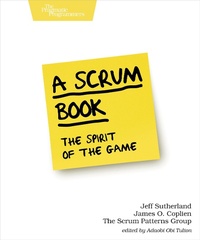
Scrum Book
Description

Building a successful product usually involves teams of people, and many choose the Scrum approach to aid in creating products that deliver the highest possible value. Implementing Scrum gives teams a collection of powerful ideas they can assemble to fit their needs and meet their goals. The ninety-four patterns contained within are elaborated nuggets of insight into Scrum’s building blocks, how they work, and how to use them. They offer novices a roadmap for starting from scratch, yet they help intermediate practitioners fine-tune or fortify their Scrum implementations. Experienced practitioners can use the patterns and supporting explanations to get a better understanding of how the parts of Scrum complement each other to solve common problems in product development.
The patterns are written in the well-known Alexandrian form, whose roots in architecture and design have enjoyed broad application in the software world. The form organizes each pattern so you can navigate directly to organizational design tradeoffs or jump to the solution or rationale that makes the solution work. The patterns flow together naturally through the context sections at their beginning and end.
Learn everything you need to know to master and implement Scrum one step at a time�the agile way.
More details
Other editions
Additional editions
Content
- Cover
- Table of Contents
- Dedications
- Product Owner's Note
- Preface
- The Search for the Bull
- Discovering the Footprints
- Perceiving the Bull
- Catching the Bull
- Taming the Bull
- Riding the Bull Home
- The Bull Transcended
- Both Bull and Self Transcended
- Reaching the Source
- In the World
- Acknowledgments
- Introduction
- Scrum---Through the Lens of Experience
- Patterns of Scrum
- Getting Started
- The Fundamental Process
- A Quick Tour of the Book
- Book Notations
- What Now?
- 1. The Scrum Core as Patterns
- ¶1 The Spirit of the Game
- The Core Patterns in Brief
- Beyond the Core
- 2. Product Organization Pattern Language
- Product Organization Sequence
- ¶2 The Mist
- ¶3 Fertile Soil
- ¶4 Conway's Law
- ¶5 Birds of a Feather
- ¶6 Involve the Managers
- ¶7 Scrum Team
- ¶8 Collocated Team
- ¶9 Small Teams
- ¶10 Cross-Functional Team
- ¶11 Product Owner
- ¶12 Product Owner Team
- ¶13 Development Partnership
- ¶14 Development Team
- ¶15 Stable Teams
- ¶16 Autonomous Team
- ¶17 Self-Organizing Team
- A Scaling Sequence
- ¶18 Mitosis
- Kaizen and Kaikaku
- ¶19 ScrumMaster
- ¶20 Oyatsu Jinja (Snack Shrine)
- ¶21 Small Red Phone
- ¶22 Scrum (Master) Coach
- ¶23 Fixed Work
- ¶24 Sprint Planning
- ¶25 Swarming: One-Piece Continuous Flow
- ¶26 Kaizen Pulse
- ¶27 Remove the Shade
- ¶28 Pop the Happy Bubble
- ¶29 Daily Scrum
- ¶30 ScrumMaster Incognito
- ¶31 Norms of Conduct
- ¶32 Emergency Procedure
- ¶33 Illegitimus Non Interruptus
- ¶34 Scrum of Scrums
- ¶35 Sprint Review
- ¶36 Sprint Retrospective
- ¶37 MetaScrum
- ¶38 Product Pride
- 3. Value Stream Pattern Language
- Value Stream Sequence
- ¶39 Vision
- ¶40 Impediment List
- ¶41 Value Stream
- ¶42 Set-Based Design
- ¶43 Sprint Burndown Chart
- ¶44 Scrum Board
- ¶45 Product Roadmap
- Rhythms: Patterns of Time
- ¶46 Sprint
- ¶47 Organizational Sprint Pulse
- ¶48 Release Plan
- ¶49 Release Range
- Value and ROI
- ¶50 ROI-Ordered Backlog
- ¶51 High Value First
- ¶52 Change for Free
- ¶53 Money for Nothing
- Product Backlog Sequence
- ¶54 Product Backlog
- ¶55 Product Backlog Item
- ¶56 Information Radiator
- ¶57 Pigs Estimate
- ¶58 Small Items
- ¶59 Granularity Gradient
- ¶60 Estimation Points
- ¶61 Fixed-Date PBI
- ¶62 Vacation PBI
- ¶63 Enabling Specification
- ¶64 Refined Product Backlog
- ¶65 Definition of Ready
- Notes on Velocity
- ¶66 Yesterday's Weather
- ¶67 Running Average Velocity
- ¶68 Aggregate Velocity
- ¶69 Specialized Velocities
- ¶70 Updated Velocity
- ¶71 Sprint Goal
- ¶72 Sprint Backlog
- ¶73 Sprint Backlog Item
- ¶74 Teams That Finish Early Accelerate Faster
- ¶75 Production Episode
- ¶76 Developer-Ordered Work Plan
- ¶77 Follow the Moon
- ¶78 Visible Status
- ¶79 Dependencies First
- ¶80 Good Housekeeping
- ¶81 Whack the Mole
- ¶82 Definition of Done
- ¶83 Team Sprint
- ¶84 Responsive Deployment
- ¶85 Regular Product Increment
- ¶86 Release Staging Layers
- ¶87 Testable Improvements
- ¶88 One Step at a Time
- ¶89 Value Areas
- ¶90 Value Stream Fork
- ¶91 Happiness Metric
- ¶92 Scrumming the Scrum
- ¶93 Greatest Value
- ¶94 Product Wake
- 4. Composing Your Own Pattern Language
- Project Languages
- A Project Language of Highly Effective Teams
- Your Own Pattern Language
- A1. Patlets
- Patterns in the Product Organization Pattern Language
- Patterns in the Value Stream Pattern Language
- Patterns from the Organizational Patterns Book
- Patterns from Fearless Change
- A2. Picture Credits
- Bibliography
- Index
- - DIGITS -
- - A -
- - B -
- - C -
- - D -
- - E -
- - F -
- - G -
- - H -
- - I -
- - J -
- - K -
- - L -
- - M -
- - N -
- - O -
- - P -
- - Q -
- - R -
- - S -
- - T -
- - U -
- - V -
- - W -
- - Y -
- - Z -
