

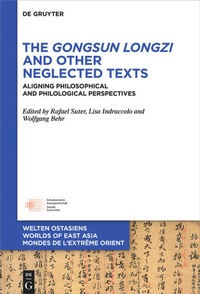
The Gongsun Longzi and Other Neglected Texts
Description

The Gongsun Longzi is often considered the only extant work of the Classical Chinese "School of Names", an early intellectual tradition (trad. dated to the 4 th cent. B.C.) mainly concerned with logic and the philosophy of language.
The Gongsun Longzi is a heterogeneous collection of five chapters that include short treatises and largely fictive dialogues between an anonymous persuader and his opponent, which typically revolve around a paradoxical claim. Its value as a testimony to Early Chinese philosophy, however, is somewhat controversial due to the intricate textual history of the text and our limited knowledge about its intellectual backgrounds.
This volume gathers contributions by leading specialists in the fields of Classical Chinese philosophy, philology, logic, and linguistics. Besides an overview of the scholarly literature on the topic and a detailed account of the reception of the text throughout time, it presents fresh insights into philological and philosophical problems raised by the Gongsun Longzi and other closely-related texts equally attributed to the "School of Names".
More details
Other editions
Additional editions
Persons
Content
- Intro
- Preface and Acknowledgements
- Contents
- The Gongsun Lóngzi and Other Neglected Texts - Aligning Philosophical and Philological Perspectives: An Introduction
- Traditions of Scholarship in China
- 1. The Gongsun Lóngzi: A Historical Overview
- 2. Notes on the Relationship between the Gongsun Lóngzi and the Dialectical Chapters of the Mòzi
- 3. The 'Discourse on the White Horse': A Concrete Analytical Philosophy of Language - with a Coda on the Authenticity of the Received Gongsun Lóngzi
- Contemporary Analytic Approaches
- 4. Reference and Ontology in the Gongsun Lóngzi
- 5. How Gongsun Lóng's Double-Reference Thought in His "White Horse Not Horse" Argumentation Can Engage with Fregean and Kripkean Approaches to the Issue of Reference
- Philosophical Readings of the Gongsun Lóngzi
- 6. Place as a Category in the 'Treatise on Name and Reality' (Míngshí lùn?? )
- 7. A New Interpretation of the Gongsun Lóngzi's 'Zhiwù lùn' (Discourse on Pointings and Things) and 'Míngshí lùn' (Discourse on Names and Actualities)
- 8. A New Interpretation of 'Báimalùn' (Discourse on White and Horse)
- Perspectives on Language and Terminology
- 9. Logically Significant Words in the Gongsun Lóngzi
- 10. Linguistic Affinites of the Yinwénzi Text in the Light of Basic Corpus Data
- 11. Gongsun Lóng and the Zhuangzi: On Classifying (Declassifying) Things Zhi (Qí) Wù Lùn ?? ??
- 12. Buddhist Murmurs? - Another Look at the Composition of the Gongsun Lóngzi
- Indices
- 1. Terms
- 2. Source Texts
- 3. Persons
