

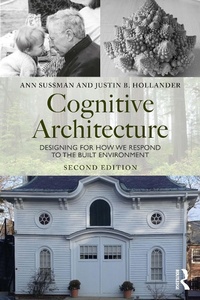
Cognitive Architecture
Designing for How We Respond to the Built Environment
2nd Edition
Published on 12. July 2021
254 pages
978-1-000-40304-6 (ISBN)
Description

In this expanded second edition of Cognitive Architecture, the authors review new findings in psychology and neuroscience to help architects and planners better understand their clients as the sophisticated mammals they are, arriving in the world with built-in responses to the environment. Discussing key biometric tools to help designers 'see' subliminal human behaviors and suggesting new ways to analyze designs before they are built, this new edition brings readers up-to-date on scientific tools relevant for assessing architecture and the human experience of the built environment.
The new edition includes:
Over 100 full color photographs and drawings to illustrate key concepts.
A new chapter on using biometrics to understand the human experience of place.
A conclusion describing how the book's propositions reframe the history of modern architecture.
A compelling read for students, professionals, and the general public, Cognitive Architecture takes an inside-out approach to design, arguing that the more we understand human behavior, the better we can design and plan for it.
The new edition includes:
Over 100 full color photographs and drawings to illustrate key concepts.
A new chapter on using biometrics to understand the human experience of place.
A conclusion describing how the book's propositions reframe the history of modern architecture.
A compelling read for students, professionals, and the general public, Cognitive Architecture takes an inside-out approach to design, arguing that the more we understand human behavior, the better we can design and plan for it.
Reviews / Votes
"At a time where architecture is all about spectacle and "wow effects", [the authors] remind us in Cognitive Architecture that buildings and cities profoundly affect our lives. Design impacts our senses, our psyche and our disposition, drawing on our history, our evolution as a species. The book brings us back to fundamentals, insisting that architectural design must consider and respond to our basic sensibilities, and as such can be either very positive or detrimental to our well-being. It returns architectural discourse to a place where the public at large can partake in the assessment of the built environment." - Moshe Safdie CC FAIA FRAIC OAA, world-renowned architect, urban planner, educator, theorist, and author."Cognitive Architecture is an important and insightful book that significantly links our responses to seemingly lifeless buildings to the very foundations of our inborn affinity for life. It takes our ancient intuitions about bringing buildings to life into the modern realm of rapidly unfolding discoveries in evolutionary biology and neuroscience. It critically goes beyond theory and science to the application of this knowledge to a better and more beneficial architecture and urban design." - Stephen R. Kellert, Professor Emeritus and Senior Research Scholar, Yale University, and author of "Birthright: People and Nature in the Modern World."
'Cognitive Architecture is an inspiring book which introduces the reader to our sense of aesthetics that is at the core of human cognition in which we shape our built environment. This book will be of great value to architects, environmentalists, designers, geographers and planners, as well as students of those fields.'- Andreas Luescher, Swiss architect and Professor of Architecture and Environmental Design, Bowling Green State University, Ohio.
"Buildings are intended to be viewed, traversed, and lived in by people, but theoreticians and practitioners of architecture have rarely thought deeply about human nature and why and how it needs to be taken seriously when designing buildings and urban areas. In this short book, one of a small but growing number of contributions that are rectifying this deficiency, Sussman and Hollander clearly describe why our attraction to edges, faces, symmetry, curves, and stories, all of which have deep evolutionary roots, should influence architecture and urban design. Every person who wishes to design buildings should read and internalize the message of this book before putting pen to paper." - Gordon H.Orians, Professor Emeritus of Biology, University of Washington (Author of "Snakes, Sunrises, and Shakespeare. How Evolution Shapes Our Loves and Fears").
"Sussman and Hollander have delivered a major advance in the creative union of human biology and architecture in the service of happiness." - Edward O. Wilson, University Professor Emeritus, Harvard University.
"The authors' intent to 'encourage many more creative approaches to the [design] task, and not proscribe one specific architectural or planning style' has been achieved, and within an admirably compact compass.' - Harold Henderson, Planning Magazine, Feb 2016
"...a book that has an angle that is fresh and a philosophical thrust that surely is sound-arguing for 'an inside-out approach to . . . solving the riddle of how to best design for humanity' and for an effort to puzzle out the preferences inside our heads before we set out to design the buildings to surround them." - Anthony Paletta, Urban Land Magazine, March 2016.
More details
Edition
2nd edition
Language
English
Place of publication
London
United Kingdom
Publishing group
Taylor & Francis Ltd
Target group
College/higher education
Professional and scholarly
Illustrations
3 Tables, color; 138 Halftones, color; 138 Illustrations, color
ISBN-13
978-1-000-40304-6 (9781000403046)
Copyright in bibliographic data and cover images is held by Nielsen Book Services Limited or by the publishers or by their respective licensors: all rights reserved.
Schweitzer Classification
Other editions
Additional editions
Ann Sussman | Justin Hollander
Cognitive Architecture
Designing for How We Respond to the Built Environment
Book
07/2021
2nd Edition
Routledge
€179.78
Shipment within 15-20 days
Ann Sussman | Justin Hollander
Cognitive Architecture
Designing for How We Respond to the Built Environment
Book
07/2021
2nd Edition
Routledge
€56.00
Shipment within 15-20 days
Persons
Ann Sussman is a registered architect, researcher, and college instructor. She co-edited (with Justin B. Hollander) the book Urban Experience and Design: Contemporary Perspectives on Improving the Public Realm. Keen on bridging the arts and science, she blogs at GeneticsofDesign.com. She currently teaches a new course on perception and the human experience of place, 'Architecture & Cognition,' at the Boston Architectural College (BAC). In 2020, she co-founded and became president of the nonprofit The Human Architecture + Planning Institute, Inc. (theHapi.org).
Justin B. Hollander is Professor of Urban and Environmental Policy and Planning at Tufts University. His research and teaching is in the areas of physical planning, big data, shrinking cities, and the intersection between cognitive science and the design of cities. He is the author of six other books on urban planning and design and the co-editor (with Ann Sussman) of Urban Experience and Design: Contemporary Perspectives on Improving the Public Realm. He was recently inducted as a fellow of the American Institute of Certified Planners and hosts the Apple podcast 'Cognitive Urbanism.'
Justin B. Hollander is Professor of Urban and Environmental Policy and Planning at Tufts University. His research and teaching is in the areas of physical planning, big data, shrinking cities, and the intersection between cognitive science and the design of cities. He is the author of six other books on urban planning and design and the co-editor (with Ann Sussman) of Urban Experience and Design: Contemporary Perspectives on Improving the Public Realm. He was recently inducted as a fellow of the American Institute of Certified Planners and hosts the Apple podcast 'Cognitive Urbanism.'
Content
1. A New Foundation: Darwin, Biology, and Cognitive Science; 2. Edges Matter: Thigmotaxis (the 'Wall-hugging' Trait); 3. Patterns Matter: Faces and Spaces; 4. Shapes Carry Weight: Bilateral Symmetry, (Hierarchy), Curves, and Complexity; 5. Storytelling Is Key: We're Wired for Narrative; 6. Nature Is Our Context: Biophilia and Biophilic Design; 7. Buildings, Biology + Biometrics: Collecting Empirical Data for Evidence-Based Design; 8. The Twenty-First-Century Paradigm Shift in Biology and Psychology Reframes Architecture + Its History
