

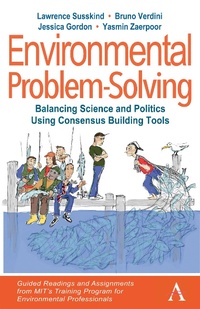
Environmental Problem-Solving: Balancing Science and Politics Using Consensus Building Tools
Guided Readings and Assignments from MIT's Training Program for Environmental Professionals
1st Edition
Published on 31. October 2020
506 pages
978-1-78527-132-8 (ISBN)
Description

'Environmental Problem-Solving' presents short excerpts from carefully selected readings, expert commentaries on those readings, assignments, and the best MIT student responses to the assignments and exam questions with excellent student response. The book presents four main models of environmental policy-making: competing theories of environmental ethics; tools for environmental assessment and environmental decision-making; and techniques for public engagement and group decision-making. The book covers the material presented in the semester-long course required of all students enrolled in MIT's Environmental Policy and Planning Specialization.
Reviews / Votes
"This remarkable book contains everything you need to teach a rich, dynamic course on the practical and theoretical dimensions of environmental policy as well as to evaluate your students' work. It integrates classic readings, commentaries, scenarios and assignments, along with videos of talks by faculty and presentations by students." -Judith E. Innes, Professor Emerita, Department of City and Regional Planning, University of California Berkeley, USA "Developed in the classroom of MIT's Department of Urban Studies and Planning, this is the long-awaited textbook for introductory environmental policy courses at both undergraduate and graduate levels. It includes a number of essential reading materials authored by leading scholars that will provide a framework for analyzing the substance and processes of environmental policy. It also comes with scenario-based exercises, suggested assignments, exam questions and even sample answers. It is a must-have volume for all instructors around the world." -Masahiro Matsuura, Professor, Meiji University, Graduate School of Governance Studies, Tokyo, JapanMore details
Series
Edition
1st Edition
Language
English
Place of publication
London
United Kingdom
Target group
Professional and scholarly
ISBN-13
978-1-78527-132-8 (9781785271328)
Copyright in bibliographic data and cover images is held by Nielsen Book Services Limited or by the publishers or by their respective licensors: all rights reserved.
Schweitzer Classification
Other editions
Additional editions
Lawrence Susskind | Bruno Verdini | Jessica Gordon
Environmental Problem-Solving: Balancing Science and Politics Using Consensus Building Tools
Guided Readings and Assignments from MIT's Training Program for Environmental Professionals
Book
10/2020
Anthem Press
€176.30
Shipment within 10-15 days
Persons
Dr. Lawrence Susskind is Ford Professor of Urban and Environmental Planning and Head of the Environmental Policy and Planning Group at MIT. One of the founders of the field of environmental dispute resolution, he has been teaching at MIT and Harvard for almost 50 years.
Dr. Bruno Verdini is Lecturer in Urban Planning and Negotiation at MIT, Affiliated Faculty at the Program on Negotiation at Harvard Law School, and Assistant Director of the MIT Science Impact Collaborative. His research focuses on energy transition, infrastructure development, and ecosystem restoration.
Dr. Jessica Gordon holds a PhD in Environmental Policy and Planning at MIT. Her research and work is on issues related to climate change, environmental policy, and sustainable development.
Dr. Yasmin Zaerpoor holds a PhD in Environmental Policy and Planning at MIT. Her research and work is on issues related to sustainable urban development in the global South, transboundary water governance, and negotiation.
Dr. Bruno Verdini is Lecturer in Urban Planning and Negotiation at MIT, Affiliated Faculty at the Program on Negotiation at Harvard Law School, and Assistant Director of the MIT Science Impact Collaborative. His research focuses on energy transition, infrastructure development, and ecosystem restoration.
Dr. Jessica Gordon holds a PhD in Environmental Policy and Planning at MIT. Her research and work is on issues related to climate change, environmental policy, and sustainable development.
Dr. Yasmin Zaerpoor holds a PhD in Environmental Policy and Planning at MIT. Her research and work is on issues related to sustainable urban development in the global South, transboundary water governance, and negotiation.
