

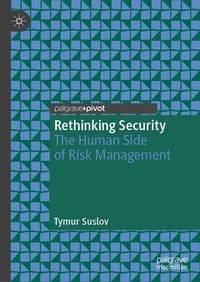
Rethinking Security
Description

This short Pivot argues for a paradigm shift towards a human-centric approach, emphasising the importance of understanding and managing human behaviour as a fundamental aspect of effective security strategies. It explores the intersection of psychology, criminology, and security, providing a comprehensive framework for integrating behavioural insights into security practices.
The book questions the dependence on technology solutions and provides a new viewpoint, emphasising human behaviour as the core cause of security challenges. It explains complex psychological and criminological insights and provides straightforward explanations of psychological and criminological ideas that are critical to comprehending security issues. It advocates for paradigm shift in security practices and encourages a move from control-based to cooperative security paradigms.
Reviews / Votes
"The author provides readers with a highly substantive overview of relevant topics. It will benefit security practitioners seeking to enhance their knowledge and strengthen their security risk management practice. Overall, while its brevity naturally limits the detail afforded to each theme, the book achieves its central aim of elevating the human dimension within security risk management. It serves as a valuable primer, encouraging continued learning and providing a robust foundation for more advanced study." (Johan J. de Wit, Security Journal, Vol. 39 (1), 2026)
More details
Other editions
Additional editions
Person
Tymur Suslov is a consultant. He has a PGDip Criminology and Criminal Psychology from the University of Essex, UK, and a PGDip in International Security and Risk Management from the University of South Wales, UK. He worked in security for 10 years, starting as a security guard and up to management.
Content
Chapter 1: Introduction to the Book.- Chapter 2: Uncertainty and Risk.- Chapter 3: Risk Perception.- Chapter 4: Risk Communication.- Chapter 5: Psychological Theories in the Context of Security.- Chapter 6: Profiling and Psychological Characteristics of Criminals.- Chapter 7: Social Engineering and Manipulation.- Chapter 8: Criminal Behaviour.- Chapter 9: Crime Prevention.- Chapter 10: Human-Centric Models and Behaviour Security.- Chapter 11: Security Education.
