

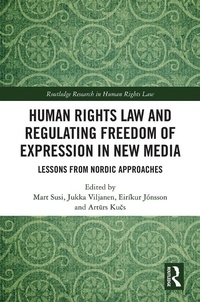
Human Rights Law and Regulating Freedom of Expression in New Media
Lessons from Nordic Approaches
1st Edition
Published on 17. April 2018
220 pages
978-1-351-01758-9 (ISBN)
Description

The Nordic countries are well known globally for their high human rights standards and, at the same time, high degree of internet freedom. This edited collection reveals how the Nordic countries have succeeded in the task of protecting freedom of expression in the new media. It contains an overview of public policy choices and best practices of domestic online companies, which have the aspiration of finding global acceptance.
Reviewing the topic of freedom of expression in new media within Nordic and Baltic countries, this book incorporates both general themes and interesting country-specific themes that will provide wider knowledge on the development of freedom of expression and media law in the online media era. A comprehensive analysis of regulation of online media, both at the level of legislation and application of law in courts and other authorities, are included. This book will contribute to the ongoing discussion as to whether there is a need to modify prevailing interpretation of freedom of expression.
Human Rights Law and Regulating Freedom of Expression in New Media focuses on the multi-layered and complicated relationship between internet and human rights law. It contributes to the ongoing discussion regarding the protection of freedom of expression on the internet in the context of various doctrines of constitutional law, including the proliferation of constitutional adjudication. It will be of interest to researchers, academics, policymakers, and students in the fields of human rights law, internet law, political science, sociology, cultural studies, media and communications studies and technology.
Reviewing the topic of freedom of expression in new media within Nordic and Baltic countries, this book incorporates both general themes and interesting country-specific themes that will provide wider knowledge on the development of freedom of expression and media law in the online media era. A comprehensive analysis of regulation of online media, both at the level of legislation and application of law in courts and other authorities, are included. This book will contribute to the ongoing discussion as to whether there is a need to modify prevailing interpretation of freedom of expression.
Human Rights Law and Regulating Freedom of Expression in New Media focuses on the multi-layered and complicated relationship between internet and human rights law. It contributes to the ongoing discussion regarding the protection of freedom of expression on the internet in the context of various doctrines of constitutional law, including the proliferation of constitutional adjudication. It will be of interest to researchers, academics, policymakers, and students in the fields of human rights law, internet law, political science, sociology, cultural studies, media and communications studies and technology.
More details
Series
Edition
1. Auflage
Language
English
Place of publication
London
United Kingdom
Publishing group
Taylor & Francis Ltd
Target group
College/higher education
Illustrations
3 Illustrations, black and white
File size
4,04 MB
ISBN-13
978-1-351-01758-9 (9781351017589)
Copyright in bibliographic data and cover images is held by Nielsen Book Services Limited or by the publishers or by their respective licensors: all rights reserved.
Schweitzer Classification
Other editions
Additional editions
Mart Susi | Jukka Viljanen | Eirikur Jonsson
Human Rights Law and Regulating Freedom of Expression in New Media
Lessons from Nordic Approaches
Book
11/2019
1st Edition
Routledge
€65.10
Shipment within 15-20 days
Mart Susi | Jukka Viljanen | Eirikur Jonsson
Human Rights Law and Regulating Freedom of Expression in New Media
Lessons from Nordic Approaches
Book
04/2018
1st Edition
Routledge
€206.20
Shipment within 10-20 days
Persons
Mart Susi is Professor of Human Rights Law and Head of Legal Studies at Tallinn University. He has been leading several international research and development projects (EU Commission-funded Horizon 2020 project "Hurmur" and Nordic Council of Ministers-funded project "Law and Media Network"). He has authored several monographs and more than 50 articles. Currently, he is editing several books on the topics of new media, and human rights and the digital society. Susi has recently introduced and is developing the concept of the Internet Balancing Formula.
Jukka Viljanen is Professor of Public Law, Adjunct Professor of Human Rights Law and University Lecturer at the University of Tampere. He is an author of several international articles on the European Court of Human Rights and its doctrines. Viljanen has been leading several important research projects, e.g. ALL-YOUTH (Strategic Research Council, 2018-2020), Law and Media (Finnish sub-group) (Nordplus, 2015-2017), evaluation of Finnish Human Rights National Action Plan (Ministry of Justice, 2013-2014) and Finnish environmental constitutional right (Ministry of Environment, 2014).
Eirikur Jonsson graduated as Cand. Juris from the University of Iceland (Faculty of Law) in 2002, LL.M. from Harvard Law School in 2006 and Ph.D. from the University of Iceland in 2011. Among other positions he has served as the chairman of the Icelandic Media Commission, chairman of the Icelandic Appeals Committee of Consumer Affairs, appointed judge at the District Court of Reykjavik and as an alternate judge at the Supreme Court of Iceland. He has written several books on Icelandic law, among other things on media law.
Arturs Kucs is a judge of the Constitutional Court of Latvia and professor of the Faculty of Law of the University of Latvia. His research areas include comparative human rights law and media law, especially analysis on privacy, defamation and hate speech laws. Arturs Kucs has been Fulbright Visiting Scholar at the University of Connecticut and DAAD Visiting Scholar at Max Planck Institute for Comparative Public Law and International Law in Heidelberg.
Jukka Viljanen is Professor of Public Law, Adjunct Professor of Human Rights Law and University Lecturer at the University of Tampere. He is an author of several international articles on the European Court of Human Rights and its doctrines. Viljanen has been leading several important research projects, e.g. ALL-YOUTH (Strategic Research Council, 2018-2020), Law and Media (Finnish sub-group) (Nordplus, 2015-2017), evaluation of Finnish Human Rights National Action Plan (Ministry of Justice, 2013-2014) and Finnish environmental constitutional right (Ministry of Environment, 2014).
Eirikur Jonsson graduated as Cand. Juris from the University of Iceland (Faculty of Law) in 2002, LL.M. from Harvard Law School in 2006 and Ph.D. from the University of Iceland in 2011. Among other positions he has served as the chairman of the Icelandic Media Commission, chairman of the Icelandic Appeals Committee of Consumer Affairs, appointed judge at the District Court of Reykjavik and as an alternate judge at the Supreme Court of Iceland. He has written several books on Icelandic law, among other things on media law.
Arturs Kucs is a judge of the Constitutional Court of Latvia and professor of the Faculty of Law of the University of Latvia. His research areas include comparative human rights law and media law, especially analysis on privacy, defamation and hate speech laws. Arturs Kucs has been Fulbright Visiting Scholar at the University of Connecticut and DAAD Visiting Scholar at Max Planck Institute for Comparative Public Law and International Law in Heidelberg.
Content
1. Introduction 2. Intermediary Liability for Online User Comments Under the European Convention on Human Rights 3. Freedom of Speech and Online Media in Denmark 4. Estonia - Raising High the Roof Beams of Freedom of Expression: New Media Environment in Estonia 5. Finland 6. Icelandic Online Media Law and the ECHR 7. Regulation of Online Media in Latvia 8. Human Rights Law and Regulating Freedom of Expression in New Media: Lithuania 9. Regulation of Online Media in Norway 10. Internet, Freedom of Expression and the Right to Privacy in Sweden 11. Comparative Analysis of the Nordic/Baltic Approaches and Standards 12. Updating Freedom of Expression Doctrines in the New Media Cases: Lessons from Strasbourg and Other International Treaty Bodies
