

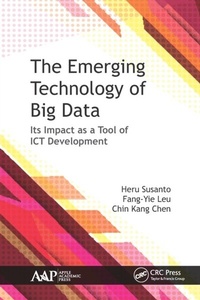
The Emerging Technology of Big Data
Its Impact as a Tool for ICT Development
1st Edition
Published on 29. March 2019
324 pages
978-1-351-24124-3 (ISBN)
Description

Big Data is now highly regarded and accepted as a useful tool to help organizations manage their data and information effectively and efficiently. This new volume, The Emerging Technology of Big Data: Its Impact as a Tool for ICT Development, looks at the new technology that has emerged to meet the growing need and demand and studies the impact of Big Data in several areas of today's society, including social media, business process re-engineering, science, e-learning, higher education, business intelligence, and green computing.
In today's modern society, information system (IS) through Big Data contributes to the success of organizations because it provides a solid foundation for increasing both efficiency and productivity. Many business organizations and educational institutions realize that compliance with Big Data will affect their prospects for success. Everyday, the amount of data collected from digital tools grows tremendously. As the amount of data increases, the use of IS becomes more and more essential.
The book looks at how large datasets and analytics have slowly crept into the world of education and discusses methods of teaching and learning and the collection of student-learning data.
The final chapter of the book considers the environmental impacts of ICT and emphasizes green ICT awareness as a corporate strategy through information systems. The global ICT industry accounts for approximately 2 percent of global carbon dioxide (CO2) emissions, and the manufacture, shipping, and disposal of ICT equipment also contributes environmentally. This chapter addresses these issues.
The information provided here will be valuable information for education professionals, businesses, faculty, scientists and researchers, and others.
In today's modern society, information system (IS) through Big Data contributes to the success of organizations because it provides a solid foundation for increasing both efficiency and productivity. Many business organizations and educational institutions realize that compliance with Big Data will affect their prospects for success. Everyday, the amount of data collected from digital tools grows tremendously. As the amount of data increases, the use of IS becomes more and more essential.
The book looks at how large datasets and analytics have slowly crept into the world of education and discusses methods of teaching and learning and the collection of student-learning data.
The final chapter of the book considers the environmental impacts of ICT and emphasizes green ICT awareness as a corporate strategy through information systems. The global ICT industry accounts for approximately 2 percent of global carbon dioxide (CO2) emissions, and the manufacture, shipping, and disposal of ICT equipment also contributes environmentally. This chapter addresses these issues.
The information provided here will be valuable information for education professionals, businesses, faculty, scientists and researchers, and others.
More details
Language
English
Place of publication
London
United Kingdom
Publishing group
Taylor & Francis Ltd
Target group
College/higher education
Professional and scholarly
Illustrations
21 farbige Abbildungen
24 Illustrations, color; 21 Illustrations, black and white
File size
8,04 MB
ISBN-13
978-1-351-24124-3 (9781351241243)
Copyright in bibliographic data and cover images is held by Nielsen Book Services Limited or by the publishers or by their respective licensors: all rights reserved.
Schweitzer Classification
Other editions
Additional editions
Heru Susanto | Fang-Yie Leu | Chin Kang Chen
The Emerging Technology of Big Data
Its Impact as a Tool for ICT Development
Book
03/2021
1st Edition
Apple Academic Press Inc.
€130.60
Shipment within 3-4 weeks
Heru Susanto | Fang-Yie Leu | Chin Kang Chen
The Emerging Technology of Big Data
Its Impact as a Tool for ICT Development
Book
04/2019
1st Edition
Apple Academic Press Inc.
€193.20
Shipment within 3-4 weeks
Persons
Heru Susanto, PhD, is currently Head of the Information Department and researcher at the Indonesian Institute of Sciences, Computational Science & IT Governance Research Group. At present he is also an Honorary Professor and Visiting Scholar at the Department of Information Management, College of Management, Tunghai University, Taichung, Taiwan. Dr. Susanto has worked as an IT professional in several roles, including Web Division Head of IT Strategic Management at Indomobil Group Corporation and Prince Muqrin Chair for Information Security Technologies at King Saud University. His research interests are in the areas of information security, IT governance, computational sciences, business process re-engineering, and e-marketing. Dr. Susanto received a BSc in Computer Science from Bogor Agricultural University, an MBA in Marketing Management from the School of Business and Management Indonesia, and an MSc in Information Systems from King Saud University, and a PhD in Information Security System from the University of Brunei and King Saud University.
Fang-Yie Leu, PhD, is currently a Professor of Computer Science Department, Tunghai University, Taiwan, and on the editorial boards of several journals. Prof. Leu organizes Mobile Commerce, Cloud Computing, Network and Communication Security (MCNCS) and Compact Wireless EVA Communications System (CWECS) international workshops. He is an IEEE member and now serves as the Technical Program Committee (TPC) member of many international conferences. He was also a visiting scholar of Pittsburg University, Pennsylvania. His research interests include wireless communication, network security, Grid applications and Security. Dr. Leu received his bachelor, master, and PhD degrees all from the National Taiwan University of Science and Technology, Taiwan.
Chin Kang Chen, PhD, is a Lecturer at Universiti Brunei Darussalam, Begawan, Brunei. He also has industry experience from working on projects with the local telecommunications companies and government ministries and agencies. His research interests include information security management system, IT governance, mobile devices, cloud computing and e-government. Dr. Chen received his bachelor of Engineering from the Royal Melbourne Institute of Technology, Australia; his Master of Digital Communication from Monash University; and his Master of Information Technology from Queensland University of Technology; and his PhD from the University of Brunei.
Fang-Yie Leu, PhD, is currently a Professor of Computer Science Department, Tunghai University, Taiwan, and on the editorial boards of several journals. Prof. Leu organizes Mobile Commerce, Cloud Computing, Network and Communication Security (MCNCS) and Compact Wireless EVA Communications System (CWECS) international workshops. He is an IEEE member and now serves as the Technical Program Committee (TPC) member of many international conferences. He was also a visiting scholar of Pittsburg University, Pennsylvania. His research interests include wireless communication, network security, Grid applications and Security. Dr. Leu received his bachelor, master, and PhD degrees all from the National Taiwan University of Science and Technology, Taiwan.
Chin Kang Chen, PhD, is a Lecturer at Universiti Brunei Darussalam, Begawan, Brunei. He also has industry experience from working on projects with the local telecommunications companies and government ministries and agencies. His research interests include information security management system, IT governance, mobile devices, cloud computing and e-government. Dr. Chen received his bachelor of Engineering from the Royal Melbourne Institute of Technology, Australia; his Master of Digital Communication from Monash University; and his Master of Information Technology from Queensland University of Technology; and his PhD from the University of Brunei.
Content
Social Media and the Impact of Big Data. Big Data as a Facilitator of Higher Education. The Big Data Revolution as a Driver of Science. Big Data and the Learning Process: Generation Y and Z Perspectives. Big Data in Fostering Academic and Learning: Creating Technopreneurship and Innovation through Big Data. Information Systems and Big Data to Support Academics. The Evolution of Big Data and Learning Analytics. Business Intelligence and Analytics: A Big Data Paradigm. Crafting Strategies through IT as Enabler of Business Process Reengineering.
Managing Online Learning: Big Data, Social Network and Cloud Computing. Green ICT Awareness as a Corporate Strategy through Information System.
Managing Online Learning: Big Data, Social Network and Cloud Computing. Green ICT Awareness as a Corporate Strategy through Information System.
