

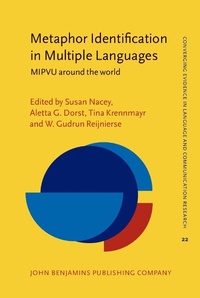
Metaphor Identification in Multiple Languages
MIPVU around the world
1st Edition
Published on 28. November 2019
336 pages
978-90-272-6175-5 (ISBN)
Description

This volume explores linguistic metaphor identification in a wide variety of languages and language families. The book is an essential read for anyone interested in researching language and metaphor, from students to experienced scholars. Its primary goals are to discuss the challenges involved in applying the Metaphor Identification Procedure Vrije Universiteit (MIPVU) to a range of languages across the globe, and to offer theoretically grounded advice and guidelines enabling researchers to identify metaphors in multiple languages in a valid and replicable way. The volume is intended as a practical guidebook that identifies and discusses procedural challenges of metaphor identification across languages, thus better enabling researchers to reliably identify metaphor in a multitude of languages. Although able to be read independently, this volume - written by metaphor researchers from around the world - is the ideal companion volume for the 2010 Benjamins book A Method for Linguistic Metaphor Identification: From MIP to MIPVU.
More details
Other editions
Additional editions
Susan Nacey | Aletta G. Dorst | Tina Krennmayr
Metaphor Identification in Multiple Languages
MIPVU around the world
Book
11/2019
John Benjamins Publishing Co
€119.04
Shipment within 10-15 days
Content
- Intro
- Metaphor Identification in Multiple Languages
- Editorial page
- Title page
- Copyright page
- Table of contents
- Chapter 1. MIPVU in multiple languages
- 1.1 Why MIPVU in multiple languages?
- 1.2 Methods for linguistic metaphor identification
- 1.2.1 The development of MIP and MIPVU
- 1.2.2 MIP vs. MIPVU
- 1.2.3 Other methods for linguistic metaphor identification
- 1.3 Perspectives on the past, present and future of linguistic metaphor identification: An interview with Gerard Steen
- 1.4 How to read this volume
- 1.5 MIPVU in multiple languages
- References
- Chapter 2. MIPVU: A manual for identifying metaphor-related words
- 2.1 The basic procedure
- 2.2 Deciding about words: Lexical units
- 2.2.1 General guideline
- 2.2.2 Exceptions
- 2.3 Indirect use potentially explained by cross-domain mapping
- 2.3.1 Identifying contextual meanings
- 2.3.2 Deciding about more basic meanings
- 2.3.3 Deciding about sufficient distinctness
- 2.3.4 Deciding about the role of similarity
- 2.4 Direct use potentially explained by cross-domain mapping
- 2.5 Implicit meaning potentially explained by cross-domain mapping
- 2.6 Signals of potential cross-domain mappings
- 2.7 New formations and parts that may be potentially explained by cross-domain mapping
- Acknowledgements
- References
- Chapter 3. What the MIPVU protocol doesn't tell you (even though it mostly does)
- 3.1 Introduction
- Part 1: Practicalities of MIPVU
- 3.2 How do I determine what comprises a lexical unit?
- 3.3 How do I determine a 'more basic meaning' of a lexical unit?
- 3.3.1 The 'it feels basic to me' pitfall
- 3.3.2 The 'but there has to be a single basic meaning' pitfall
- 3.3.3 The 'no contextual meaning' pitfall
- 3.3.4 The 'grammatical category / word class' pitfall
- 3.4 How do I go about contrasting and comparing meanings?
- 3.5 Which tools should I use to annotate my dataset?
- 3.5.1 Initial independent MIPVU analysis
- 3.5.2 Further comparative MIPVU analysis
- 3.5.3 Statistical analysis of MIPVU results
- 3.6 Reliability testing
- Part 2: Choosing your approach and your data
- 3.7 Decision 1: Quantitative, qualitative, or both?
- 3.8 Decision 2: Which (elements in) texts and why?
- 3.9 Concluding thoughts
- Acknowledgements
- References
- Chapter 4. Linguistic metaphor identification in French
- 4.1 Introduction
- 4.2 Linguistic metaphor identification in French
- 4.2.1 Idiosyncratic features of French that may affect metaphor identification by means of MIPVU
- 4.2.2 Prepositions à and de, and contracted forms
- 4.2.3 Turning MIP into PIM: Guidelines for applying MIPVU to French
- 4.2.4 PIM in practice: Identifying metaphor in French
- 4.3 Some consequences of using one dictionary (and not another) for metaphor identification (in French)
- 4.3.1 Data and dictionaries
- 4.3.2 Results: Comparing agreement between the two dictionaries
- 4.3.3 The qualitative perspective: Some clear differences between the two dictionaries
- 4.3.4 Some final thoughts about choosing and using a dictionary for metaphor identification in French
- 4.4 Concluding remarks
- References
- Dictionaries used
- Chapter 5. Linguistic metaphor identification in Dutch
- 5.1 Introduction: Metaphor in Dutch discourse
- 5.2 Operational issues
- 5.2.1 The corpus: News and conversation
- 5.2.2 Van dale dictionary and its implications
- 5.3 Linguistic issues: Complex words and fixed expressions
- 5.3.1 Separable complex verbs
- 5.3.2 Polywords
- 5.4 Dutch metaphor analysis: Agreement and disagreement
- 5.4.1 Dutch discourse and agreement
- 5.4.2 Dutch discourse and disagreement
- 5.5 Conclusion
- Acknowledgements
- References
- Chapter 6. Linguistic metaphor identification in German
- 6.1 Introduction
- 6.2 Language-specific issues
- 6.3 Operational issues
- 6.3.1 The data
- 6.3.2 Part-of-Speech tagging
- 6.3.3 Lexicographic resources
- 6.4 The guidelines
- 6.4.1 Demarcation of lexical units
- 6.4.2 Non-autonomous sense descriptions
- 6.4.3 Deciding about distinctness of word meanings
- 6.5 Reliability
- 6.5.1 Lexical units
- 6.6 Conclusion
- Acknowledgements
- References
- Chapter 7. Linguistic metaphor identification in Scandinavian
- 7.1 Introduction
- 7.2 Lexico-grammatical features of Scandinavian
- 7.3 Procedural issues
- 7.3.1 Dictionaries
- 7.3.2 Lexical units
- 7.4 Scandinavian MIPVU in a nutshell
- 7.5 Application of Scandinavian MIPVU
- 7.6 Reliability results
- 7.6.1 Demarcation of lexical units
- 7.6.2 Identification of metaphor-related words
- 7.7 Concluding remarks
- References
- Chapter 8. Linguistic metaphor identification in Lithuanian
- 8.1 Introduction
- 8.2 Operational challenges: Lithuanian dictionaries
- 8.2.1 Dictionaries and corpus of Lithuanian
- 8.2.2 Cross-referencing
- 8.2.3 Absence of senses
- 8.2.4 Obsolete or dialectal basic senses
- 8.2.5 Conflated concrete and abstract senses
- 8.3 Challenges to MIPVU application in Lithuanian: Grammatical cases and derivational morphology
- 8.4 Illustrations of MIPVU application in Lithuanian
- 8.4.1 Two cases of straightforward application of MIPVU
- 8.4.2 Grammatical case: From non-metaphorical to metaphorical
- 8.4.3 Potential metaphoricity of derivational affixes and the reflexive particle
- 8.5 Concluding remarks: Possible adjustments of MIPVU to Lithuanian
- 8.6 Reliability tests
- References
- Chapter 9. Linguistic metaphor identification in Polish
- 9.1 Introduction
- 9.2 Data collection and coding
- 9.3 Linguistic issues
- 9.3.1 Demarcation of lexical units: Unitization
- 9.3.2 Establishing the basic and contextual sense: Itemization
- 9.3.3 Metaphor and declination
- 9.3.4 Metaphor categorisation: Direct, indirect and implicit metaphors
- 9.4 Sample analysis
- 9.5 Applying MIPVU to Polish: Reliability measures
- 9.6 MIPVU for Polish: Final guidelines and conclusions
- Acknowledgements
- References
- Chapter 10. Linguistic metaphor identification in Serbian
- 10.1 Introduction
- 10.2 Relevant lexico-grammatical properties of Serbian: Inflectional morphology and case
- 10.3 Operational issues
- 10.3.1 Data
- 10.3.2 Procedure
- 10.3.3 Selection and use of dictionary
- 10.4 Unit demarcation and contextual/basic meaning identification
- 10.4.1 Determining lexical units
- 10.4.2 Contextual and basic meaning identification
- 10.5 Case-encoded metaphoricity
- 10.5.1 Solutions
- 10.6 Sample analysis
- 10.6.1 An overview in numbers
- 10.6.2 Case-encoded metaphor
- 10.7 Conclusions
- Acknowledgment
- References
- Sources
- Chapter 11. Linguistic metaphor identification in Uzbek
- 11.1 Introduction
- 11.2 Operational issues
- 11.2.1 Data collection
- 11.2.2 Dictionary use
- 11.3 Linguistic issues
- 11.3.1 Locative, dative and ablative cases
- 11.3.2 Compound verbs
- 11.4 Sample analyses
- 11.5 Conclusion
- References
- Chapter 12. Linguistic metaphor identification in Chinese
- 12.1 Introduction
- 12.2 Operationalisation issues
- 12.2.1 Data of this study
- 12.2.2 Choice of lexical tools
- 12.2.3 Use of lexical tools
- 12.3 Linguistic issues
- 12.3.1 Demarcation of lexical units in Chinese texts
- 12.3.2 Chinese-specific types of lexical units
- 12.4 Annotation categories
- 12.4.1 Indirect metaphor
- 12.4.2 Direct metaphor
- 12.4.3 Implicit metaphor
- 12.4.4 Borderline cases
- 12.5 Conclusions
- References
- Chapter 13. Linguistic metaphor identification in Sesotho
- 13.1 Introduction
- 13.2 Operationalization
- 13.2.1 The Sesotho dictionaries
- 13.2.2 The use of SED and Macmillan
- 13.3 Demarcation of lexical units
- 13.3.1 The orthographic word
- 13.3.2 Multiword expressions and compounds
- 13.3.3 The first person singular object marker n- and the reflexive marker i-
- 13.3.4 The locative case marker -ng
- 13.3.5 The affixes ra- and ma-
- 13.4 Further linguistic characteristics of Sesotho that affect the use of MIPVU
- 13.4.1 Verb extensions
- 13.4.2 The diminutive marker, the augmentative marker, and reduplication
- 13.5 MIPVU adjusted for Sesotho
- 13.6 Sample analysis
- 13.7 Conclusion
- References
- Chapter 14. Linguistic metaphor identification in English as a lingua franca
- 14.1 Introduction
- 14.2 Metaphor in English as (academic) lingua franca: Problems and challenges
- 14.3 The European corpus of academic talk (EuroCoAT)
- 14.4 Lexical units
- 14.5 Contextual meanings
- 14.6 More basic meanings
- 14.7 Deciding on metaphorical meanings
- 14.8 Application of the modifications to MIPVU: Mark-up system and the search for coherence
- 14.9 Conclusion
- Acknowledgements
- References
- Chapter 15. Afterword: Some reflections on MIPVU across languages
- 15.1 Introduction: Counting metaphors without an identification procedure
- 15.2 MIP, MIPVU and English
- 15.3 MIPVU in languages other than English: The contribution of this book
- 15.3.1 Problems with lexical units
- 15.3.2 Problems with dictionaries
- 15.4 Concluding caveats, and looking ahead
- References
- About the authors
- Index
