

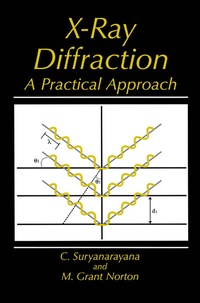
X-Ray Diffraction
A Practical Approach
Published on 29. June 2013
XIII, 273 pages
978-1-4899-0148-4 (ISBN)
Description

In this, the only book available to combine both theoretical and practical aspects of x-ray diffraction, the authors emphasize a "hands on" approach through experiments and examples based on actual laboratory data.
Part I presents the basics of x-ray diffraction and explains its use in obtaining structural and chemical information.
In Part II , eight experimental modules enable the students to gain an appreciation for what information can be obtained by x-ray diffraction and how to interpret it.
Examples from all classes of materials -- metals, ceramics, semiconductors, and polymers -- are included. Diffraction patterns and Bragg angles are provided for students without diffractometers. 192 illustrations.
Part I presents the basics of x-ray diffraction and explains its use in obtaining structural and chemical information.
In Part II , eight experimental modules enable the students to gain an appreciation for what information can be obtained by x-ray diffraction and how to interpret it.
Examples from all classes of materials -- metals, ceramics, semiconductors, and polymers -- are included. Diffraction patterns and Bragg angles are provided for students without diffractometers. 192 illustrations.
More details
Other editions
Additional editions
Book
06/2013
Springer
€171.19
Shipment within 15-20 days
Content
I. Basics.- 1. X-Rays and Diffraction.- 2. Lattices and Crystal Structures.- 3. Practical Aspects of X-Ray Diffraction.- II. Experimental Modules.- Module 1. Crystal Structure Determination. I: Cubic Structures.- Module 2. Crystal Structure Determination. II: Hexagonal Structures.- Module 3. Precise Lattice Parameter Measurements.- Module 4. Phase Diagram Determination.- Module 5. Detection of Long-Range Ordering.- Module 6. Determination of Crystallite Size and Lattice Strain.- Module 7. Quantitative Analysis of Powder Mixtures.- Module 8. Identification of an Unknown Specimen.- Appendixes.- Appendix 1. Plane-Spacing Equations and Unit Cell Volumes.- Appendix 2. Quadratic Forms of Miller Indices for the Cubic System.- Appendix 3. Atomic and Ionic Scattering Factors of Some Selected Elements.- Appendix 4. Summary of Structure Factor Calculations.- Appendix 6. Multiplicity Factors.- Appendix 8. Physical Constants and Conversion Factors.- Appendix 9. JCPDS-ICDD Card Numbers for Some Common Materials.- Appendix 10. Crystal Structures and Lattice Parameters of Some Selected Materials.
