

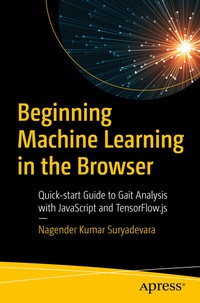
Beginning Machine Learning in the Browser
Description

Apply Artificial Intelligence techniques in the browser or on resource constrained computing devices. Machine learning (ML) can be an intimidating subject until you know the essentials and for what applications it works. This book takes advantage of the intricacies of the ML processes by using a simple, flexible and portable programming language such as JavaScript to work with more approachable, fundamental coding ideas.
Using JavaScript programming features along with standard libraries, you'll first learn to design and develop interactive graphics applications. Then move further into neural systems and human pose estimation strategies. For training and deploying your ML models in the browser, TensorFlow.js libraries will be emphasized.
After conquering the fundamentals, you'll dig into the wilderness of ML. Employ the ML and Processing (P5) libraries for Human Gait analysis. Building up Gait recognition with themes, you'll come to understand a variety of MLimplementation issues. For example, you'll learn about the classification of normal and abnormal Gait patterns.
With Beginning Machine Learning in the Browser , you'll be on your way to becoming an experienced Machine Learning developer.
What You'll Learn
- Work with ML models, calculations, and information gathering
- Implement TensorFlow.js libraries for ML models
- Perform Human Gait Analysis using ML techniques in the browser
Who This Book Is For
Computer science students and research scholars, and novice programmers/web developers in the domain of Internet Technologies
More details
Other editions
Additional editions
Person
Content
Chapter 1: Web Development.- Chapter 2: Browser- based Data Processing.- Chapter 3: Human Pose.- Chapter 4: Human Pose Classification.- Chapter 5: Gait Analysis.- Chapter 6: Future Possibilities for Running AI Methods in a Browser.
