

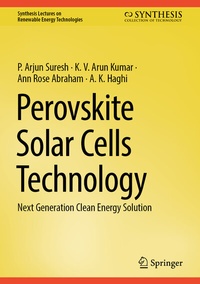
Perovskite Solar Cells Technology
Description

Solar energy is considered one of the most important forms of renewable energy. Silicon solar cells are commonly used in the photovoltaic industry, but their higher production costs and complicated fabrication processes make them less affordable. Various other technologies, such as perovskite solar cells and dye-sensitized solar cells, are also emerging.
Among these, perovskite solar cells are promising type of solar cells, offering comparable efficiency to that of silicon solar cells, at significantly lower costs. However, one of the drawbacks of perovskite solar cells is their relatively short lifespan, which limits their applications. Researchers are actively working to improve both the lifetime and efficiency of perovskite solar cells.
This book begins by covering the basics of solar energy and the principles and different types of solar cells. The focus is then put on perovskite solar cells, how they work, their advantages and challenges, and what sets them apart from other solar cells. Device fabrication techniques and recent advancements in the field are discusses next, finishing up with a look into the future of solar cell technology.
More details
Other editions
Additional editions
Persons
P. Arjun Suresh is a researcher working in the field of perovskite solar cells. He is currently pursuing a PhD in Physics at MG University, Kottayam. Arjun has published his research in respected journals such as Springer and has contributed to books under Apple Academic Press. His recent work centers on advancing fabrication techniques and enhancing the efficiency of perovskite solar cells.
K. V. Arun Kumar is currently an Assistant Professor of Physics at CMS College, Kottayam. With over 30 publications in reputed journals, he brings extensive expertise in sol-gel synthesis of metal, semiconductor, and rare-earth-doped glasses. His research includes plasmonic absorption studies of metal nanoparticles, nanomaterial characterization, structural analysis, and dielectric and conductivity studies of nanoparticles in sol-gel samples. Dr. Arun is also skilled in the fabrication of piezoelectric devices and perovskite solar cells. Additionally, he has contributed numerous book chapters to various academic publications.
Ann Rose Abraham is currently Assistant Professor of Physics at Sacred Heart College (Autonomous), Thevara, Cochin, India. She is conducting research at the Materials Research Laboratory (MRL), Sacred Heart College, Kochi. Dr. Abraham received her M.Sc, M.Phil, and Ph.D degrees in Physics from the School of Pure and Applied Physics, Mahatma Gandhi University, Kerala, India. She has authored, co-authored, edited, or co-edited more than 50 publications, including books, book chapters, and papers in peer reviewed journals.
She has research experience at various national institutes including Bose Institute, SAHA Institute of Nuclear Physics, UGC-DAE CSR Centre, Kolkata and has collaborations with various international laboratories, such as the Université de Lorraine (France), University of Johannesburg, Institute of Physics Belgrade, etc. She is the recipient of young researcher award in physics. She has expertise in the field of materials science, nanomagnetic materials, multiferroics, polymeric nanocomposites, biomaterials, etc.
A. K. Haghi is a retired professor and has written, co-written, edited or co-edited more than 1000 publications, including books, book chapters, and papers in refereed journals with over 4000 citations and h-index of 33, according to Google Scholar database. He was appointed as Honorary Research Associate (HRA) of Bioprocesses and Bioproducts Group, Facultad de Ciencias Químicas, Universidad Autónoma de Coahuila, Saltillo, Coahuila, México. He has also been appointed as Honorary Research Associate (HRA) at Chemistry Centre, University of Coimbra, Portugal and held a Senior Research Fellowship (SRF) at the Tbilisi State University.
Professor Haghi holds a BSc in urban and environmental engineering from the University of North Carolina (USA) and holds two MSc degrees, one in mechanical engineering from North Carolina State University (USA) and another one in applied mechanics, acoustics, and materials from the Université de Technologie de Compiègne (France). He was awarded a PhD in engineering sciences at Université de Franche-Comté (France). He is a regular reviewer of leading international journals.
Content
Introduction to solar energy.- Perovskite materials.- Fabrication of perovskite solar cell.- Efficiency enhancement of PSC.- Challenges of preparing PSC.- Future of PSC.
