

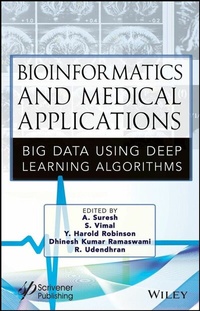
Bioinformatics and Medical Applications
Description

The main topics addressed in this book are big data analytics problems in bioinformatics research such as microarray data analysis, sequence analysis, genomics-based analytics, disease network analysis, techniques for big data analytics, and health information technology.
Bioinformatics and Medical Applications: Big Data Using Deep Learning Algorithms analyses massive biological datasets using computational approaches and the latest cutting-edge technologies to capture and interpret biological data. The book delivers various bioinformatics computational methods used to identify diseases at an early stage by assembling cutting-edge resources into a single collection designed to enlighten the reader on topics focusing on computer science, mathematics, and biology. In modern biology and medicine, bioinformatics is critical for data management. This book explains the bioinformatician's important tools and examines how they are used to evaluate biological data and advance disease knowledge.
The editors have curated a distinguished group of perceptive and concise chapters that presents the current state of medical treatments and systems and offers emerging solutions for a more personalized approach to healthcare. Applying deep learning techniques for data-driven solutions in health information allows automated analysis whose method can be more advantageous in supporting the problems arising from medical and health-related information.
Audience
The primary audience for the book includes specialists, researchers, postgraduates, designers, experts, and engineers, who are occupied with biometric research and security-related issues.
A. Suresh, PhD is an associate professor, Department of the Networking and Communications, SRM Institute of Science & Technology, Kattankulathur, Tamil Nadu, India. He has nearly two decades of experience in teaching and his areas of specialization are data mining, artificial intelligence, image processing, multimedia, and system software. He has published 6 patents and more than 100 papers in international journals.
S. Vimal, PhD is an assistant professor in the Department of Artificial Intelligence & DS, Ramco Institute of Technology, Tamilnadu, India. He is the editor of 3 books and guest-edited multiple journal special issues. He has more than 15 years of teaching experience.
Y. Harold Robinson, PhD is currently working in the School of Technology and Engineering, Vellore Institute of Technology, Vellore, India. He has published more than 50 papers in various international journals and presented more than 70 papers in both national and international conferences.
Dhinesh Kumar Ramaswami, BE in Computer Science, is a Senior Consultant at Capgemini America Inc. He has over 9 years of experience in software development and specializes in various .net technologies. He has published more than 15 papers in international journals and national and international conferences.
R. Udendhran, PhD is an assistant professor, Department of Computer Science and Engineering at Sri Sairam Institute of Technology, Chennai, Tamil Nadu, India. He has published about 20 papers in international journals.
More details
Other editions
Additional editions
Content
- Cover
- Half-Title Page
- Series Page
- Title Page
- Copyright Page
- Contents
- Preface
- 1 Probabilistic Optimization of Machine Learning Algorithms for Heart Disease Prediction
- 1.1 Introduction
- 1.1.1 Scope and Motivation
- 1.2 Literature Review
- 1.2.1 Comparative Analysis
- 1.2.2 Survey Analysis
- 1.3 Tools and Techniques
- 1.3.1 Description of Dataset
- 1.3.2 Machine Learning Algorithm
- 1.3.3 Decision Tree
- 1.3.4 Random Forest
- 1.3.5 Naive Bayes Algorithm
- 1.3.6 K Means Algorithm
- 1.3.7 Ensemble Method
- 1.3.7.1 Bagging
- 1.3.7.2 Boosting
- 1.3.7.3 Stacking
- 1.3.7.4 Majority Vote
- 1.4 Proposed Method
- 1.4.1 Experiment and Analysis
- 1.4.2 Method
- 1.5 Conclusion
- References
- 2 Cancerous Cells Detection in Lung Organs of Human Body: IoT-Based Healthcare 4.0 Approach
- 2.1 Introduction
- 2.1.1 Motivation of the Study
- 2.1.1.1 Problem Statements
- 2.1.1.2 Authors' Contributions
- 2.1.1.3 Research Manuscript Organization
- 2.1.1.4 Definitions
- 2.1.2 Computer-Aided Diagnosis System (CADe or CADx)
- 2.1.3 Sensors for the Internet of Things
- 2.1.4 Wireless and Wearable Sensors for Health Informatics
- 2.1.5 Remote Human's Health and Activity Monitoring
- 2.1.6 Decision-Making Systems for Sensor Data
- 2.1.7 Artificial Intelligence and Machine Learning for Health Informatics
- 2.1.8 Health Sensor Data Management
- 2.1.9 Multimodal Data Fusion for Healthcare
- 2.1.10 Heterogeneous Data Fusion and Context-Aware Systems: A Context-Aware Data Fusion Approach for Health-IoT
- 2.2 Literature Review
- 2.3 Proposed Systems
- 2.3.1 Framework or Architecture of the Work
- 2.3.2 Model Steps and Parameters
- 2.3.3 Discussions
- 2.4 Experimental Results and Analysis
- 2.4.1 Tissue Characterization and Risk Stratification
- 2.4.2 Samples of Cancer Data and Analysis
- 2.5 Novelties
- 2.6 Future Scope, Limitations, and Possible Applications
- 2.7 Recommendations and Consideration
- 2.8 Conclusions
- References
- 3 Computational Predictors of the Predominant Protein Function: SARS-CoV-2 Case
- 3.1 Introduction
- 3.2 Human Coronavirus Types
- 3.3 The SARS-CoV-2 Pandemic Impact
- 3.3.1 RNA Virus vs DNA Virus
- 3.3.2 The Coronaviridae Family
- 3.3.3 The SARS-CoV-2 Structural Proteins
- 3.3.4 Protein Representations
- 3.4 Computational Predictors
- 3.4.1 Supervised Algorithms
- 3.4.2 Non-Supervised Algorithms
- 3.5 Polarity Index Method
- 3.5.1 The PIM® Profile
- 3.5.2 Advantages
- 3.5.3 Disadvantages
- 3.5.4 SARS-CoV-2 Recognition Using PIM® Profile
- 3.6 Future Implications
- 3.7 Acknowledgments
- References
- 4 Deep Learning in Gait Abnormality Detection: Principles and Illustrations
- 4.1 Introduction
- 4.2 Background
- 4.2.1 LSTM
- 4.2.1.1 Vanilla LSTM
- 4.2.1.2 Bidirectional LSTM
- 4.3 Related Works
- 4.4 Methods
- 4.4.1 Data Collection and Analysis
- 4.4.2 Results and Discussion
- 4.5 Conclusion and Future Work
- 4.6 Acknowledgments
- References
- 5 Broad Applications of Network Embeddings in Computational Biology, Genomics, Medicine, and Health
- 5.1 Introduction
- 5.2 Types of Biological Networks
- 5.3 Methodologies in Network Embedding
- 5.4 Attributed and Non-Attributed Network Embedding
- 5.5 Applications of Network Embedding in Computational Biology
- 5.5.1 Understanding Genomic and Protein Interaction via Network Alignment
- 5.5.2 Pharmacogenomics
- 5.5.2.1 Drug-Target Interaction Prediction
- 5.5.2.2 Drug-Drug Interaction
- 5.5.2.3 Drug-Disease Interaction Prediction
- 5.5.2.4 Analysis of Adverse Drug Reaction
- 5.5.3 Function Prediction
- 5.5.4 Community Detection
- 5.5.5 Network Denoising
- 5.5.6 Analysis of Multi-Omics Data
- 5.6 Limitations of Network Embedding in Biology
- 5.7 Conclusion and Outlook
- References
- 6 Heart Disease Classification Using Regional Wall Thickness by Ensemble Classifier
- 6.1 Introduction
- 6.2 Related Study
- 6.3 Methodology
- 6.3.1 Pre-Processing
- 6.3.2 Region of Interest Extraction
- 6.3.3 Segmentation
- 6.3.4 Feature Extraction
- 6.3.5 Disease Classification
- 6.4 Implementation and Result Analysis
- 6.4.1 Dataset Description
- 6.4.2 Testbed
- 6.4.3 Discussion
- 6.4.3.1 K-Fold Cross-Validation
- 6.4.3.2 Confusion Matrix
- 6.5 Conclusion
- References
- 7 Deep Learning for Medical Informatics and Public Health
- 7.1 Introduction
- 7.2 Deep Learning Techniques in Medical Informatics and Public Health
- 7.2.1 Autoencoders
- 7.2.2 Recurrent Neural Network
- 7.2.3 Convolutional Neural Network (CNN)
- 7.2.4 Deep Boltzmann Machine
- 7.2.5 Deep Belief Network
- 7.3 Applications of Deep Learning in Medical Informatics and Public Health
- 7.3.1 The Use of DL for Cancer Diagnosis
- 7.3.2 DL in Disease Prediction and Treatment
- 7.3.3 Future Applications
- 7.4 Open Issues Concerning DL in Medical Informatics and Public Health
- 7.5 Conclusion
- References
- 8 An Insight Into Human Pose Estimation and Its Applications
- 8.1 Foundations of Human Pose Estimation
- 8.2 Challenges to Human Pose Estimation
- 8.2.1 Motion Blur
- 8.2.2 Indistinct Background
- 8.2.3 Occlusion or Self-Occlusion
- 8.2.4 Lighting Conditions
- 8.3 Analyzing the Dimensions
- 8.3.1 2D Human Pose Estimation
- 8.3.1.1 Single-Person Pose Estimation
- 8.3.1.2 Multi-Person Pose Estimation
- 8.3.2 3D Human Pose Estimation
- 8.4 Standard Datasets for Human Pose Estimation
- 8.4.1 Pascal VOC (Visual Object Classes) Dataset
- 8.4.2 KTH Multi-View Football Dataset I
- 8.4.3 KTH Multi-View Football Dataset II
- 8.4.4 MPII Human Pose Dataset
- 8.4.5 BBC Pose
- 8.4.6 COCO Dataset
- 8.4.7 J-HMDB Dataset
- 8.4.8 Human3.6M Dataset
- 8.4.9 DensePose
- 8.4.10 AMASS Dataset
- 8.5 Deep Learning Revolutionizing Pose Estimation
- 8.5.1 Approaches in 2D Human Pose Estimation
- 8.5.2 Approaches in 3D Human Pose Estimation
- 8.6 Application of Human Pose Estimation in Medical Domains
- 8.7 Conclusion
- References
- 9 Brain Tumor Analysis Using Deep Learning: Sensor and IoT-Based Approach for Futuristic Healthcare
- 9.1 Introduction
- 9.1.1 Brain Tumor
- 9.1.2 Big Data Analytics in Health Informatics
- 9.1.3 Machine Learning in Healthcare
- 9.1.4 Sensors for Internet of Things
- 9.1.5 Challenges and Critical Issues of IoT in Healthcare
- 9.1.6 Machine Learning and Artificial Intelligence for Health Informatics
- 9.1.7 Health Sensor Data Management
- 9.1.8 Multimodal Data Fusion for Healthcare
- 9.1.9 Heterogeneous Data Fusion and Context-Aware Systems a Context-Aware Data Fusion Approach for Health-IoT
- 9.1.10 Role of Technology in Addressing the Problem of Integration of Healthcare System
- 9.2 Literature Survey
- 9.3 System Design and Methodology
- 9.3.1 System Design
- 9.3.2 CNN Architecture
- 9.3.3 Block Diagram
- 9.3.4 Algorithm(s)
- 9.3.5 Our Experimental Results, Interpretation, and Discussion
- 9.3.6 Implementation Details
- 9.3.7 Snapshots of Interfaces
- 9.3.8 Performance Evaluation
- 9.3.9 Comparison with Other Algorithms
- 9.4 Novelty in Our Work
- 9.5 Future Scope, Possible Applications, and Limitations
- 9.6 Recommendations and Consideration
- 9.7 Conclusions
- References
- 10 Study of Emission From Medicinal Woods to Curb Threats of Pollution and Diseases: Global Healthcare Paradigm Shift in 21st Century
- 10.1 Introduction
- 10.1.1 Scenario of Pollution and the Need to Connect with Indian Culture
- 10.1.2 Global Pollution Scenario
- 10.1.3 Indian Crisis on Pollution and Worrying Stats
- 10.1.4 Efforts Made to Curb Pollution World Wide
- 10.1.5 Indian Ancient Vedic Sciences to Curb Pollution and Related Disease
- 10.1.6 The Yajna Science: A Boon to Human Race From Rishi-Muni
- 10.1.7 The Science of Mantra Associated With Yajna and Its Scientific Effects
- 10.1.8 Effect of Different Woods and Cow Dung Used in Yajna
- 10.1.9 Use of Sensors and IoT to Record Experimental Data
- 10.1.10 Analysis and Pattern Recognition by ML and AI
- 10.2 Literature Survey
- 10.3 The Methodology and Protocols Followed
- 10.4 Experimental Setup of an Experiment
- 10.5 Results and Discussions
- 10.5.1 Mango
- 10.5.2 Bargad
- 10.6 Applications of Yagya and Mantra Therapy in Pollution Control and Its Significance
- 10.7 Future Research Perspectives
- 10.8 Novelty of Our Research
- 10.9 Recommendations
- 10.10 Conclusions
- References
- 11 An Economical Machine Learning Approach for Anomaly Detection in IoT Environment
- 11.1 Introduction
- 11.2 Literature Survey
- 11.3 Proposed Work
- 11.4 Analysis of the Work
- 11.5 Conclusion
- References
- 12 Indian Science of Yajna and Mantra to Cure Different Diseases: An Analysis Amidst Pandemic With a Simulated Approach
- 12.1 Introduction
- 12.1.1 Different Types of Diseases
- 12.1.1.1 Diabetes (Madhumeha) and Its Types
- 12.1.1.2 TTH and Stress
- 12.1.1.3 Anxiety
- 12.1.1.4 Hypertension
- 12.1.2 Machine Vision
- 12.1.2.1 Medical Images and Analysis
- 12.1.2.2 Machine Learning in Healthcare
- 12.1.2.3 Artificial Intelligence in Healthcare
- 12.1.3 Big Data and Internet of Things (IoT)
- 12.1.4 Machine Learning in Association with Data Science and Analytics
- 12.1.5 Yajna Science
- 12.1.6 Mantra Science
- 12.1.6.1 Positive Impact of Recital of Gayatri Mantra and OM Chanting
- 12.1.6.2 Significance of Mantra on Indian Culture and Mythology
- 12.1.7 Usefulness and Positive Aspect of Yoga Asanas and Pranayama
- 12.1.8 Effects of Yajna and Mantra on Human Health
- 12.1.9 Impact of Yajna in Reducing the Atmospheric Solution
- 12.1.10 Scientific Study on Impact of Yajna on Air Purification
- 12.1.11 Scientific Meaning of Religious and Manglik Signs
- 12.2 Literature Survey
- 12.3 Methodology
- 12.4 Results and Discussion
- 12.5 Interpretations and Analysis
- 12.6 Novelty in Our Work
- 12.7 Recommendations
- 12.8 Future Scope and Possible Applications
- 12.9 Limitations
- 12.10 Conclusions
- 12.11 Acknowledgments
- References
- 13 Collection and Analysis of Big Data From Emerging Technologies in Healthcare
- 13.1 Introduction
- 13.2 Data Collection
- 13.2.1 Emerging Technologies in Healthcare and Its Applications
- 13.2.1.1 RFID
- 13.2.1.2 WSN
- 13.2.1.3 IoT
- 13.2.2 Issues and Challenges in Data Collection
- 13.2.2.1 Data Quality
- 13.2.2.2 Data Quantity
- 13.2.2.3 Data Access
- 13.2.2.4 Data Provenance
- 13.2.2.5 Security
- 13.2.2.6 Other Challenges
- 13.3 Data Analysis
- 13.3.1 Data Analysis Approaches
- 13.3.1.1 Machine Learning
- 13.3.1.2 Deep Learning
- 13.3.1.3 Natural Language Processing
- 13.3.1.4 High-Performance Computing
- 13.3.1.5 Edge-Fog Computing
- 13.3.1.6 Real-Time Analytics
- 13.3.1.7 End-User Driven Analytics
- 13.3.1.8 Knowledge-Based Analytics
- 13.3.2 Issues and Challenges in Data Analysis
- 13.3.2.1 Multi-Modal Data
- 13.3.2.2 Complex Domain Knowledge
- 13.3.2.3 Highly Competent End-Users
- 13.3.2.4 Supporting Complex Decisions
- 13.3.2.5 Privacy
- 13.3.2.6 Other Challenges
- 13.4 Research Trends
- 13.5 Conclusion
- References
- 14 A Complete Overview of Sign Language Recognition and Translation Systems
- 14.1 Introduction
- 14.2 Sign Language Recognition
- 14.2.1 Fundamentals of Sign Language Recognition
- 14.2.2 Requirements for the Sign Language Recognition
- 14.3 Dataset Creation
- 14.3.1 American Sign Language
- 14.3.2 German Sign Language
- 14.3.3 Arabic Sign Language
- 14.3.4 Indian Sign Language
- 14.4 Hardware Employed for Sign Language Recognition
- 14.4.1 Glove/Sensor-Based Systems
- 14.4.2 Microsoft Kinect-Based Systems
- 14.5 Computer Vision-Based Sign Language Recognition and Translation Systems
- 14.5.1 Image Processing Techniques for Sign Language Recognition
- 14.5.2 Deep Learning Methods for Sign Language Recognition
- 14.5.3 Pose Estimation Application to Sign Language Recognition
- 14.5.4 Temporal Information in Sign Language Recognition and Translation
- 14.6 Sign Language Translation System- A Brief Overview
- 14.7 Conclusion
- References
- Index
- EULA
