

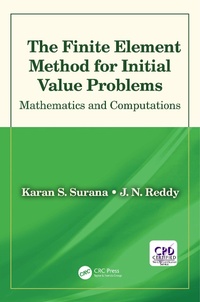
The Finite Element Method for Initial Value Problems
Mathematics and Computations
Published on 17. October 2017
630 pages
978-1-351-26998-8 (ISBN)
Description

Unlike most finite element books that cover time dependent processes (IVPs) in a cursory manner, The Finite Element Method for Initial Value Problems: Mathematics and Computations focuses on the mathematical details as well as applications of space-time coupled and space-time decoupled finite element methods for IVPs. Space-time operator classification, space-time methods of approximation, and space-time calculus of variations are used to establish unconditional stability of space-time methods during the evolution. Space-time decoupled methods are also presented with the same rigor. Stability of space-time decoupled methods, time integration of ODEs including the finite element method in time are presented in detail with applications. Modal basis, normal mode synthesis techniques, error estimation, and a posteriori error computations for space-time coupled as well as space-time decoupled methods are presented. This book is aimed at a second-semester graduate level course in FEM.
Reviews / Votes
"Partial differential equations can be solved numerically using finite differences, finite elements (including discontinuous Galerkin) and their variants, among others. In finite element textbooks we usually find only a cursory discussion of the solution of the system of initial value problems resulting from the spatial discretization. This book is dedicated to the finite element solution of the initial value problems. It can be used as a textbook for a follow-up course to a first coarse on finite elements. The textbook consists of 11 chapters with several exercises at the end of each chapter (except for Chapters 1 and 10). Each chapter includes a summary and a list of references. The book closes with an appendix on how to non-dimensionalize the mathematical models. The first chapter gives an introduction and defines the space-time coupled approach and the space-time decoupled approach for numerically solving the initial value problem (IVP). The second chapter introduces concepts from functional analysis to be used when discussing error estimates. These two chapters can be considered a review of a first course on finite elements. The authors consider space-time coupled classical methods of approximation, such as the Galerkin method (STGM), the Petrov-Galerkin method (STPGM), the weighted residual method (STWRM) and the least squares method (STLSP) for nonlinear problems. The one-dimensional wave equation and Burgers' equation are modeled to illustrate the various methods. A space-time finite element method is discussed in Chapter 4. The difference between this and the previous methods is the fact that the domain is now divided into space-time elements and the solution is locally approximated on each element. The continuity and di erentiability along the boundaries of the neighboring elements determine the continuity and di erentiability of the solution globally. Non-self-adjoint as well as nonlinear models in several space dimensions are discussed. This is by far the longest and most detailed chapter. Thefirst model problem of the chapter is a 1D wave equation (vibration of a string). This is discussed also as a set of first-order PDEs. The second model is a 1D advection equation approximated using STGM and STLSP. The third model is a convection-diffusion equation. Again here the model is also discussed as a system of first-order PDEs. The fourth model is a nonlinear 1D viscous incompressible flow. The fifth model is a 1D diffusion-reaction equation and the last 1D model is a Riemann shock. A numerical solution of the system of algebraic equations is given and a graphical solution is presented and analyzed. The last model in this chapter is a 2D phase transition.The numerical study here is solid-liquid transition. Chapter 5 discusses a decoupling of space-time by using a product of functions each depending on one variable. Thus the finite element in space leads to a system of IVPs instead of algebraic equations. Four 1D models are discussed: heat conduction, wave equation, fourth-order in space and nonlinear advection models. The finite element is applied in space and the system of IVPs in time is given. Chapter 6, the second longest, details explicit as well as implicit methods for approximating the system of IVPs resulting from the decoupled space-time approximation in the previous chapter. A numerical example of axial deformation of a rod is solved using the variety of methods discussed in this chapter. If we discretize the time domain, we can solve the IVP using finite elements. This is the subject of Chapter 7. Five 1D model problems are solved and the results are compared to those from the previous section. Chapter 8 discusses the stability of both coupled and decoupled space-time finite element methods. Clearly in the case of decoupled space-time methods, the stability depends on whether the method for the time is explicit or implicit. The authors also show that variational consistency of the space-time integral form ensures unconditional stability when using finite elements in time. Chapter 8 deals with the mode superposition technique for linear structural dynamics problems. The idea is to uncouple the system of ODEs and eliminate the use of time integration methods. The last chapter is more theoretical and includes no exercises. It covers approximation errors (both a priori and a posteriori), convergence and rates of convergence."
- Beny Neta - Mathematical Reviews Clippings - December 2018
More details
Language
English
Place of publication
London
United Kingdom
Publishing group
Taylor & Francis Ltd
Target group
College/higher education
Product notice
Reflowable
Illustrations
75 Illustrations, color; 75 Illustrations, black and white
File size
9,67 MB
ISBN-13
978-1-351-26998-8 (9781351269988)
Copyright in bibliographic data and cover images is held by Nielsen Book Services Limited or by the publishers or by their respective licensors: all rights reserved.
Schweitzer Classification
Other editions
Additional editions
Karan S. Surana | J. N. Reddy
The Finite Element Method for Initial Value Problems
Mathematics and Computations
Book
10/2017
1st Edition
CRC Press
€323.10
Shipment within 10-20 days
Persons
Karan S. Surana attended undergraduate school at Birla Institute of Technology and Science (BITS), Pilani, India and received a B.E. in mechanical engineering in 1965. He then attended the University of Wisconsin, Madison where he obtained M.S. and Ph.D. in mechanical engineering in 1967 and 1970. He joined The University of Kansas, Department of Mechanical Engineering faculty where he is currently serving as Deane E. Ackers University Distinguished Professor of Mechanical Engineering. His areas of interest and expertise are computational mathematics, computational mechanics, and continuum mechanics. He is the author of over 350 research reports, conference papers, and journal papers.
J. N. Reddy is a Distinguished Professor, Regents' Professor, and inaugural holder of the Oscar S. Wyatt Endowed Chair in Mechanical Engineering at Texas A&M University, College Station, Texas. Dr. Reddy earned a Ph.D. in Engineering Mechanics in 1974 from University of Alabama in Huntsville. He worked as a Post-Doctoral Fellow in Texas Institute for Computational Mechanics (TICOM) at the University of Texas at Austin, Research Scientist for Lockheed Missiles and Space Company, Huntsville, during l974- 75, and taught at the University of Oklahoma from 1975 to 1980, Virginia Polytechnic Institute & State University from 1980 to 1992, and at Texas A&M University from 1992. Professor Reddy also played active roles in professional societies as the President of USACM, founding member of the General Council of IACM, Secretary of Fellows of AAM, member of the Board of Governors of SES, Chair of the Engineering Mechanics Executive Committee, among several others. He either served or currently serving on the editorial boards of a large number of journals. In addition, he served as the Editor of Applied Mechanics Reviews, Mechanics of Advanced Materials and Structures, the International Journal of Computational Methods in Engineering Science and Mechanics, and the International Journal of Structural Stability and Dynamics.
J. N. Reddy is a Distinguished Professor, Regents' Professor, and inaugural holder of the Oscar S. Wyatt Endowed Chair in Mechanical Engineering at Texas A&M University, College Station, Texas. Dr. Reddy earned a Ph.D. in Engineering Mechanics in 1974 from University of Alabama in Huntsville. He worked as a Post-Doctoral Fellow in Texas Institute for Computational Mechanics (TICOM) at the University of Texas at Austin, Research Scientist for Lockheed Missiles and Space Company, Huntsville, during l974- 75, and taught at the University of Oklahoma from 1975 to 1980, Virginia Polytechnic Institute & State University from 1980 to 1992, and at Texas A&M University from 1992. Professor Reddy also played active roles in professional societies as the President of USACM, founding member of the General Council of IACM, Secretary of Fellows of AAM, member of the Board of Governors of SES, Chair of the Engineering Mechanics Executive Committee, among several others. He either served or currently serving on the editorial boards of a large number of journals. In addition, he served as the Editor of Applied Mechanics Reviews, Mechanics of Advanced Materials and Structures, the International Journal of Computational Methods in Engineering Science and Mechanics, and the International Journal of Structural Stability and Dynamics.
Content
Introduction. Concepts from Functional Analysis and Calculus of Variations. Space-Time Coupled Classical Methods of Approximation. Space-Time Finite Element Method. Space-Time Decoupled or Quasi Finite Element Methods. Methods of Approximation for ODEs in Time. Finite Element for ODEs in Time. Stability Analysis of the Methods of Approximation. Mode Superposition Technique. Errors in Numerical Solutions of Initial Value Problems. Appendix A: Nondimensionalizing Mathematical Models. Appendix B: Mapping and Interpolation Theory. Appendix C: Numerical Integration using Gauss Quadrature. Index
