

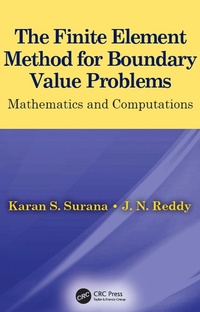
The Finite Element Method for Boundary Value Problems
Mathematics and Computations
Published on 17. November 2016
824 pages
978-1-4987-8051-3 (ISBN)
Description

Written by two well-respected experts in the field, The Finite Element Method for Boundary Value Problems: Mathematics and Computations bridges the gap between applied mathematics and application-oriented computational studies using FEM. Mathematically rigorous, the FEM is presented as a method of approximation for differential operators that are mathematically classified as self-adjoint, non-self-adjoint, and non-linear, thus addressing totality of all BVPs in various areas of engineering, applied mathematics, and physical sciences. These classes of operators are utilized in various methods of approximation: Galerkin method, Petrov-Galerkin Method, weighted residual method, Galerkin method with weak form, least squares method based on residual functional, etc. to establish unconditionally stable finite element computational processes using calculus of variations. Readers are able to grasp the mathematical foundation of finite element method as well as its versatility of applications. h-, p-, and k-versions of finite element method, hierarchical approximations, convergence, error estimation, error computation, and adaptivity are additional significant aspects of this book.
Reviews / Votes
"This book is written by notable experts in the field, and its content has been verified and used in university courses for thirty years. It is self-contained, and it includes a balance of mathematical background/derivations and applications to general problems (rather than restriction to solid mechanics, for example), and this it will be of high interest to students in applied mathematics, applied physics, as well as all branches of engineering mechanics."--John D. Clayton, University of Maryland, College Park, USA
More details
Series
Language
English
Place of publication
London
United Kingdom
Publishing group
Taylor & Francis Ltd
Target group
College/higher education
Illustrations
250 Illustrations, black and white
File size
26,98 MB
ISBN-13
978-1-4987-8051-3 (9781498780513)
Copyright in bibliographic data and cover images is held by Nielsen Book Services Limited or by the publishers or by their respective licensors: all rights reserved.
Schweitzer Classification
Other editions
Additional editions
Karan S. Surana | J. N. Reddy
The Finite Element Method for Boundary Value Problems
Mathematics and Computations
Book
11/2016
1st Edition
CRC Press
€282.26
Shipment within 15-20 days
Persons
Karan S. Surana attended undergraduate school at Birla Institute of Technology and Science (BITS), Pilani, India and received a B.E. in mechanical engineering in 1965. He then attended the University of Wisconsin, Madison where he obtained M.S. and Ph.D. in mechanical engineering in 1967 and 1970. He joined The University of Kansas, Department of Mechanical Engineering faculty where he is currently serving as Deane E. Ackers University Distinguished Professor of Mechanical Engineering. His areas of interest and expertise are computational mathematics, computational mechanics, and continuum mechanics. He is the author of over 350 research reports, conference papers, and journal papers.
J. N. Reddy is a Distinguished Professor, Regents' Professor, and inaugural holder of the Oscar S. Wyatt Endowed Chair in Mechanical Engineering at Texas A&M University, College Station, Texas. Dr. Reddy earned a Ph.D. in Engineering Mechanics in 1974 from University of Alabama in Huntsville. He worked as a Post-Doctoral Fellow in Texas Institute for Computational Mechanics (TICOM) at the University of Texas at Austin, Research Scientist for Lockheed Missiles and Space Company, Huntsville, during l974-75, and taught at the University of Oklahoma from 1975 to 1980, Virginia Polytechnic Institute & State University from 1980 to 1992, and at Texas A&M University from 1992. Professor Reddy also played active roles in professional societies as the President of USACM, founding member of the General Council of IACM, Secretary of Fellows of AAM, member of the Board of Governors of SES, Chair of the Engineering Mechanics Executive Committee, among several others.
J. N. Reddy is a Distinguished Professor, Regents' Professor, and inaugural holder of the Oscar S. Wyatt Endowed Chair in Mechanical Engineering at Texas A&M University, College Station, Texas. Dr. Reddy earned a Ph.D. in Engineering Mechanics in 1974 from University of Alabama in Huntsville. He worked as a Post-Doctoral Fellow in Texas Institute for Computational Mechanics (TICOM) at the University of Texas at Austin, Research Scientist for Lockheed Missiles and Space Company, Huntsville, during l974-75, and taught at the University of Oklahoma from 1975 to 1980, Virginia Polytechnic Institute & State University from 1980 to 1992, and at Texas A&M University from 1992. Professor Reddy also played active roles in professional societies as the President of USACM, founding member of the General Council of IACM, Secretary of Fellows of AAM, member of the Board of Governors of SES, Chair of the Engineering Mechanics Executive Committee, among several others.
Content
1 Introduction
General Comments and Basic Philosophy
Basic Concepts of the Finite Element Method
Summary
Concepts from Functional Analysis
General Comments
Sets, Spaces, Functions, Functions Spaces, and Operators
Elements of Calculus of Variations
Examples of Differential Operators and their Properties
2.5 Summary
Classical Methods of Approximation
Introduction
Basic Steps in Classical Methods of Approximation based on Integral Forms
Integral forms using the Fundamental Lemma of the Calculus of Variations
Approximation Spaces for Various Methods of Approximation
Integral Formulations of BVPs using the Classical Methods of Approximations
Numerical Examples
Summary
The Finite Element Method
Introduction
Basic steps in the finite element method
Summary
Self-Adjoint Differential Operators
Introduction
One-dimensional BVPs in a single dependent variable
5.3 Two-dimensional boundary value problems
5.4 Three-dimensional boundary value problems
5.5 Summary
6 Non-Self-Adjoint Differential Operators
6.1 Introduction
6.2 1D convection-diffusion equation
6.3 2D convection-diffusion equation
6.4 Summary
7 Non-Linear Differential Operators
7.1 Introduction
7.2 One dimensional Burgers equation
7.3 Fully developed ow of Giesekus Fluid between parallel plates (polymer flow)
7.4 2D steady-state Navier-Stokes equations
7.5 2D compressible Newtonian fluid Flow
7.6 Summary
8 Basic Elements of Mapping and Interpolation Theory
8.1 Mapping in one dimension
8.2 Elements of interpolation theory over
8.4 Local approximation over : quadrilateral elements
8.5 2D p-version local approximations
8.6 2D approximations for quadrilateral elements
8.10 Serendipity family of interpolations
8.11 Interpolation functions for 3D elements
8.12 Summary
9 Linear Elasticity using the Principle of Minimum Total Potential Energy
9.1 Introduction
9.2 New notation
9.3 Approach
9.4 Element equations
9.5 Finite element formulation for 2D linear elasticity
9.6 Summary
10 Linear and Nonlinear Solid Mechanics using the Principle of Virtual Displacements
10.1 Introduction
10.2 Principle of virtual displacements
10.3 Virtual work statements
10.4 Solution method
10.5 Finite element formulation for 2D solid continua
10.6 Finite element formulation for 3D solid continua
10.7 Axisymmetric solid finite elements
10.8 Summary
11 Additional Topics in Linear Structural Mechanics
11.1 Introduction
11.2 1D axial spar or rod element in R1 (1D space)
11.3 1D axial spar or rod element in R2
11.4 1D axial spar or rod element in R3 (3D space)
11.5 The Euler-Bernoulli beam element
11.6 Euler-Bernoulli frame elements in R2
11.7 The Timoshenko beam elements
11.8 Finite element formulations in R2 and R3
11.9 Summary
12 Convergence, Error Estimation, and Adaptivity
12.1 Introduction
12.2 h-, p-, k-versions of FEM and their convergence
12.3 Convergence and convergence rate
12.4 Error estimation and error computation
12.5 A priori error estimation
12.6 Model problems
12.7 A posteriori error estimation and computation
12.8 Adaptive processes in finite element computations
12.9 Summary
Appendix A: Numerical Integration using Gauss Quadrature
A.1 Gauss quadrature in R1, R2 and R3
A.2 Gauss quadrature over triangular domains
General Comments and Basic Philosophy
Basic Concepts of the Finite Element Method
Summary
Concepts from Functional Analysis
General Comments
Sets, Spaces, Functions, Functions Spaces, and Operators
Elements of Calculus of Variations
Examples of Differential Operators and their Properties
2.5 Summary
Classical Methods of Approximation
Introduction
Basic Steps in Classical Methods of Approximation based on Integral Forms
Integral forms using the Fundamental Lemma of the Calculus of Variations
Approximation Spaces for Various Methods of Approximation
Integral Formulations of BVPs using the Classical Methods of Approximations
Numerical Examples
Summary
The Finite Element Method
Introduction
Basic steps in the finite element method
Summary
Self-Adjoint Differential Operators
Introduction
One-dimensional BVPs in a single dependent variable
5.3 Two-dimensional boundary value problems
5.4 Three-dimensional boundary value problems
5.5 Summary
6 Non-Self-Adjoint Differential Operators
6.1 Introduction
6.2 1D convection-diffusion equation
6.3 2D convection-diffusion equation
6.4 Summary
7 Non-Linear Differential Operators
7.1 Introduction
7.2 One dimensional Burgers equation
7.3 Fully developed ow of Giesekus Fluid between parallel plates (polymer flow)
7.4 2D steady-state Navier-Stokes equations
7.5 2D compressible Newtonian fluid Flow
7.6 Summary
8 Basic Elements of Mapping and Interpolation Theory
8.1 Mapping in one dimension
8.2 Elements of interpolation theory over
8.4 Local approximation over : quadrilateral elements
8.5 2D p-version local approximations
8.6 2D approximations for quadrilateral elements
8.10 Serendipity family of interpolations
8.11 Interpolation functions for 3D elements
8.12 Summary
9 Linear Elasticity using the Principle of Minimum Total Potential Energy
9.1 Introduction
9.2 New notation
9.3 Approach
9.4 Element equations
9.5 Finite element formulation for 2D linear elasticity
9.6 Summary
10 Linear and Nonlinear Solid Mechanics using the Principle of Virtual Displacements
10.1 Introduction
10.2 Principle of virtual displacements
10.3 Virtual work statements
10.4 Solution method
10.5 Finite element formulation for 2D solid continua
10.6 Finite element formulation for 3D solid continua
10.7 Axisymmetric solid finite elements
10.8 Summary
11 Additional Topics in Linear Structural Mechanics
11.1 Introduction
11.2 1D axial spar or rod element in R1 (1D space)
11.3 1D axial spar or rod element in R2
11.4 1D axial spar or rod element in R3 (3D space)
11.5 The Euler-Bernoulli beam element
11.6 Euler-Bernoulli frame elements in R2
11.7 The Timoshenko beam elements
11.8 Finite element formulations in R2 and R3
11.9 Summary
12 Convergence, Error Estimation, and Adaptivity
12.1 Introduction
12.2 h-, p-, k-versions of FEM and their convergence
12.3 Convergence and convergence rate
12.4 Error estimation and error computation
12.5 A priori error estimation
12.6 Model problems
12.7 A posteriori error estimation and computation
12.8 Adaptive processes in finite element computations
12.9 Summary
Appendix A: Numerical Integration using Gauss Quadrature
A.1 Gauss quadrature in R1, R2 and R3
A.2 Gauss quadrature over triangular domains
