

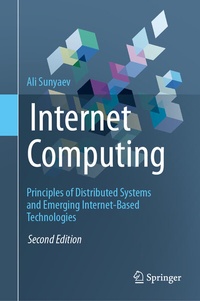
Internet Computing
Description

The 2nd edition of this well-established textbook introduces the reader to the fundamentals of contemporary and emerging technologies and services in Internet computing. It covers essential concepts such as distributed systems architecture and web technologies, contemporary paradigms such as cloud, fog, and edge computing, the Internet of things, and emerging technologies like distributed ledger technologies and the InterPlanetary File System. The book also highlights the interconnection and recombination of these Internet-based technologies, which together form a critical information infrastructure with major impacts on individuals, organizations, governments, economies, and society as a whole.
Intended as a textbook for upper undergraduate and graduate classes, it features a wealth of examples, learning goals and summaries for every chapter, numerous recommendations for further reading, and questions for checking students' comprehension. A dedicated author website offers additional teaching material and more elaborate examples. Accordingly, the book enables students and young professionals in IT-related fields to familiarize themselves with the Internet's basic mechanisms, and with the most promising Internet-based technologies of our time.
More details
Other editions
Additional editions
Person
Ali Sunyaev is Director of the Institute of Applied Informatics and Formal Description Methods (AIFB) and a Professor at Karlsruhe Institute of Technology (KIT). By using theory-driven design, development methods, computational tools, and empirical research, his research work employs a new and interesting perspective to generate insights into the complex process of future internet-based systems and their dependability and application in real-world settings. His research work accounts for the multifaceted use contexts of internet-based systems with research on human behavior affecting IT applications and vice versa. Ali devotes himself to the advancement of theory and applications in this area.
Content
1 Introduction to Internet Computing.- 2 Information Systems Architecture.- 3 Design of Good Information Systems Architectures.- 4 Internet Architectures.- 5 Applications and Systems Integration.- 6 Cloud Computing.- 7 Fog and Edge Computing.- 8 Distributed Ledger Technology.- 9 Peer-to-Peer Data Networks and the InterPlanetary File System.- 10 The Internet of Things.- 11 Critical Information Infrastructures.- Glossary.
